November 30, 2008

Marathon today

I did not participate in this year’s marathon, because. . . according to their web site (http://www.beirutmarathon.org/raceinfo1.php )

* Roller-skates, inline skates, bikes, baby strollers or carriages of any kind are not allowed on the Marathon course. If you are caught with any of these, you will be directed off of the route.
* Please do not run with your baby or child under 9 years old.
* A pack of thousands of runners poses a serious risk hazard to your child or baby. As cute as you and your baby will look, we do not want you (or us) to take this risk. Participants under 9 years old are not covered by our insurance.

And although my daughter has done every marathon since she was born, I guess I never read the instructions. I’ll be watching from the side lines for a change.

November 22, 2008

Indian Summer

It’s fall, and the Beqaa Valley was absolutely teeming with colors.
The Beqaa is a fertile valley in Lebanon, located about 30 km (19 miles) east of Beirut. The valley is situated between the Mount Lebanon to the west and the Anti-Lebanon mountain ranges to the east. It forms the northeastern extension of the Great Rift Valley, which stretches from Syria through the Red Sea into Africa. Beqaa Valley is about 120 km (about 75 miles) in length and has an average width of about 16 km (about 10 miles). (Source)

November 17, 2008

A Flora and Fauna Guide to Lebanon Needed

What’s lacking? A guide to Lebanon’s flora and fauna, I was thinking, as I saw this snake in the riverbed of the Walnut River (Nahr el Jaouz) in Northern Lebanon. I’m sure they have guides in Arabic, and maybe even French, but this illiterate Dutch would like one in English please. The - still dry - riverbed of the Walnut River The snake looks like a gigantic python on the picture, or something of the likes, but in reality it was a puny little snake of 40 centimeters in length at best. Hanging on a branch, basking in the sun around a garbage bag (how appropriate). So here we (SIL and I) stand with four little kids (well, one a very fierce and incredibly bored teenager), trying to teach them to appreciate nature.
It hissed quite fiercely (the snake), so what do you do? Grab it? Not grab it? Is it going to bite?
What is it anyway, mom?”
It’s a snake.”
Yeah, I know THAT! What kind of snake?”
Well, a snake kind of snake.”

We let it be in the end, but I would like to know what kind of snake it was. So, what’s lacking? A guide to Lebanon’s flora and fauna. Anyone up for the job?

The weekend was spent hiking in a – still dry – canyon of the Walnut River in Northern Lebanon, near the village of Kaftoun. Although I’ve been roaming around the Kaftoun area a number of times now, I haven’t been in Kaftoun itself yet, but it must be quite a place, because they even have their own web site (‘I have a web site, so I exist’). I picked this little piece of information from their site; “The houses of Kaftoun number seventy, and its inhabitants number about three hundred. They are mostly Greek Orthodox Christians, who are peaceful, respectful of others, and generally well educated.” I like the ‘generally well educated’. Define educated for me.
It has been raining a bit, and where the riverbed was encased in limestone, there was water, but everywhere else it had seeped away.
There was a lot of mud, which was greatly appreciated by kids and dogs. 'I am getting old,' I remember thinking, because all I could worry about was the upholstery of my new car. 'All that mud? How am I going to get that off them? Nobody gets into my car, they'll all have to sit in the trunk.'
SIL and I are planning to build a Frank Lloyd Wright type of villa right over the riverbed, and we were exploring a good site for our project, that will probably never materialize, but it is always good to dream. We better be fast, because it looks like this is becoming a protective area (which is a very wise decision). The good thing is that you see absolutely nobody. (We're staking our claim) Totally stuck Lebanese hill top villages as the sun is setting on them.

November 16, 2008

Saddest Thing Ever

While on my way home from a dinner at my in-laws, I crossed the saddest scene ever on Hamra. A cart with turmos had fallen over. You know, the yellow beans they sell on a carton dish, with cumin, salt and chunks of lemon? (Some call them lupini beans.)

And in between the yellow beans and lemons, strewn over the cobblestones, sat an older gentleman, grey haired, in his sixties, if not more, crying.
He was dressed very decently; dark pants, striped shirt. And there he sat, while the police looked on, and the traffic tried to navigate around him; crying.

I don’t know how his cart had fallen over. Maybe it had tipped over when he tried to navigate the side walk. Or maybe in a scuffle with the police. This type of commerce is no longer allowed in Hamra, and there was a police car next to him.

Anyway, there he sat, in between his turmos beans, his head in his hands. Crying. A man old enough to be your father. Or your grandfather. That a man at that age still has to walk the streets at night, trying to sell beans at 2,000 pounds a dish. Somehow the scene broke my heart. Maybe it was because everyone was hurrying home, it was dark, and with the thought of warm, well-lit house waiting for you, this man in the dark, under the street lamp, crying over his beans, really did it.

I stopped and got out of the car to give him money. And who do I spot there? My hubbie on his bike. Also giving him money. And so were several by-standers. They all stuffed some bills in his hand. He got up, and the police escorted him away, leaving his beans on the street. And while I walked back to my car, I still saw some people hopping out of their car, giving money, and driving on.

I hope he made his money tonight. I think he did, probably twice as much as he would have selling beans.
The Lebanese can be so good at times.

November 15, 2008

Archaic

My bank calls me. Whether I have a minute.
Sure.
Well, there’s this offer on a credit card. It’s really a good deal, because it has all these benefits and I’ll never be stuck somewhere without money and the interest is good and basically, there isn’t anything wrong about this offer. The guy’s sales pitch is really good.

Except for one thing. When I come and get the card, I have to bring my husband.

“My husband?”
“Yes, your husband.”
“What for?”
“He has to sign.”
“Sign for what?”
“For the card.”
“But I thought it was for me?”
“Yes it is, but he has to sign.”

Now listen to this. This is my bank, my bank account, my salary, the card will be on my name, my husband has nothing to do with this entire business, he’s not putting money on the account nor taking it off, he doesn’t even do business with this bank, yet he’s got to come in and sign?
Positively archaic.

I remember them calling me somewhere back in March as well, with the same deal. The ‘husband thing’ was an issue then as well. If he’s smart, they’ll write behind my name ‘refuses to bring husband.’

November 08, 2008

Saturday Morning in Beirut

I had some errands to run in town. It’s almost impossible to find a parking spot these days in this part of Beirut, and traffic is slow, so you might as well walk if it is within a 5 kilometer radius of your house. So this is Beirut on a Saturday morning, on foot.

There seems to be little entertainment in this town, if you look at these people. At least 10 people were watching how this road worker flattened a piece of newly laid tarmac. Tar is called 'zift', or 'ziffit' in Arabic, which is also used as a derogatory remark. When someone is considered a piece of s***, he or she is called 'zift'. Some of Beirut's more traditional architecture, dating back from colonial French times, mixed with Ottoman bits. The wrought iron balconies and wooden shutters. They don't build like this anymore, and the definitely do not preserve and restore either. People just live here until the place falls apart, or until they can sell the land to someone who will demolish it and replace it with a 12 story apartment building.

Another example. Still inhabited, but probably not for long. Real estate prices in Beirut are - despite the economic slump in the world - are rocketing sky-high.

Beirut was listed as one of the top ten liveliest cities in the world by the lonely planet list of the top ten cities for 2009. But that is probably a bit of an urban legend. It isn't 2009 yet, and we sure as hell don't feature on the 2008 list either; Damascus does. We do feature on this Lonely Planet list though. And we make the #1 place as well.

Pre-schoolers with their teacher in the park on a Satuday morning. Most schools still require some sort of uniform.

November 06, 2008

Life Is Good

The weather is downright pleasant! The politicians are quiet; they won’t be entering into a dialogue until December, so we’ll have peace until then. The gas prices are (somewhat) dropping, I haven’t had a ‘Do you know what the lowest grade was in class on this test?’-conversation with my son in a while, the transition between my old housekeeper flying home and the new one flying in has been extremely smooth, and my washing machine hasn’t broken down yet, so life – in all aspects – is good. We do have those moments here in Lebanon. We know how rare they are, and so we relish them. At least I do. And thus, another sunset. Sorry.

November 02, 2008

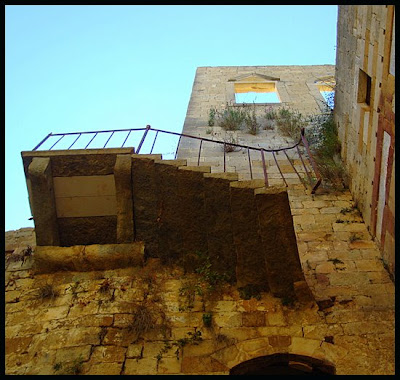
I didn't do much this weekend, but while trying to find the road back to Beirut today (after not doing much in the mountains), I stumbled upon this place in Salima, some 40 kilometres above Beirut.
I’ve explored this region extensively, or so I thought, but apparently not extensively enough, because it is the first time I saw it. No signs around it, and no one to ask what it was (They were all in church. They still do that on Sundays here), so I had to wait to get back to Beirut to find out through the Internet. Makes me wonder; how did we ever find things out before the Internet?
According to this web site it is the ‘Salima Palace, a Druze fortress of the Abillama Emirs built in 1721 by Hussein, the first Prince Abillama. Acquired in 1882 by the Capuchins, the building was changed and restored in 1895 and 1906.The main portal is enclosed in an ornate arabesque molding with two lions flanking the central arch.’
‘Above the portal is the old "diwan" or reception room’

The courtyard.

This web site writes that the Emirs of Abillama set up shop in Salima in 1515.
And this book states that the Abillama’s arrived in here in the 9th century, ‘but this palace was built by Emir Hussein in 1134 of the Hegira, before the druze princes became christian’.

So take your pick. 1134, 1515 or 1721. Well, it looked old, but not THAT old. I go for 1721,

They are in the process of restoring the palace.
And that was all there was on this palace. But I googled this piece of interesting stuff;

This village was one of the first communities (mixed christian and druze) to be severely damaged ‘on a human, physical and psychological level by the Lebanese civil war. It was one of the first villages to be destroyed and is one of the last to be able to return to any resemblance of normality for its inhabitants.’ (source)

The fighting in this village began with a Romeo and Juliette story. A Druze boy was in love with a Christian girl. Her brother, blinded by fanaticism, murdered the fiancĂ©. Revenge bred revenge. By the time the killing ended, the Christian half of the village had fled. “ (Source)

It was definitely in the hot zone. I passed a forest with a ‘do not enter. Mines’ sign, and according to the International Campaign to Ban Landmines there are still some 47 uncleared minefields, or suspected mine fields, in that area.
I cannot vouch for its accuracy, only plucked it off the Internet. Nevertheless, maybe I should get Internet on my phone, so I can read this stuff while actually being there, instead of in Beirut.

November 01, 2008

Dutch Joke (Grapje van mijn broer)

This Dutch T-shirt is a bit of a joke (Dutch joke); I thought it was quite funny. The Dutch will get it. For the non-Dutch, I’ll explain it. These letters are supposed to look like Arabic letters, but when you look carefully, it’s Dutch, and it reads ‘Your mamma’s got a moustache’. Reference to the fact that ladies of Arabic origin not necessarily have more facial hair than their Dutch counterparts, but as they are in general darker, the facial hair just shows more prominent. Hence the ‘Your mamma’s got a moustache’.
It’s an interesting display of how relations are between the Dutch and the Arab community living in the Netherlands.