May 31, 2009

On Nothing Much in Particular

There’s election ralleys all over town, in preparation of the June 7 parliamentary elections. This week alone I got caught up in the traffic of two major christian parties on opposite sides of the spectrum, and one muslim; I got stuck in between flags of green cedar trees, and orange flags, and green flags, and yellow flags and blue flags and you-name-it-flags.
Did I miss any colors? All the colors of the rainbow have been claimed by some political party or other, so in the morning you really have to watch what you wear, in order not to be associated with some part of this society.

It is funny how Lebanese society is almost identical to Holland in the forties. We call it pillarisation’ (verzuiling in Dutch); a society where all institutions (sports, media, education, union, businesses etc) are organized around political organizations that in turn are organized according to their religion.

Normally I would have had to cover all these events for my newspaper, but I’ve passed that job on to another Dutchie some time ago. I was fed up with the politic antics in this place.

You may be pleased to know that we (Holland) eventually got out of that system, and now are considered to be one of the world's most tolerant nations.
There's light at the end of the tunnel so to speak. Maybe. Eventually.

I do miss it a bit; running all over town finding out who are the first 3 swine flu victims reported in Lebanon, checking out who’s been spying for Israel, whether the first Syrian ambassador to Lebanon is any fun, if US vice-president Biden and Hillary made any faux-pas (because who really cares what they have to say), what people on the street think of the Spiegel article, and hanging around in the women’s section at Hezbollah gatherings, watching the ladies swoon over Nasrallah’s words.

I feel a little out of it, having to read what is happening in this society in the newspaper instead of experiencing it first-hand. On the other hand, I do have more time on my hands to hang out with friends.
Some Dutchies in Lebanon. The fifth one came late and missed the picture (somehow that sentence sounds familiar).
They’re not easy to find, and you’ve got to go off the main road quite a bit, but there are quite a lot of beautiful (and still pristine) spots not that far from Beirut,
where you can lounge on the rocky banks of a river in which you can actually swim, or float around in a rubber boat,
with dogs (who I swear, were white, when we arrived),
catch river crabs,
scale the rapids, cath tadpoles
and water snakes.
We had one Lebanese boy with us, the neighbor of one of the half-Dutch children, who had never ever seen anything like this. He had the best time of his life, he said, crawling around in the mud, with crabs nipping at your toes, and river weed on your head.
And then when you drive home, they fall asleep in the back of the car (well, mine did).
(33°49'38.72"N & 35°40'11.08"E for the interested. But please pick up your garbage after you leave!)

May 24, 2009

Back in the Headlines

Life was getting a little sedate lately, but we’re back in the headlines again. It seems Hezbollah is now directly linked to the Hariri murder. Somehow I had heard this theory already before, it is not new, but it is bound to spice things up a bit some 2 weeks before the parliamentary elections.
The story is dropped by the German magazine Der Spiegel, and it is an interesting read, but I do remember that when I was in Journalism College, Der Spiegel was seen as a rather ‘sensational’ publication, which in general is not a positive characteristic in the media. So there’s a distinct smell of fish here. The author of the article, Erich Follath, also published a book titled; ‘Who shot Jesus Christ’. That one is fiction, though.


Hezbollah, equally predictable, has denied the charges. And the saga continues. This is better than Desperate Housewives.

May 23, 2009

Teach Your Children Well

All over the world, we teach our children to ‘never ever go with strangers!’ But here on the streets of in Beirut, I teach my children never EVER to touch an iron lamp post, electricity post or iron fence.

This may sound odd, as odd as “look right, look left, and look right again before crossing the street” but when we walk on the street, and a lamppost blocks our way, I go “DON’T TOUCH THE LAMP POST!” It isn’t as easy as it sounds, because the municipality just loves to put these lamp posts right in the middle of the side walk, so you have to wiggle your way either through wall & post or parked car & post.

And it really isn’t that odd either, if you read all these stories about North American pet owners who have had their dogs electrocuted while stepping on man hole covers. And believe me; if it happens in the ‘civilized’ west, it is happening here. Maybe dogs don’t get electrocuted here in Beirut, because who has dogs here?

But I once knew a lady here, whose 5-year old son was getting into a small plastic baby pool at the ground floor of their building, while holding the fence, and ‘ZAP’, he was gone. Seems one of the neighbors was tapping into the city grid, and had the wires running from the electricity pole, past the fence, to his balcony.

On my daily dog walk route, there is one lamp post, where the bottom cover is gone, and you can see all the wiring hanging loose. It is just at ‘pee’ height, and every time I see my dog lift his leg against the post, I hope he doesn’t hit the wiring, because it will be a ‘hotdog’, and how will I be explaining that to my daughter?

The electric wiring here is something eerie. It’s hanging loose, along walls, tied to (iron) fences, the wires blow with the wind, are tied, retied and triple tied with pieces of plastic, iron and whatever.
And yet you seldom hear of people getting electrocuted. Is it because we all teach our children well? Or maybe because of our lack of electricity? I don’t know.

But in the meantime, in my household it is “DON’T TOUCH THAT IRON POLE!”

May 17, 2009

In Which I Inherit an Aunt

What is a common and perfectly acceptable occurrence in the west, is a virtual impossibility here in the Middle East; placing an elderly family member in an old-people’s home.
Parents that can no longer take care of themselves, or no longer wish to live alone, are overall taken in by the family. They either provide a live-in housekeeper, take turns among the siblings when it comes to care, or move the parent into their own house.

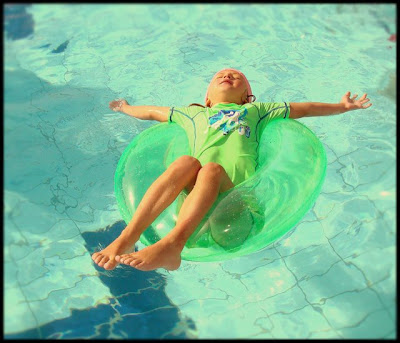
These pictures are not related to this post, but the aunt in questions does not want to be on a blog. So you get to see H, who spent her entire day lounging in the pool today.

Placing them into a house with lots of other older people, and visit them on Sundays, is just ‘not done’ in this place. It is not (only) because the care for the elder is not that organized and up to standards, but primarily because of the shame it would bring to the family that does not take care of its own.

And thus, last week, I came to inherit an aunt of the family.

The lady in question moved in with the family when she was quite young, in order to take care of the children of the family.

In Holland, in the old days, when large families still existed, there were always a few children that did not marry, but instead went into the convent. Here, they did not send them into the convent, but they got to take care of other family members’ children.

My friend joked that my daughter looked as if she were a religious muslim (which the friend can joke about as she is a muslim herself, but not ‘that kind’ of muslim, as she explains it), swimming with a shirt and cap. But as it happens, the pool required that the girls wear bathing caps, and she wore her surf shirt at the end of the day because she was getting a sun burn. So no, we do not bathe like this in general in Lebanon.

And so she has lived with my husband’s family forever. The children grew up, moved out, married, and had children of their own, for whom she baby-sat. More family members moved out, or died, and since a year she had been living on her own in the ancestral home. But the house had become too big and lonely, and in her advanced age, she could use the help, but more importantly, the company. For some 50 years, she had taken care of the children of the family, and now it was time for the children, to take care of her.

And thus, I inherited the aunt. Without much discussion, she moved in. It was a smooth transition. She knows our ways, and we know hers. That it had to be my house was purely because of logistical reasons. I happen to have the place, and my house is near her old house, enabling her to stay in touch with her old neighborhood and friends.

And we’re finally having decent food on the table again.

(That this is another post on the positive side of Lebanese culture is purely a coincidence. It just so happens that I haven’t had anything to gripe about lately. Don’t worry, the occasion will arise again)

May 11, 2009

Why I Live in Beirut; or Random Acts of Kindness

This story has a point. (Although it may take a while before I get to it).

Every morning, I walk my daughter to school. I enjoy the early Beirut, and my daughter entertains me with interesting stories and millions of questions about life and other things during the half-hour walk to school.

I live in a neighborhood with lots of schools. There are two universities, two international schools and a large number of local Lebanese schools, all within walking distance. And so, every morning, when I walk with my daughter, I cross the path of many other children, and parents with children, also on their way to school.

This morning, my daughter had no school, and so I walked alone.

First I was stopped at the girls’ school around the block by a group of teenagers whom I did not know.
Wain el princessa, tante”? they asked (Where’s the princess, aunty?) , and I explained that she was at home because she had no school today. I continued my way.

Then, a few blocks later, I was stopped again by the husband of a colleague, out on his daily training run.
I see you’re missing some of the troops,” he said jokingly, and so I explained that my daughter had no school today. I continued my way.

And finally, a little further, I was stopped by a father (quite a handsome one because I secretly ogle him every morning) with a young boy and a girl, who I meet every morning walking in the opposite direction. We’ve never talked or even said hello.
Bintik mareed?” he asked (Is your daughter sick?). No, I replied, she just has no school today.

And I continued my way.

And I thought about a conversation a Dutch friend and I had some days ago about the changes in Dutch society. You may not have read it, but the senseless violence is on the rise in the otherwise so peaceful nation of Holland. People are getting beaten up for no reason on a daily basis, it seems. This conversation came up because we tried to understand the motifs of a man, who out of the blue sky, ran through a crowd of spectators in order to try and kill/harm the Dutch queen on Queens Day. Eight people died, the royal family in shock (and more popular than ever, it seems), celebrations cancelled, and a nation wondering why on earth a man would do something like that? What for? What was the point?

My friend contributed it to the growing harshness of Dutch society. I think it is our individualism. We hold our individualism very high. But in order to ensure that, we need to have lots of privacy. And to make sure you get your privacy, you need people not to mind your business. We in Holland are – in fact -trained so well not to mind anybody’s business that it has turned into carelessness, because we only care about our own business.

For instance, this gentleman (who attempted to harm the queen and killed 8 people, including himself while doing it) lived in a dormitory where he always ate on his own. He cooked in the communal kitchen, but then took his dish to his room and ate on his own. Can you imagine that in Lebanon? If you really want a quiet meal, do not show your face 3 hours before and 3 hours after dinner time. If you do however show up on someone’s doorsteps within that time period, chances are you are forced to sit down and made to eat. Together. With other people. There is no ‘alone time’ in this place.

Here in Lebanon people do not belief too much in privacy. I have had acquaintances, not family or friends, no, distant acquaintances ask me when I am planning on getting pregnant again, because “a woman of your age…”, tell me that they know an excellent Botox doctor for me because “it would really improve your looks,”, and whether I have contemplated lifting my neck line, because really, “you could be so pretty…”
A Dutch friend of mine once walked with her elderly (and rather wrinkled) mother past a pharmacy here in Beirut, when the owner came out of the story with a jar of anti-wrinkle cream. “Just what YOU need!” he said. You wouldn’t dare say that in Holland.

But because of the lack of privacy, there is not much room for individualism. And although I am sure this has its draw backs, it does have its advantages. We (in Lebanon) do not experience these random acts of violence. Like school shootings (US, Germany, Finland), men barging into day care centers slaughtering toddlers (Belgium), and sending people bomb letters. It never gets to that point because we stick our noses into everybody’s business, no matter how annoying this may be at times. And thus people are never left feeling alone. Abandoned. Because everybody cares, or at least give the impression that they care.

You’ll probably laugh by now. What? No violence in Lebanon? Yes, we do have our car bombs, and shootings. But they are organized by ‘powers high up’. By governments, or organizations, or movements. These are not random acts cooked up by a loner with the simple goal to make himself known before he steps out of this world. Our acts of violence have a political gain, are part of a political game. That doesn’t make it any less painful for the innocent people that succumb to the bombings. But at least we understand why.

These random acts of violence within the Dutch society are often without an explanation. And if there is an explanation, it is so trivial, so useless, so stupid.

Now what was my point, you wonder?

Lebanon is a society with an immense amount of troubles. Dutch problems probably pale in comparison. But what we do have in this place are the thousands Random Acts of Kindness you experience.
Like the strangers in the street, stopping me and asking me about my daughter. People here care.

And so this morning I was reminded again of why I live in Beirut.

May 10, 2009

Who Broke the Water Pipe!?

The beach goers were greatly entertained today by the – rather late – arrival of this extended family. They clumped onto the beach at 3 o’clock on Sunday, dragging an enormous amount of equipment with them, and set up store on the shore.
And all went well, until – lo and behold - it was discovered that ‘someone’ had broken the water pipe. The water pipe, or at least the glass partition of it, had not survived the transport from home to beach, and here were a number of people, who had been looking forward to pull on the water pipe while lounging on the beach. It was not to be. The ruckus that ensued was tremendously entertaining. A good old family fight (verbal, that is) enrolled itself not more than 10 meters away, but the entire beach could enjoy the verbal abuse that many family members had to endure. Old cows were pulled out of the ditch, long standing grievances were finally verbalized, and dirty laundry was hung out to dry for the entire beach to see, much to the amuse of everyone (except themselves, but they did not notice).

I wonder how it ended, I had to go home.

May 03, 2009

Wildflowers

It is spring time in Lebanon, and the wildflowers are coming out in full force. Although we’re officially situated in a desert biome, this place is absolutely green. I went on a number of walks (read strolls) over the long weekend, and the place was teeming with flowers.
A meadow in Jabal el Knisse (above Hammana)

A side-effect is the ticks; the place is teeming with those as well. Although I haven’t heard of Lyme disease in Lebanon (everyone over here is obsessed with swine flu at the moment), I had to pick off at least 20 ticks per dog every time I took them through the fields. And H. – after first giving an intricate explanation as to how come her dog had ‘fallen’ into her bed at night - woke up this morning with a tick right under her eye, and another one on her body. Well, you know what they say when you sleep with dogs.
Parasol Pine Forest
A staircase in the forest
Ground covered with Cistus salviifolius

On Saturday, I walked through a parasol pine forest, the ground covered with white flowers, until we - in the middle of the forest – stumbled upon a staircase that led all the way to the top of the hill, where a gate gave access to an abandoned house overlooking a cliff and the valley of the Beirut River. A beautiful property, obviously abandoned during the civil war and never fixed since, stood on top of the cliff. We strolled around the property for a good hour, looking into all the buildings and rooms and gardens. When I asked hubbie what the words on the garden gate read, he replied: “Beware; mines.”
Beware; mines.”

There are a lot of monumental houses here that were (partially) destroyed during the war and never rebuild. It is a pity, because there is plenty of new construction going on, so obviously there is a need for housing here. Mind you, these are all summer residences, for when Beirut gets too hot and humid in the summer. And a lot of them go to Gulf Arabs. In winter time this place is pretty dead.
Double Waterfall

On Sunday, we played Heidi in the Alpine meadow, on the mountain top above Hammana, where the Sohat water factory gets its water. There’s a double waterfall, which is the beginning of the Beirut River, but access is difficult. You have to walk along an old irrigation channel to get there, and in some parts the narrow channel is all there is between a mountain wall and a sheer drop, which is tricky to negotiate with a 6-year old and a blind/deaf dog in tow. On the other hands, it ensures the pace stays clean. The waterfalls look over Hamana and the valley. There were thousands of flowers in the meadow. A 'Heidi' meadow above Hammana. In the distance you can see the bridge (one of some 70) that got bombed in 2006 by the Israelis. It is stillbeing rebuilt.

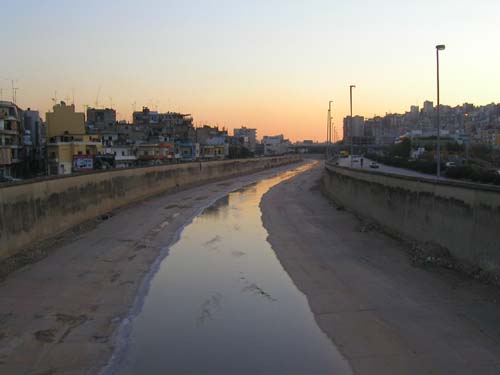
The Beirut River, which starts so beautifully, ends very unceremoniously in a sewer canal in Karantina.

I think I have plugged this web site before, but it has categorized all the Lebanese wildflowers, and I have never seen as many different flowers as the region in which I am now (Hamana/Baabda), which is a region some 35 kilometers east of Beirut.