 . . . you're into fusion and you're in Beirut, check out this guy, Ryo Kawasaki. He's still playing Sunday (in Eight, downtown), Monday and Tuesday (in Bar Louie, Gemayze). For more information, call 70 990198.
 . . . you're into fusion and you're in Beirut, check out this guy, Ryo Kawasaki. He's still playing Sunday (in Eight, downtown), Monday and Tuesday (in Bar Louie, Gemayze). For more information, call 70 990198.
  H, Uncle W. and cousin O. in the olive grove, chewing on lemon grass
The grass and wild flowers were thigh high
Not just the north of Lebanon is olive country. There are olive groves all over the south as well.
We like our olives.
There are an estimated 13 million olive trees in Lebanon, covering around 57,000 hectares. ‘This represented 20% of the total cultivated area in the country. (. . . ) The regional distribution of olive groves in Lebanon is 40% in the North, 39% in the South, 15% in Mount Lebanon, and around 6% in the Bekaa Valley.’ (Source)
You wonder with so many olive groves what we do with all those olives? Lebanon produces between 30,000 metric tons of olives (low yield) to a production high of 190,000 metric tons (in 2000).
Climbing the olive trees
Apparently we consume them all ourselves. I read here that a Western agricultural expert had commented that the agricultural sector of Lebanon was ‘export averse’, i.e. . not really looking to export.
The northern groves produce different olives that the southern ones. Little did I know, but it seems a ‘connaisseur’ can pick out the region (not the grove).
Descriptions of Regional Lebanese Olive Oils (source)
Whatever the type of the local olive variety, Lebanese olive oils are typically characterized by a mild aroma that is perceived as intense, but mellow once it enters the mouth sometimes with a peppery finish. Taste descriptions of selected typical olive growing areas in Lebanon are :
Batroun (Northern Lebanon, hilly, beautiful serene mountain region): Rich and fruity with a zesty flavor.
Koura (Northern Lebanon, coastal, with plains and hills): The four season climate and low soil acidity create a light and delicately flavored oil ideal for use in cooking.
Zgharta (Northern Lebanon, hilly with intermediate elevations): Fruity and fragrant with a subtle aroma.
Akkar (extreme Northern Lebanon, hilly with intermediate elevations): Rich with a distinct flavor of tomatoes and a strong spicy finish.
Rachaya el Foukhar (South East Lebanon, hilly with intermediate elevations): Mildly sweet with a herbal and floral aroma, oils from this region often have a distinct peppery flavor.
Hasbaya (South East Lebanon, steep hills and terraces): A rich taste and smoothly textured oil, moderately sweet with a pleasant herbal aroma.

The olive trees we were climbing and lounging in between were the Batroun version. We didn’t taste them though; the olive harvest does not start until November. We had the Rashaya version with us.
For more information on the Lebanese olive oil, check out this.


 We did wonder why there was a picture of Jesus stuck against a tree. That mystery was pretty soon solved when three ladies came with candles to pray. Turns out we had set up shop in the middle of an ancient church, which was a shrine for the local villagers.
  Not much was left of it, but obviously it was still quite vibrant in the minds of the people to come and pray there. It seems the village is a popular Christian pilgrimage site where believers visit the shrine and monastery of Our Lady of Nourieh (Nourieh = Light). The place is teeming with ancient shrines and churches, and ruins, many of them apparently in spots where there used to be pagan temples before. And we sat in the middle of one.
 Hamat Military Airport, it turns out, although that’s a name a bit too grand for the place. I didn’t even know they had an airport up north. HMA apparently was built by the Lebanese Forces in the 70’s (cannot verify that), and subsequently occupied by Syrian troops until 2005. Since then it is sometimes used as a racing track for the local youth. It’s not more than one sorry runway, but perfect to teach a 15-year old how to drive.
  We then ended up in an oak forest (although these are not your regular oak trees, but rather a stubby version), where we were soon surrounded by porkers. You rarely see pigs in Lebanon, being a dominantly muslim country, and you most definitely do not see them walking around freely, but that’s what they did. I doubt these are free range pigs. Pork meat is not very popular here, even among christians.
  They once had an outbreak of trichinosis in South Lebanon, after eating raw pork. That’s not overly smart, I must say. Definitely not here, where at times there is little quality control.
 So we spend an entire day on a limestone cliff, which, by the way, is on the Ramsar list (Conservation of wetlands), discovering all kinds of things we never looked for. There are a million and one things to see on this cliff. Check out this site.
 Watching the Sunday races

While that did not materialize, we did win a whopping 36,000 LBP (well, Theo did, and so he paid for lunch) with Abou El Moulouk, horse # 2, and it was an excellent day on the town. 

The track houses some 100 purebred Arabian horses. In the old days owners might have over a 100 horses. These days it is all small time owners. It’s pretty expensive to maintain one, although it seems buying one is not that expensive, You can get a god one for some $700, but you won’t win any races with it.
 These horses are on an edge, very nervous. They are not very happy with little kids around that make sudden movements.
 You can still see the shrapnel in the door; reminders of a past less peaceful
 This one was not racing today
 This one was being prepared for today’s race
 Our winning horse! Abou El Moulouk

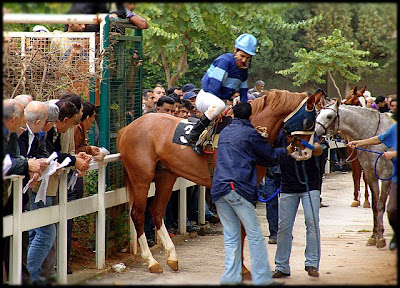 This is where the people view the horses up close and decide on their bets, just before the jockeys mount and go to the track.
 An ex-jockey, and die-hard better, he’s been coming to the track from some 50 years now. He once had a horse shot dead from under him by a soldier with a machine gun. The horse died, he got away with just one bullet hole above the knee.
 Short little man with odd body ratios
 Terror Theo going for a bet.
 And winning
 Racing Babes

 Windy? Noooh, not at all. Okay, so we braved the winds, almost got blown out of the ski lift, definitely got blown backwards, and were pretty much the only ones left on the slopes, but windy? Naah (kniesoor die daar op let). The snow was soup, half of the lifts didn’t function, and it was hot. It felt like we were skiing in 30 degrees Celsius.
 But we are totally ready for this one; a race against the Lebanese Armed Forces on cross-country skis and snow shoes around the Cedars. They do require that participants fill in their blood type while applying for the race. That sounds promising. It means they expect to go all the way. It will be quite the battle.
 I am afraid however, that by March 22nd, there will be no snow left. My thermometer in Beirut registered 31C. The ski season is now officially over, I think. Which means we will win be default.
 It’s T-shirt weather. This man yesterday was fixing the carpets outside his store yesterday.
  Random pictures of Beirut on a Sunday afternoon, 5:30 P.M.

 I took a different route today while walking that pesky little dog of my daughter. There are some benefits to this dog (though precariously few); you have to take a walk twice a day. And so you get to see things.
