November 30, 2014

The Pink House

From the balcony of the Pink House
  
Everybody  in town is talking about the Rose House after this post“The Rose House is opening up its doors? Have you seen it?” is the news. 

I have wondered for 20-something years about that house. I knew who lived there, but had never been inside. And who hasn't walked past that house, secretly hoping they'd have a house like that, in a neighborhood like that, with a view like that?

Now it's open to the public, because the house has recently been vacated, and a British painter, Tom Young, has taken the opportunity to paint from the house, and display his work from the Rose House, as the exhibition is called.


Actually, everybody I know always called it the ‘Pink House’. Others called it the Ardati House (after its original owner, Najib Ardati).  What’s in a name? Nothing really, but ‘rose’ is too soft. The house makes more of a statement than ‘rose’, and so for me, it will remain the ‘Pink House’.
 
The pink house is a prominent feature on Beirut’s Corniche. It’s an old part of Beirut, next to the house is the old Beirut lighthouse, still functioning, but no longer working since high-rise around it made it impossible, and a new lighthouse had to be build closer to shore. It’s the way Beirut must have once looked like, with villas surrounded by gardens and palm trees.
 
Tourists automatically take pictures of the house as they walk by, without really knowing anything about it; it's that eye-catching.  It’s been around for almost more than 200 years: The two upper floors (which you can see from the Corniche) since 1822, the bottom part (which is hidden behind the garden wall) much longer.
 
Photos of the Ardati family, the owners of the house, who rented it out more than 50  years ago
 
The house has seen an awful lot of battle (as being explained by a lady living right behind the pink house). The Palestinians, the Syrians and the Israelis all set up base right in front of it at one point in time, and since they were all shelled heavily by opposing factions, the house was under fire quite often.
 
Side of the house
 
The house, rented by the owners some fifty years agovto the Khazen family, housed a group of Syrian soldiers at one time. Not voluntarily of course, but who could say no to the Syrians? I had a friend once, who had a Syrian colonel living in the apartment under him, right on the Corniche, in 1990. Actually, the colonel had 'taken' the apartment, as they did with all the property in Beirut. An education man he was, but not someone you’d mess with. And as educated as he was, the Syrians were very poor, at least the soldiers that were stationed in Lebanon, and when he left, he took the sinks, the tub and  the toilets with him back to Syria, leaving behind a gutted place.
 
Beautiful tile floor (and my red boots)
 
 
The story of the house is a common one. One family owned it, rented it out for a good price before the war (it was beach front property), but (old) Lebanese law required a fixed rent in the contract, and then when the economy went down, and the dollar went from 3 pounds to a dollar to 1,500 pounds a dollar, entire families owned properties that only cost money, and didn’t make any, whereas others lived in prime real estate for under a $2,500 a year!
The house from the back; the top floor (which would be the 4th) doesn't look like it was ever inhabated
The pink house is a similar story. Mrs. Khazen lived in the house until recently (I don't know what she paid for rent, would love to know) , until the house was sold, and she had to vacate the premises.
What is to become of the house? My guess is a real-estate developer is going to destroy it and build a 20 story, one-and-a-half million $,  400 square meters,  super deluxe apartments that will be bought by Arabs living abroad, and that will be inhabited, if the situation permits it, one month a year. That’s what’s happening with pretty much of all Beirut’s heritage.
 
The bottom floor of the house

And my favorite thing in the house; some water sculpture fountain things, with water coming out of the ceiling. Looks like something from the early sixties, an indoor rain curtain, very advanced for its time.  I would love to see pictures of the inside of the house during the sixties and seventies.

If we’re lucky the house will be preserved. Experience tells us that we’re seldom lucky in Beirut. More on that story here.

November 29, 2014

More Things Up North

Enfeh village; a collection of home-built structures
 
 
Okay, last (long drawn out) post on some things to see up north: We’re still in Enfeh, a small (Greek orthodox) fishing village on the coast. It’s funny how villages in Lebanon are typified according to their religion, as if there’d be a difference. But we do that in Holland too, if it involves a religious community with a rather extreme character. Staphorst, for instance, a village in the north east, is always associated with the ‘Black Stocking Church’, a Calvinistic domination of a rather severe kind. I remember that you were not supposed to lawn on Sunday, but do not know if that is still this way.


Enfeh is a jumbled collection of houses all build on the shore, in a style that reminds me of Catal Huyuk, or modern day touristic Greece. To get to the peninsula, which is the oldest (and no longer inhabited) part of the village, you really need to clamber over home-made wooden bridges, through a graveyard, by some rather disheveled summer chalets, through a volleyball field, past some fishing huts and through a deep rock-cut trench, before you end up on the peninsula.
 
 
That rock-cut trench is an odd feature. Some say it was cut out during Crusader times, something like a moat, which would protect the inhabitants of the peninsula from attackers. If that is the case, then it is a bit of a fail, as the water level isn’t high enough; you can just walk across. At one point there is a standing pillar, which could be interpreted as a support for a draw bridge, but either the trench wasn’t finished, or the sea level dropped, or the floor lifted itself, or it just isn’t meant as a safety barrier. I go for the last explanation. The differences between high and low tide in the Mediterranean are neglectable.
 
The rock-cut trench, separating the peninsula from the main land
 
Then there’s the story that this was a Phoenician dry-dock, where ships were built in very close proximity of the sea. Why they would cut through the entire rock from one end to the other, is a bit of an overachiever’s feat. So I nix that theory as well. It’s got to have some purpose though to put so much manpower in a feature for a small town, that at one point in time, Enfeh must have been a thriving village.
 
 
What’s nice about the town is that it looks pretty much the same as it must have some 1,000 years ago, if not more. Very little town planning, they just built on top of the ruins of previous dwellings, like in the old days. For some reason I always end up in this town in winter time, when it is grim weather with ominous skies. I keep telling myself to spend a summer here, go fishing, start diving again, and make art projects with shells and drift wood. I seem to lose myself in working, rather than living, these days. But one day, I am going to do it.
 

November 23, 2014

On Goat Meat (and Butchers)

Today a ‘house, garden and kitchen’ post, as we say in Dutch (which translates itself into ‘simple’ or ‘common’). 

The road to the Beqaa valley was wet and muddy; with total precipitation so far this winter already exceeding the yearly average for this time of year,
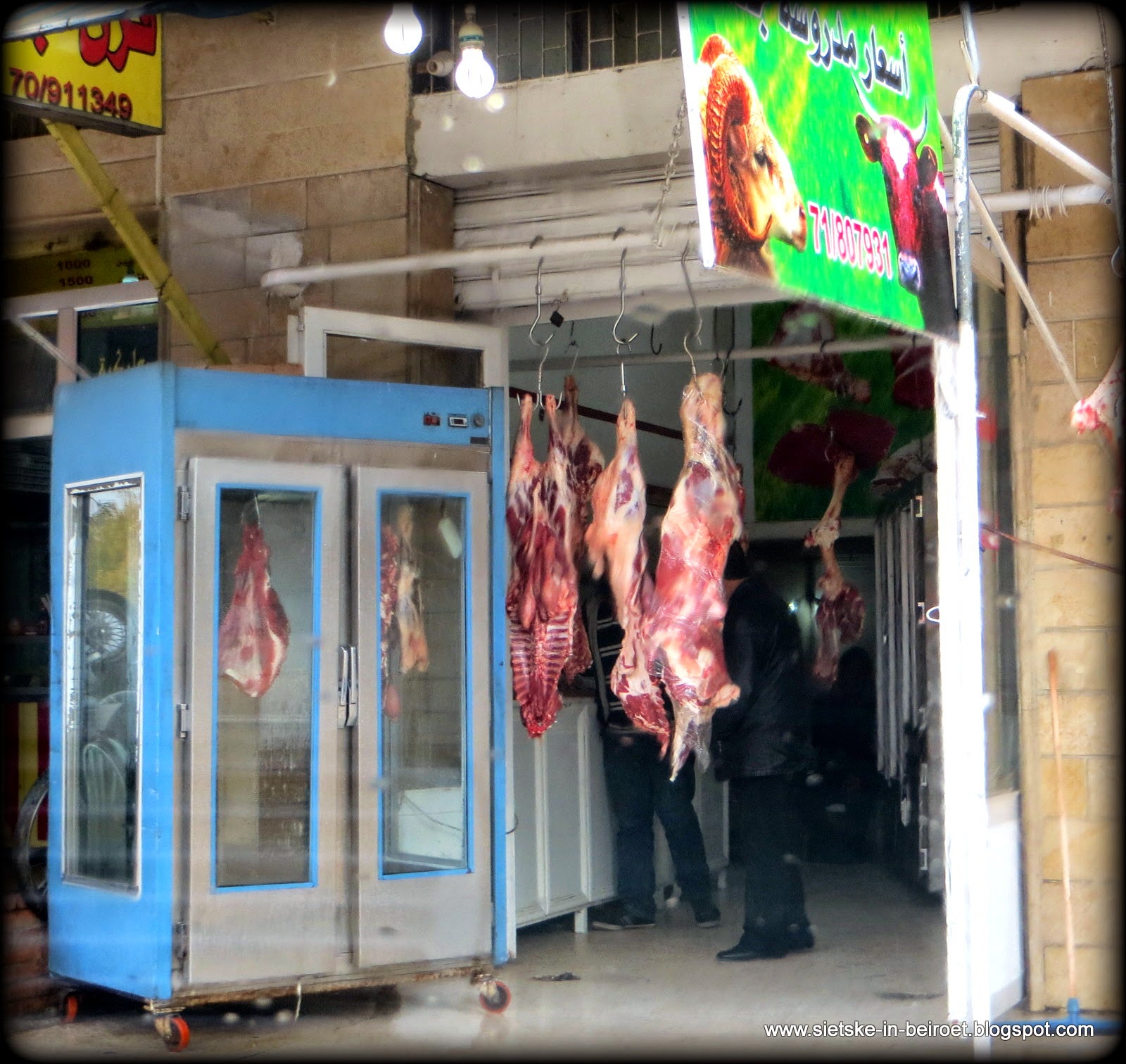
This weekend, I bought goat meat (or mutton, as it is called), and I thought I’d show you some pictures of a typical Lebanese butcher. If you’re from Lebanon, you will find nothing unusual about this. If you’re from Holland, you probably will never have seen an entire animal hanging in a butcher shop. We (the Dutch) only see our meat pre-cut and pre-packaged, unrecognizable as having once been something furry and alive.

You wonder - after last week’s report of the Ministry of Health on the Lebanese food industry, including the state of slaughterhouse, butchers and restaurants, - why anyone would still dare eat meat? Fecal matter in food, rotten meat in the supermarkets, and slaughterhouses where the carcasses lie on the ground between their own feces and urine. We don’t eat a lot of meat in my household, it’s mainly fish and chicken, but this weekend we needed goat meat

Zahle was wet but sunny. I liked this elderly man with his hat on. Something else than the dumb little woolen hats many men wear. 

You see, every morning, as we leave the house to go to jobs or school, the old aunt who lives in our house, corners us near the elevator door with the question: “What do you want to eat tonight?” When she just moved in with us, this was a welcome question; there were tons of things we wanted to eat because now we finally had a household member who could cook Lebanese food. 

But now we are quite some years down the line, and this one question every morning is one that everyone in our house dreads. 
We just cannot think of anything anymore, after years and years of thinking of different dishes, and so we try to sneak out without her noticing. This is no mean feat, because she recognizes the whirring of the elevator being pulled up, and the metallic ‘click’ of the elevator door as it reaches our floor. 


Sometimes we quietly tiptoe to the floor below us, and take the elevator from there. Sometimes my husband leaves before me, and will yell “Isal marti,” (ask my wife) as he runs out of the house. And the dishes that I can think of, are somehow always out of season.

So when we actually think of something we’d like to eat, we have to act upon it. And on Saturday  my daughter suddenly thought of spare ribs. This comes from our summer BBQ’s in Holland, where copious amounts of spare ribs get consumed. 

You point to the piece, and he cuts it right off the carcass
Pork is very difficult to come by here in Lebanon, so it had to be goat. Goat ribs needed to be purchased, but we were up in the mountains, and due to the pouring rain, the already incredibly congested road down to Beirut would be further impassible with either water or broken down trucks. So we had to go to the other side of the mountains, where we ended up in Zahle. In the Beqaa Valley, they’ve got plenty of goats.

The advantages of mutton over beef are numerous, according to Wikipedia, but then I cannot vouch for the source of that information; it could be it was the Mutton Wholesale Dealers Association of Northern America for all I know.

So maybe I would not have my meat minced here. 

You don’t get your spare ribs from the supermarket, especially not after this report, so you go straight to the source. We have butchers here that have the life goats tied up in front of their stores in the morning, slaughters the beasts (okay, so they do it right on the street, which was also a bit of an issue according to the report)  and by the evening they've cut up and sold the entire carcass: Fresh from the animal. Of course you can’t tell whether the goat was sick or not, or fed with something wicked, and I am pretty sure that it is not that hygienic either, but in the end, what doesn't kill you makes you stronger, and you've got to die of something.


We found a butcher who had his goats hanging in his shop, pointed at the spareribs, and he cut them right in front of us off. It couldn't get any fresher. Tonight I am eating spare ribs. If you don’t hear from me anymore, blame it on the meat.

November 22, 2014

Salt Basins of Enfeh

Salt basins bordering the sea in Enfeh
A little under Qalamoun (yes, we’re still up North with this story: Road Trippin' Part II) you find the salt basins of Enfeh. It is winter now, the slow season; salt is typically ‘farmed’ or harvested during the summer heat, but it is still a pretty interesting place to stop and check out.
 The mining of salt through evaporation pools is a very old process; we were already doing it while still out there hunting and gathering our food, way back when. The process is simple; you fill a basin with a thin layer of sea water, let the sun evaporate the water, and you can shovel the mineral salt out. Salt, of course, brings out the flavor in food, or can help preserve it by drying it.
Salt was quite a commodity in the old days. In fact, ‘salary’ derives from the word salt.  Apparently Roman soldiers were paid in salt; salt money, which translates into ‘salarium’.  
I remember that some 20 years ago, you’d see basins all along the coast line in the north. The rising value of coastal properties, and the import of cheaper foreign salt have pretty much done in this ancient industry. The government didn’t help much either when they stopped taxing foreign salt imports. It is no longer a viable business, it seems. As a result, you do not see many salt basins that are still in working order. (Interesting article on it here).


'The Anfeh salinas alone represents half of Lebanese salt production, although its ancient methods really set it apart from the country's other salt beds, which employ more modern methods. Until 1990, Lebanon was self-sufficient in salt production, selling 45,000 tons a year locally. Because of government accords with other Arab countries, notably Egypt, Lebanon now produces only 20,000 tons annually.' (Source)
 
Shepherds graze their sheep on the upper part; These sheep dogs chase my car that has my sheep dog in it.
I don’t quite get this part. If you’re self-sufficient at 45,000, how come now we end up with only 20,000 a year? If I were in the government, I’d tax foreign salt imports to the point where they become as expensive as local salt. Start with blocking Egyptian salt.  Since salt isn’t all that healthy, taxing would give you a triple benefit. 1) you make money of taxing import, 2) local salt farmers will make a living, which brings money into the economy and 3) because salt become more expensive, people may use less of it, which should help in the costs of health care.
Deir Sayedet al-Natour, or 'Wife of the Janitor Monastery' (did I get the translation right here?)


Besides, it’s interesting for tourist, who - I admit – do not show up anymore, but if ever we become a peaceful nation, a day at the salt basins could be an attraction. Add some B&B’s, organize workshops on ‘Salt Harvesting’ and ‘Lebanese Kitchen with Sea Salt’ , and voila, you got yourself package deal.
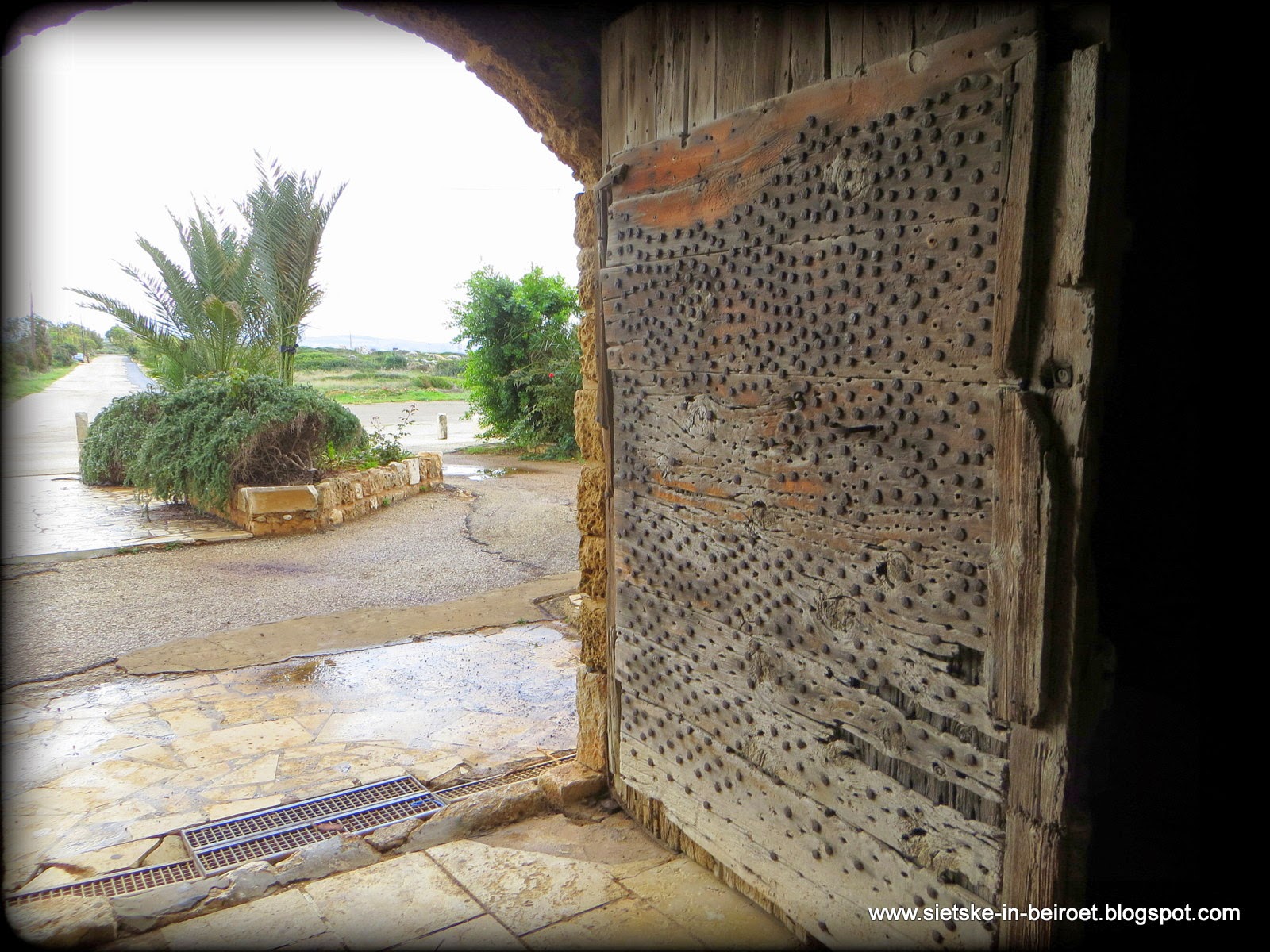
Door of the monastery


Another odd thing (I think) is that the church finds little value in maintaining them as well. Many of the salt basins near Enfeh belong to the Greek Orthodox Monastery, Deir Sayedet al-Natour, but their salt basins have been pretty much abandoned. Just a few at the lower part of the hill are still functioning. They sell little bags of salt at 2,000 at the monastery entrance.
Salt for sale; 2,000 pounds a bag ($1.33)
So it doesn’t make money anymore, but I would think that it is the responsibility of a religious order to not only provide spiritual guidance, but to help their people with work. Right now they lease the basins, but there are no takers. What if they would not ask for money, but lease the basins against maintenance costs only? This way the salt basins are maintained, a local industry is kept alive and people work and make some money. There’s got to be plenty of people there who need an income. So the church doesn’t get rich from it but I don’t think that’s their job description anyway.
In the West, you find all kinds of different salts , and exotic salts, in gourmet stores these days. Black salt from the Himalayas, coarse grey salt from Bretagne, pink salt from Thailand, and they sell at ridiculously high prices. 7 euros for a jar of Himalayan pink, I remember. Of course salt tastes like salt, although some may argue, but if packed nicely, it becomes a nice gimmick. Imagine, if you can market 3 exotic salts for $39.95, you won’t be able to market real Lebanese Sea Salt for $10 a jar?


But I am not in the government. Nor do I manage a religious order. But if it were up to me, I’d turn these salt basins into a money making business.

November 16, 2014

Road Trippin' Up North Part I

Qalamoun Main Street; rain is looming in the distance
Had to go up north this morning to buy some olive oil.
Why not go across the supermarket and buy a bottle, you wonder? Only suckers by olive oil by the liter. Here in Lebanon, we buy our olive oil buy the ‘tankeh’, which is slang for 20 liters. Actually, we buy more than just 20 liters; I think we’re going through some 60 liters a year if not more. I’ve been living here like forever, and have grown to not only like olives and olive oil, but to even develop a preference for the color and type of oil. Olive oil is a bit like wine for the ‘connoisseurs’, they can taste the region it comes from (who knows even the year?). I like my olive oil a little spicy.  Sometimes I buy it straight from the press up in Douma, but that’s quite expensive, especially of you go through a liter a week, if not more.
This old house had some fancy balcony corbels with painted dragons. Wonder who thought of that? The balconies are missing though.

Another option is to buy it from a wholesale dealer. It is key to buy the very first oil of the season, which is about now. Or at least, that is what I have been told. Actually, we were a little too early; our regular wholesale dealer up north didn’t have the harvest of 2014 in yet, he’d have it by next Saturday. We tried some other places, but it was pretty much the same story: the olive harvest was not in yet, but they were working on it.

Oranges hanging right over the garden wall
What you do with all that oil? I am not sure. You bake in it, you add it to the salads, you eat it for breakfast with Labneh (cottage cheese) and zaatar (thyme with sesame seeds), I sometimes eat it just with toast, and the old aunt in the house rubs it on just about any ailment she can think of. And she's got many.
Many Lebanese still have a connection with the ancestral village, and they get it from the family’s own olive orchard. The benefits of olive oil are quite substantial, it seems. ‘Olive oil is the main source of dietary fat in the Mediterranean diet, which is associated with a low death rate from cardiovascular diseases compared to other parts of the world’ the article claims. Of course, something else will kill you in this place.

Port of Qalamoun
Fixing the nets
Anyway, no olive oil yet, but since we were there anyway, we drove by the port of Qalamoun, and decided to look around a bit.  It’s a small town on the old coast road to Tripoli. Not much happening there these days, but it was already knows in Greek time as ‘Kalamos’ and during the Crusader time, it was called ‘Calmont’, and that’s all I can tell you about that. These days it is a mainly sunni enclave. But what do you know, a fellow blogger and volleyball enthusiast from New Zealand apparently spent some time in Qalamoun: the Internet is an amazing invention. 
Abandoned material used when building the port
The current port is quite new, but it’s pretty amazing to see how quickly they’ve managed to turn it into a dump. A young pelican was standing near an army post, no idea how it got there, but it didn’t seem very scared of people, or dogs, for that matter.  
Nets were stacked everywhere, but little fishing activity; a big storm was on the horizon, and the fishermen stayed on shore.  I’ve written before about the fate of the Lebanese fishing industry, so I won’t repeat myself. It is a pretty bleak existence.

Pelican versus dog. Both seemed not very interested in one another.
On the way home, we stopped in a number of interesting places. More about those later this week. I am working so hard that I cannot even blog anymore regularly; I need to cut up and spread my adventure into 'adventures'. Talking bout a dog life. Time for retirement, so I can spent more time hanging around in this country, methinks.

This man had an impressive beard; it reminded me of the article about hipsters in Beirut who were mistakes for Jihadists

November 09, 2014

12th Beirut Marathon


Aregu chasing the professional runners from Ethiopia (take from a phone)

Today was the 12th edition of the International Marathon of Beirut. The weather couldn’t have been better; slightly overcast with a little breeze. Aregu Sisay Abateh, the lady that works in the house, was going to run her very first marathon today. She was a little worried that she was not going to be able to run the entire 42 K. ‘Too long,” was her verdict.
 
'The brides' running to protest against child marriages
That was until she was asked to help pick up the professional Ethiopian runners from the airport earlier this week. She took one look at the women, and decided that she could beat them. “They are so skinny,” she said, “they don’t look like much.”

 
And although her trainer had given her a schedule to run on, and although he had paired her up with an awesome male athlete who’d help her pace herself during the race, it was not to be. She took off after the elite runners.

But looks can deceive. As scrawny as the little Ethiopian ladies looked like, they could not be beaten so easily.
According to her trainer she “took off the first K with elite group at over 18k/h and maintained for over 1 K. This is unforgiving for the rest of distance. Lactic acid haunted her for the next 41K. Moreover she refused to drink!!! Her lack of experience and marathon culture have proven lethal for Aregu on her first attempt on the marathon distance. “
 
This pre-teenager refused to wear proper foot wear to run a 10K, and ended up having to re-assemble her shoes halfway through the course.

 She did complete the 42 K however, but not in the time she had hoped for. She passed the finish line in 3 hours and 33 minutes and was rather disappointed with that. Her team mate, Sonia Wansa, won second place. I do not see what the problem is; I also needed about 3 hours and 33 minutes, albeit for the 10 K , maybe a little less. But then again, we had to stop for bathroom breaks, and ice creams and the like.

A very relaxed atmosphere
 
All in all the atmosphere was good. There was music along the way, and everybody was happy. It is amazing to see that on the political plan, entire sects cannot get through the same door at the same time together, yet when it concerns running, nobody seems to have a problem. It’s sad to see how we are led on by politicians.

At the finish
 
And next year there’s another marathon for her to try. She needs to run in more marathons however to gain experience. I think it’s time to start some crowd funding to get this lady’s professional career on the road. 

November 02, 2014

Indian Summer

Our Indian Summer is definitely over: Fall has set in; gone are the beach days. Here in the mountains it has rained pretty much 24 hours on end. In Beirut it’s been a little drier.
 
Changing colors in an orchard up in the mountains
I am doing the 10K next Sunday during the Beirut Marathon, and I hope it’ll be dry by then. Aregu Sisay, my famous housekeeper, is running her very first marathon. She finds herself between a rock and a hard place on this run. She usually wins when competing in Lebanon; 5K, 10 K, 21K, she wins them all these days. The Beirut Marathon however is an international event; she cannot run as a Lebanese, and thus has to compete with the professional runners coming out of Kenya and Ethiopia. She stands little chance against these guys; these athletes run for a living, have personal trainers and do nothing but run: She only runs in the morning, before her works starts. She doesn’t know what type of food makes her run better, refuses to take the multi-vitamins that her trainer prescribed for her, and doesn’t eat breakfast before a race because it makes her vomit while running.


Shaggy Ink Cap (Apparently a very common mushroom in the mountains in fall. Edible (they say)

I had wanted to help a friend in the south with the olive harvest. “Don’t bother,” was the reply, “we had so little rain last year, that we have almost no olives. We’re not even harvesting what we have, not worth the trouble.” They don’t live off their olive groves; they happen to have them. But there are plenty of farmers who exist from their olives. I wonder how they get through this year because our Ministry of Agriculture does not provide financial aid to farmers who suffer setbacks due to seasonal conditions.

 
Some odd type of apple

There are few olive groves here, east of Beirut; it’s mainly apples, cherries (their harvest has passed) and persimmon (kaki).  According to certain folklore, you can predict what kind of winter is coming by cutting open the seeds of a persimmon. You see a spoon, lots of snow. A fork indicates a light winter and with a knife you’ve got a cold and icy winter coming up. I might give that a try next week. Personally, I am hoping for a long and snowy winter. Granted, that will not be very nice for the many refugees that are currently living in tent cities in the Beqaa valley. Winter in the Beqaa is much more severe than here on the coast line anyway: it’s a land climate versus a marine climate. It’s amazing what a change one mountain ridge can make on weather patterns. 


Persimmon (kaki)

Up here in the mountains, it was cold enough to light the first fire of the season. Some years ago, a friend of mine and I were discussing about things we really wanted, but couldn’t get because our husband vetoed them. For her it as was dog, for me it was a fire place in the house. So the discussion went; what’s the first thing we do after our husbands die? But then her son brought a dog into the house, and we bought a mountain house that had a fire place, which was a good thing; now we no longer had to wait.


No idea what type of mushroom this is.

So Friday night was cool enough for the first fire: The dogs and the pre-teenager in my household all curled up in front of the fireplace.