February 26, 2012

Happiness is

Sunny skies

No traffic

Crispy snow

Empty slopes

No queues

Family to ski with

Kids that will (still) ski with you (now and then. Sometimes. If they cannot organize a ride up themselves. Albeit incognito, as a very last resort.)

Friends you can sleep over at,

Beirut sunsets when going back home


And money to pay for it all.

February 19, 2012

The Wife and the Parrot

It is cold in Beirut. Cold for Beirut standards, that is. Nothing compared to the Siberian temperatures that pummeled Europe the past weeks. No Arctic winters here, but 11 degrees Celsius for Beirut, now that is cold. I, as a Northerner, should have no problem with that type of weather. And indeed, outside the house I am in my element. Makes me all nostalgic, feels like Holland (in summer).

It’s inside the house that I suffer. Beirut houses are not built for this kind of weather. Thin cinder block walls, no double glazing, marble floors and aluminum window frames sort of suck the cold in instead of keeping it out. Well, turn on the heat then, you say?

That is a bit of an issue. Since it doesn’t often get cold like this, we’re not really into advanced heating systems. My building did – at one point –have a central heating system. I know that from a radiator I once discovered in the back of a closet. The war, lack of water pressure, the price of oil, the state of electricity or the general Arab attitude towards the maintenance of equipment; you take your pick, but that radiator was all that was left of a once functioning system.

I don’t know many people that have central heating in their houses in Beirut these days. The stack of cast-iron radiators at the ‘antique’ dealers of Basta is an indication that many houses are now without. Only the new high-end apartments these days come with central heating; the rest of us mortal souls have to do with a variety of solutions.

There is the inverted AC, (If you can turn it on cold in summer, you can put it on ‘hot’ in winter), there’s your ‘subia’; an old-fashioned furnace that runs on oil (or wood, if you’re lucky), you have your little push-around heaters fed by bottled gas, and you have the mobile radiators, which run on electricity, and will suck your bank account dry and blow up your main switch board once the neighborhood generator takes over from the government electricity.

If you are not from Lebanon, you have probably no idea what I am talking about.
If you are from Lebanon, but living abroad, you are probably laughing your ass off because you do not have to deal with this misery anymore.
If – however – you live in country , you have by now identified your source of heat in these cold days, and sympathize with me in my misery.

I am an inverted AC gal. (although I do have the mobile radiator for the bathroom in the mornings). Inverted AC sucks. Your hair gets static, there’s the constant drone of the unit, it is only really warm if you’re right in the flow of it, and if it turns off, it’s back to cold within a matter of minutes. But if that’s all there is, you take it.

Now in comes the parrot. (Hence the title). Hubbie got a parrot last summer. It flew in, just like that, and it stayed. It’s an African grey. Not really an indigenous species, but quite popular, and so now and then there’s an escape artist landing on our balcony. Hubbie is quite smitten by this one.

And so, when this morning, I decided to turn on the heating unit because I was freezing to death, he said: “No, you cannot do that. It is not good for the parrot. He’ll die with these temperature changes and the draft. Turn it off.” (Did I hear a please somewhere?)

Now I sit here on the couch, in four layers, a scarf around my head and a blanket around me, typing with 4 fingers (the others don’t function well when it gets this cold), and reflecting upon my faith and that of the parrot.

On a totally different note, I did go and see Cat Stevens in concert (Yusuf, these days). I was more impressed with being recognized by Tracy (thank you Tracy!) then with Cat Stevens.

February 16, 2012

A Thousand Words?


A picture is worth a thousand words. Isn’t that the saying? So here’s a picture, and let’s see if you can figure out what the thousand words might be. I can easily churn out a 1,000 words about this one. One of my main problem – as a journalist – has always been that I use too many words. When my paper went to tabloid format, my articles were downsized from the usual 900 to a mere 600 words. I’d write a story in an hour, en then spent another 6 hours downsizing it until it reached the required amount. I was a frequent 598 or 599 words per article writer. You do get the hang of it after a while, and become much more apt at ‘killing your darlings’. Look, I am already at 134 words and haven’t said a thing yet.


So what exactly are you seeing here? These are the confiscated tools from the shoe shiners, standing outside a police station in West-Beirut. The shoe shiners in general are young Syrian boys, who apparently were not in the possession of the proper shoe shining permit, or whatever it is you need in order to shine people’s shoes, and so they get arrested, and their meager boxes are confiscated, and discarded in the back yard of the police station. No idea what happened to the shoe shiners themselves. They probably pay a fine, are let off, and then have to scramble a new set together.
The shoeshining business isn't what it used to be, I reckon. People where either Uggs, Converse, sneakers, or plastic rain boots, as seems to be the fashion in Beirut these days. But as every Dutch person can tell you; you get awfully wet and cold feet in rubber boots.
There you go, and some 700 more words to go.

February 12, 2012

On Traffic Jams and AA's

The pictures in the post are serene and not in accordance with the contents of this post. You might choose to look at the pictures only.

I went skiing yesterday. I got stuck in a traffic jam. A jam is opposed to a traffic flow: Traffic phenomena are complex and nonlinear, depending on the interactions of a large number of vehicles. Due to the individual reactions of human drivers, vehicles do not interact simply following the laws of mechanics, but rather show phenomena of cluster formation and shock wave propagation, both forward and backward, depending on vehicle density in a given area.(source)

Did you know that there’s a field of science that involves itself with traffic jams? The problem, according to this diagram, is saturation (of cars, that is). This saturation is caused by 3 reasons (as displayed in this diagram): 1) butterfly effect, 2) invisible waves, and 3) tragedy of commons.
I think we should add a fourth reason, one particular applicable to the Lebanese situation; it’s called the AA (that stands for Asshole Alert).

Lovely skiing! The slopes were positively empty. Hana did her first red run (proud mom)

And it goes like this.
You are on a two-way road. A narrow road, at that. At one point in time, your lane slows down due to the fact that the beginning of the line has reached its end-point at a village (let’s use Feraya, for example) where everyone wants to embark. This, of course, will cause the entire line to slow down. Logic has it that eventually this line will dissipate, as everyone will find a parking spot.

Now in comes the AA factor. These are people that can see no further than their nose is long (which according to this source means that they are ‘narrow-minded; and lack understanding and perception’.

And since they cannot see further than the end of their nose, they most defenitely cannot see further than the bend in the road, and since there seems to be no clear reason for the line the stop on this particular stretch of road, than there must be no reason at all for them to stop.
It is as if we are just standing there in a line, admiring the landscape.
All that it takes then, in their futile little brains, is to drive past this line, and voila, problem solved.

A and his sister. (Ever since he's been buying his own clothes, his style has significantly changed. I kind of like it, even though it's not really mystyle)


This is not the case however, as any sane thinking person can predict.
 
And so these AA's get out of the line, and proceed to drive past the line. Unfortunately, that lane is used by upcoming traffic. Oh surprise oh surprise, didn't see that one coming.

What happens, as a matter of fact, is that they block the way for upcoming traffic; people that are in fact emptying the village, which will allow our line to occupy the space of the departing cars. But since the departing cars can no longer depart, due to the actions of the AA, the line will subsequently not move anymore at all.  


They have Hollywood-like ambitions in this place

This, the AA’s, find very curious. Now why would there be upcoming traffic?
But no problem, they can just get back into their former line. Usually without any qualms, or so much as an ‘’excuse me”.

Now in Holland, we can be pretty narrow minded too, believe me. But what we would do, in a case like this, is to make that ‘former line’ absolutely inpenetratable for the offender, forcing him to have to drive backwards all the way to the very beginning of the line.

Empty slopes, sunny skies and crispy snow 

This would 1) greatly alleviate the stress is causes the people that actually do understand the reason for the traffic jam and display civilized behavior, and 2) it might help understand the AA that this particular behavior is non-social, and will not get him (or her), anywhere but to the end of the line (i.e. the beginning of the traffic jam.
I, in particular, can be a regular 'B' at that. I will not let anyone get back in front of me. I am willing to bend my fender for that (on my account, no problem) if I have to.

Alas, not in Lebanon. We’re too smooth, and let the asshole take our place. Now if it were only one AA, the line would eventually slowly budge, and you might reach your destination within humanly acceptable time. Unfortunately, the AA’s are abound! Especially fathers with children in their cars. Cars with legislative license plates. The mini-bus gypsy drivers.

At the end of the day, there was a boarders and skiers competition. Testosterone abound. It was fun to watch.

As a result, the AA’s are gratified in their actions, and are confirmed in their beliefs that we – the people in line – are just dumb suckers, and they are well above us. I have complained about this before; the majority of the Lebanese are meek like sheep. I don’t get this. An otherwise passionate people, can be so meek about getting pushed around be a couple of bozzos in SUV’s.

The lift from Cabane

The skiing was – by the way – fantastic. And when it gets to lining up in the ski lift, I just shove those AA’s aside with much verbal and physical ado. It embarrasses my son to no extent, one of the reasons why he is no longer skiing with me. I couldn’t give a rat’s ass. Because nobody shoves me around.

February 05, 2012

Another Intermezzo

Slopes of Feraya

My computer was (re)formatted this week. While everyone has Internet faster than the speed of light these days, mine only seemed to slow down more and more, till it got to a point where I could go and make myself a cup of coffee between the loadings of pages. My brother blames it on Bill Gates. I blame it on my downloading of 1000 and 1 free programs. Now that I have formatted the computer, and am back to zero, I have to download the bare essentials (for me); Picasa.
Some of you sometimes comment on the lovely photos I make, but although I’d love to take all the credit, most have been pulled though Picasa. Such as these, made yesterday on the slopes of Feraya; 6 Degrees, sunshine, good snow, few people (on the Wardeh slopes) and only one traffic jam. Holland is currently in a Siberian time zone, with -20 Celcius in some places. - 13 C in my hometown. I miss the Dutch winters (now and then), but luckily the snow is just 55 km away.
 

We’re not getting any younger, Marijke and I. We’ve known each other since 1990 if I am correct, but she’s got a better memory than I have. And that’s why I thought this 60’s filter (which comes straight out of Picasa) was appropriate. Two old bags in the ski-lift.

February 02, 2012

Travels with Hubbie Part III

In the mist

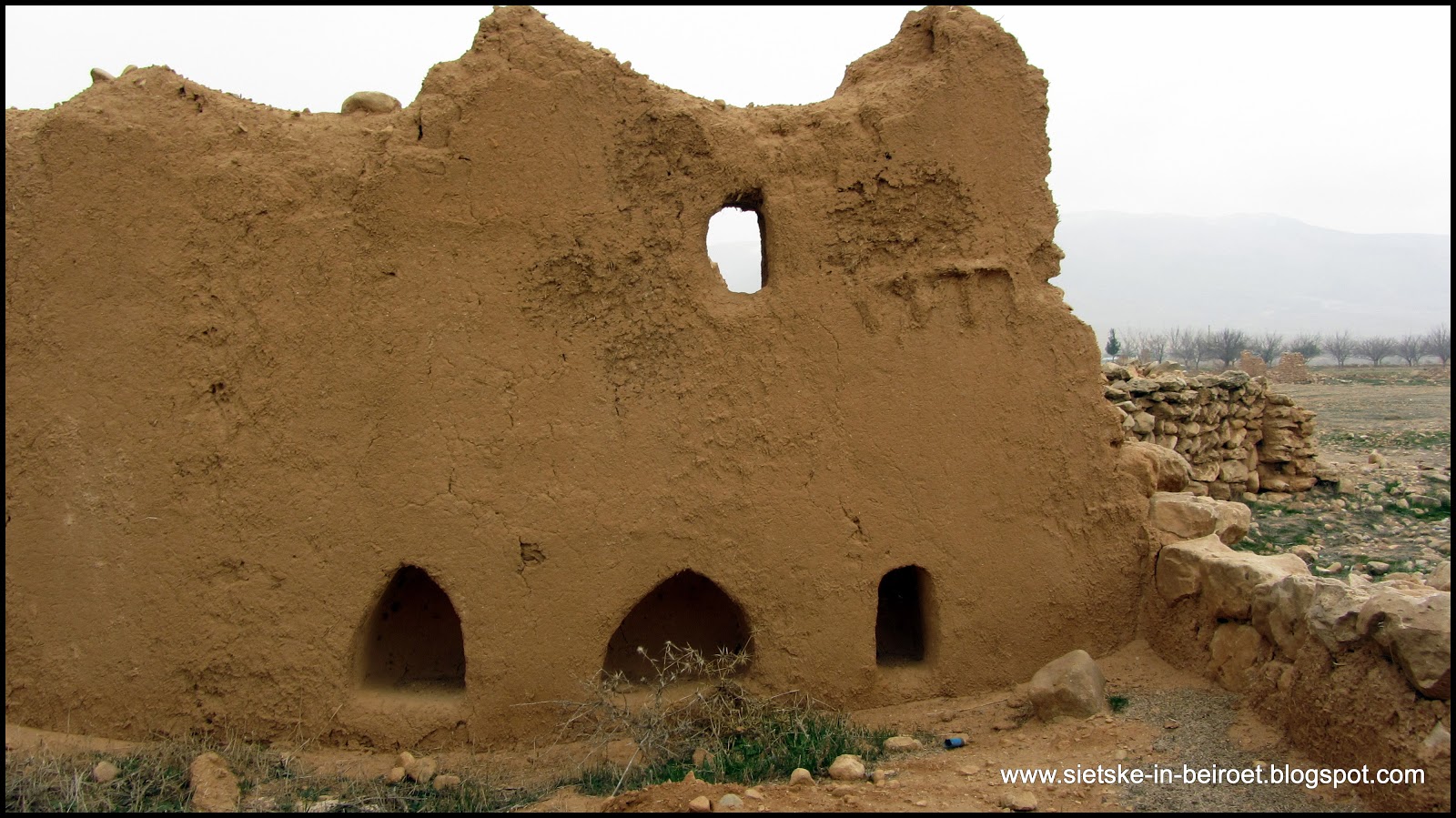
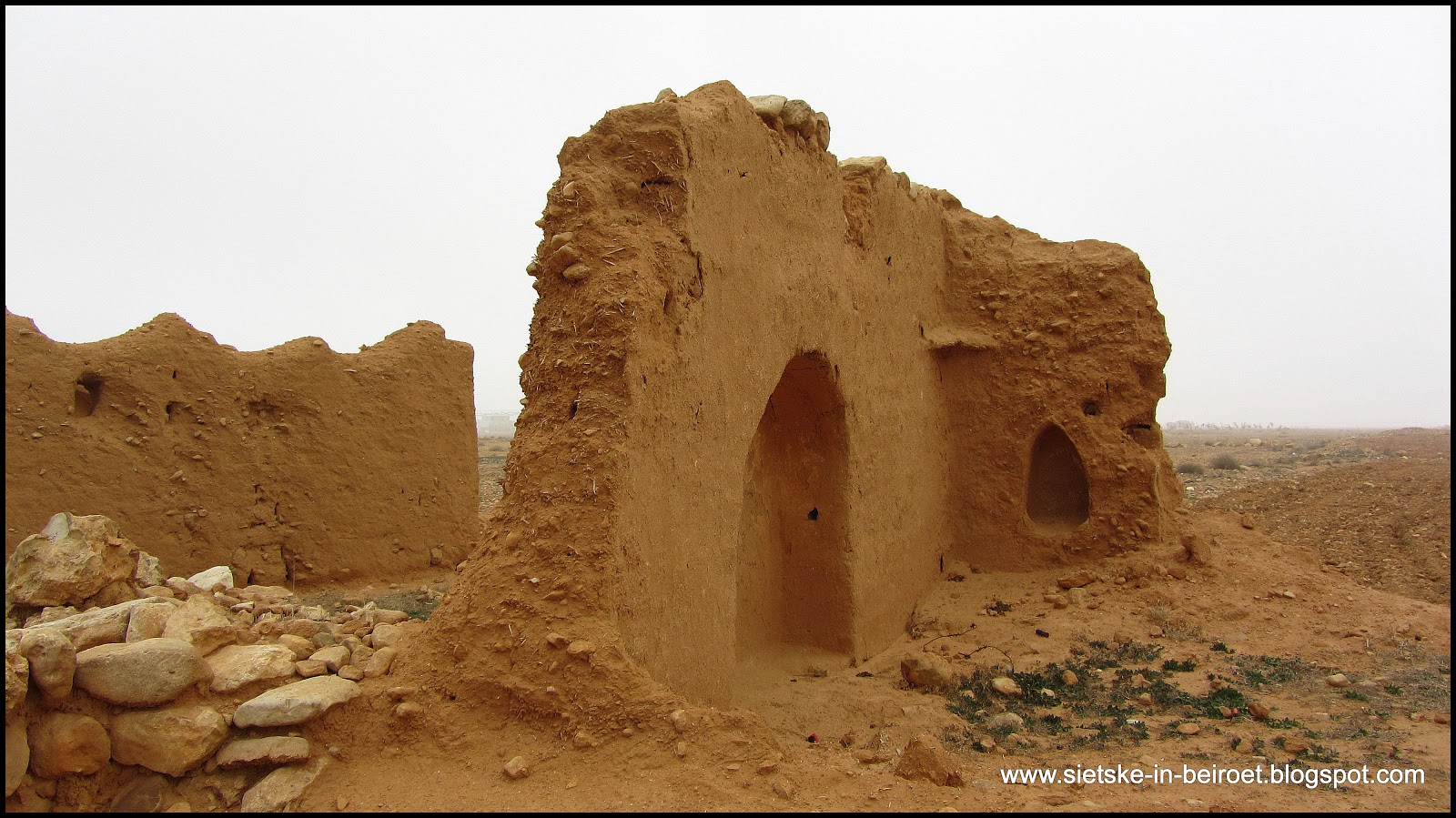
Yes, still in that northern region of the Beqaa Valley. So we are driving around, and suddenly in the mist, we see all these shapes popping up all over the plain. The area around el Qaa is teeming with ancient mud dwellings.

In the old days, mud was the only building material, since there is very little rock in the valley, and wood, well, that was hauled off eons ago. The rich built in stone. The rest used mud, because mud brick was the only building material around that didn’t cost (much), and everyone was living in little mud brick dwellings.


All these mud brick dwellings have since been abandoned and fallen to ruins, but here in el Qaa, you can see that at one point in time, this region must have been teeming with these little houses, each one on its own little plot of land. The mud bricks were prepared in wooden forms from a mixture of loamy earth, chaff and water. (source) . This type of housing has been in use since Neolithic times, and our mud is pretty famous, I found out while surfing the web.


The Israelis – while occupying the southern part of it - apparently referred to Lebanon as ‘the mud’; Once you get struck into it, there’s just no way to get out. (source).
Mud houses are environmental friendly, isolate well against the winter’s cold (and boy, does it get cold over there) and the summer’s heat, and are made from local products. It is a pity when you see all these ruins, that the knowledge of how to build these houses is gone.


They have totally disappeared from the valley landscape since the introduction of cement, and if you do want to see an original house from those days, you will have to go to the Terbol Museum, where Bedouin women have constructed an original mud brick farm house.


You can also sleep in one in Taanayel, where the NGO Arc-en-Ciel has one fixed as an eco-lodge. It seems you can participate in the making of the mud bricks and children can learn how to build mini mud houses.


We also ran into this bizarre project. Although it looks good and very romantic, I think it might be better for the local economy if we’d give mud bricks a try.