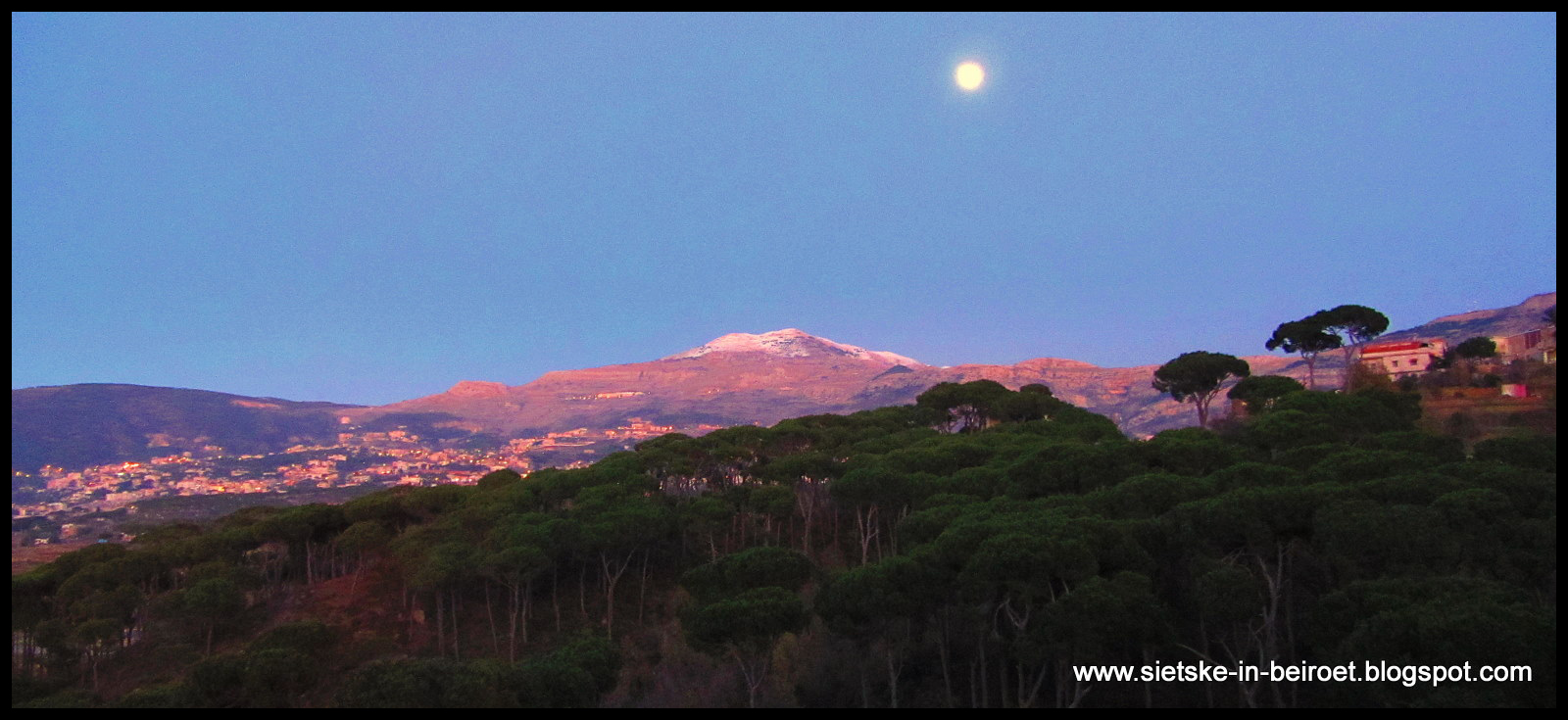
January 31, 2012

Travels with Hubbie Part II

Catching trout

While in the northern part of the Beqaa, we ran into a fish farm. They’re breeding trout in the Assi river, rainbow trout. I have lived here for a long time now, but have driven trough Hermel maybe once. And only last fall did I end up there by chance while taking the kids out on a rafting trip, and we were served trout for lunch. I didn’t even know they had trout in Lebanon. Well, they do. And good ones too.

Look at that weight; It think it was once part of a car engine

We used to have brown trout in Lebanon, but that one is practically extinct due to overfishing. The rainbow trout was introduced somewhere in the fifties and is 'characterized by a fast growth rate. Trout is raised in areas where a constant supply of high quality water is available all year round. Lebanese waters are predominantly calcareous and suitable for trout production. Water temperature is usually the most critical water quality factor. Trout Farms in Lebanon are mostly family owned businesses. An average yield of 30 kg/m2 is common.' If you are interested in fish, you can find the entire document here.

Catch of the day

 
The fish gets pulled out of the river right in front of you, gutted and weighed, and all that at $4 the kilo.

The average annual production of trout is around 1 100 tonnes (MOA figures). This is produced by 150 farms, 80 percent of which are in Hermel-North Bekaa, at a total value of USD 3.7 million and an estimated average yield of 10-12 tonnes (at approximately 1.5 Kg/liter/minute). (Taken from here)

The fish gets gutted and cleaned in front of you, and goes home for $4 a kilo.

 Now all that hubbie needs is a wife that knows how to cook.

January 29, 2012

My Bank Sucks

It is Sunday, and I am doing my banking online. 'Online' banking needs some explanation here. It isn't really that 'online'. For most transactions you still need to pass by the bank in person to get permission to do what you want to do online.
I want to transfer some Lebanese pounds to my Euro account. I get an error message. I try again. Same message. I call the help center of the bank.


Oh, but you cannot transfer Lebanese pounds to Euros. Only Lebanese pounds to dollars,” says the man on the other side of the line.
Oh really? Well, how about the other 10 times when I was able to do it?
Silence.
Maybe because it is Sunday. There are no rates.”


Maybe. Maybe not. That was helpful. Not.


Then I notice that my Euro account has 5 Euros less from last September. Now how did that happen? I check the account summary. Guess what I read?

I paid 5 Euros en 25 cents for service fees. Come again? I thought it was supposed to be the other way. Isn’t the bank supposed to give me money, as in interest?

It is that same sucky bank that offers me a credit card for MY account with MY salary, but who want my husband to come and sign.

Me thinks I need a new bank. Any suggestions out there?

January 28, 2012

Intermezzo


They said it was going to storm this weekend. And so no one went skiing this today. I am kind of surprised that anyone still believes these weather forecasts because they are consistently two days off. It was a little foggy, and not all slopes were open, but it was lovely. Lovely and quiet, and so you go up and down and up and down.

For those unfamiliar with Feraya; do not think we've got a whole lot of trees on the slopes. These are the only ones

The best part of the day remains the evening though, when the slopes close down, and everyone goes home. It got horrendously icy suddenly, and we saw several cars running into the ditch or each other. My son went down with friends, and their car got banged up on both sides; one side by a lady coming from the opposite directions, the other side by a gasoline truck losing grip. I think somebody’s driver is getting fired tonight.

Going home

January 26, 2012

Travels with Hubbie Part I

There’s this book, 'Travels with Charlie’  where the author John Steinbeck travels the back roads of America and writes about what he sees. I was inspired by that title. You see, my hubbie works some 360 days a year. But sometimes, he decides to take a break. And if you manage to direct him onto the road, you get to see stuff. Lots of stuff, because hubbie doesn’t like things half done. And so we roamed over the northern part of the Beqaa last week.

The channel of an old water mill near Hermel

And while roaming the northern part of Beqaa Valley, we stumbled upon a number of interesting things. None of my guidebooks gave an explanation, and as it was 0 degrees Celsius with a fiercely icy wind, none of the locals were out in the fields to ask for information.  But I figured it out. Long live the Internet.
Same water mill, by the side of the road


The northern part of the Beqaa Valley is probably the most deserted part of Lebanon, as well as the most desert-like. It is a dry and windy plain, where people subsist on farming, and a marginal existence it is. It is one of the poorest regions in the country. In the ‘good old days’ people were able to make a living from hashish crops, but now that we try to be part of the ‘real’ world, they can barely scrape by.

Barren en bleak, and when the mist rolls in, the picture is complete.

The place is bleak; not a very inviting place. But a long time ago, it used to provide massive amounts of wheat or the Roman Empire. For wheat, you need water, and it doesn’t rain much. There are a number of rivers though, that were used to irrigate the region, and an extensive irrigation system was built.

A recently restored water mill near el Qaa

And so in the middle of the desert there are these stretches of ancient aqueducts. Most have fallen to ruins, such as the ones on the side of the road between Baalbeck and Hermel . (‘Don’t go there’, says the Dutch embassy. ‘Do go there’, says Sietske in Beirut) , and you cannot really figure out how they must have operated once. The area around LabouĂ©, Maashouq et Nasryieh has several Roman aqueducts and canals and for long, the organization of such traditional irrigation was based on ways and customs, which were considered as law. (This bit of information was stolen from here)

The long wall which helps bring the water from ground level all the way up

They are intricate contraptions. Apparently they did not have windmills in the old days (although there’s plenty of wind, if you ask me), but they did need mills for grinding grain. In order to do that, they’d built a water canal, and while the ground would descend, they’d keep the canal level, until the water was elevated enough above the land to make a drop strong enough to run a mill.


On top of the wall


This is about similar mills, but in Jordan and Cyprus:  (...) the vertical penstock chamber of the majority of mills ( . . ) , into which the water would flow from the water leat or channel, creating a forceful exit through the opening into the wheel chamber in front. This would create a force strong enough to turn the mill wheel, which was attached to the mill stone grinding the cereal above. (. . . ). In Jordan, many of the water mills had leats that abutted a natural upward slope from which the water would gain a greater momentum as it flowed into the penstock tower, hitting the mill wheel with a greater force. In Cyprus, many of the mills appeared to ave long water leats that did not incline with a slope,but continued on a horizontal level. (source, page 53) 

The ground was teeming with these fuzzy caterpillars, no idea what kind they are.


One of them has been recently reconstructed. But how does it work? Who originally built these water irrigation systems? And who restored the one that is on the outskirts of al Aaq? It cannot be the government, now can it? That government that is not able to provide us with round the clock electricity. The installation is not a new one, as the architecture is identical to the one that has fallen to ruins near Baalbeck. So why did they restore this one, and not the others? Is it working? And if yes, how? The wall ends near a dilapidated goat farm, although I should not say dilapidated because everything looks dilapidated in that part of the country. Except for this wonderfully restored irrigation center/mill.


The roads after Baalbeck are courtesy of the Iranian government, it says under every single road sign (in blue). Lest you forget.

There is a story that Queen Zenobia of Palmyra once ordered an aqueduct to transport water from Lebanon to her oasis in the Syrian desert, but these channels and mills  are for local use. Had this been in Rome, or Israel, for that matter, they'd have built a million-dollar visitors center around it. I couldn't even find a little wooden sign.

January 21, 2012

Snowy Slopes

Feraya slopes

Whoever thought that today the weather wouldn’t be nice up in the mountains, or that there would be too many people skiing anyway, or that there would be too much traffic going up, boy, did you make a judgment error! I am glad you did though, because the slopes of Faraya were lovely and reasonably quiet, particularly in the Warde part (the slopes all the way to the left side of the map).
A little cold and foggy in the morning, but by 11 it was sunny, crispy snow and short lines.


H and L (her friend)

I cannot say my daughter was as jubilant as I was. My friends pity my daughter. They say things like ‘poor thing’ and ‘when she grows up she’ll never forgive you for this’ or ‘why don’t you just leave her at home if she doesn’t like it?’ You see, my daughter hates skiing. Not necessarily with a vengeance, but it is an activity that – as far as she is concerned – she can do without. I come from a country where you cannot ski, and people pay a fortune just to go to Switzerland to learn how to ski. I live an hour away from a slope, so it is ridiculous, as far as I am concerned, that she would not know how to ski. And so I religiously drag her to the mountains those 2 ½ months a year that we get snow.

A couple of dare-devils (notice the boy on the bottom; he's jumping off a cliff. Could be my son, except I know he's a boarder. It's probably a good thing I don't see him snow-board; my heart would stop)

It goes well for a while, but then after one fall, the moaning and whining begins. It helps if you drag along other munchkins, it seems to alleviate her incessant suffering. She’ll thank me for it, one day. Or not.


Her brother became an adult this Friday. How did we celebrate it? Well, I saw my son 5 minutes that evening, just as I came in the door back from work and he was on his way out the door on his way to Faraya. I saw him maybe for a split second today on the slopes, as this shadow flew by me and I heard a ‘Hi Mom’, but that might have been someone else’s son. Needles to say no picutre of him on the slope. And now he just got home and crashed on the couch, asleep. I guess we’ll celebrate tomorrow then. If he’s got time.


He wanted a car for his birthday, That plan got axed quite quickly. Apart from the logistical issue (‘Where are you going to park it?” ‘Wherever you need to be the coming 2 years is within walking distance.’ ‘A service is cheaper’ and ‘So who will drive if you had a drink at night?’), it doesn’t really build much character. If he wants a car, he better get a job and work for it. I do not foresee a car in his near future. Not sure what he wants instead of a car. I’ll try and find out when he wakes up.

January 20, 2012

Winter Wonderland


Winter has been late this year, but it has finally arrived. This morning it was 7 degrees Celsius in Beirut. I think that is as low as it gets in this town. On the way to the Beqaa Valley, the police were stopping cars to check for snow chains.


Apparently they had gotten tired of pulling people out of the snow at the mountain pass. I had to go to the Barouk Cedar Reserve, and it was right after the storm, so everything was covered with virgin snow, and I was the first one to make a trail.


There’s a lot to be sa(i)d about Lebanon’s urbanization, and in many ways, this is no longer such a pretty country. But if you get way up in the mountains, far away from cities and villages, there are areas that are postcard material. It is a pity I already sent out my Christmas cards, because today was a real Winter Wonderland. I might try and make it to the ski slopes tomorrow, although I fear the rest of the country may be of the same thought, and I’ll end up in a traffic jam to the ski slope instead of at the ski slope, but we’ll see.

January 16, 2012

Beirut on Ice


Well, a building came crashing down in Beirut last night, (here is a face to the building, much more interesting than any newspaper article, and it's got a powerful quote: "So in simple terms: the rental law in Lebanon is hurtful for both the tenant and the landlord.") and Lebanese designers dominated the Golden Globe Awards .
And all I can come up with is some skating rink in downtown Beirut. Methinks I should get back into journalism really soon.
 

I used to laugh at those Arabs on skis in the Dubai mall. I mean, really, what were they thinking, creating a ski slope in a shopping mall in the middle of a hot desert?
Well, Saturday I went to that skating rink in downtown Beirut, and I think some westerners who were passing by must have thought; “Really, what are these Arabs thinking, creating a ski rink in the middle of downtown Beirut?”

They’re probably right.
The rink is about an eight of the size of any home-made-neighborhood skating rink in Northern Europe. The ice was way too hard, with a layer of water on top of it, ensuring that if you fall - which is quite inevitable, considering that you stick a bunch of non-skaters on dull ice skates on a slab of non-natural ice – you’ll be wet from top to bottom, and the price is probably out of reach for most Lebanese, especially of you have a family of 3 kids or more. I don’t understand why they ask so much. If you go for 5,000 for an hour, you get 5 times the amount of kids, and a full rink always looks better than a rink with just 15 suckers on skates. (Here’s home economics speaking) .

But what the heck, you’ve got four kids running around in your house, it’s been raining all week now, and cabin fever is all abound.

In retrospect, it was quite fun. And who liked it the most of all? The Ethiopian housekeeper! Never seen ice before, let alone skate on it.  I have respect for this lady.

January 11, 2012

On Soil and the Beqaa Valley


In the middle of the Beqaa Valley, looking west (Lebanon mountains)


I’ve been plodding around the Beqaa Valley quite a bit these last two weeks. Quite against the advice of the Dutch Ministry of Foreign Affairs (scroll to onveilige gebieden), who believes most horrific things might befall upon me, due to criminal activities over there of a serious degree. Specifically Hermel, Brital, Ersal, Majdel Anjar en Anjar. Hmmm. I think I’ve driven through there just last weekend, although we avoided Brital, out of fear for my car, not my life.

Why the Beqaa Valley? Courtesy of hubbie, who has decided he is in need of a piece of land on which he is going to build a little shack where he can sit and contemplate life. The mountain house won’t do. He wants something more . . . I don’t know what. Isolated, I think it is.


Working outdoors; the shoemaker and the tailor.

I have stipulated I want to be able to see the sea from my chair. He has decided it is going to be somewhere in the Beqaa Valley. I have mentioned that I wouldn’t mind having a supermarket nearby. He’s set on having a herd of sheep next door. I want the hills, he wants the valley floor.
I think it has to do with the fact that he’s fed up with people and clutter, two things the Beqaa Valley is quite void of. Relatively speaking, of course.


My prospective neighbors? I think not.

But as a good wife, I slug along, stare intensely at plots of land, and then give some well-thought of advice. Such as; “If it floods, you’ll need a boat here.” Or; “So how are you going to hook on to the main sewer system?”, and “Do you think you’ll have much in common with your neighbors? What are you going to talk to them about?” nodding at some Bedouin tents in the field.

But as he is quite set in his ways, and as I know him, he will throw all my well-meant advice into the wind. That doesn’t really matter. I greatly enjoy driving around with him and looking at things. There’s just so much to see in the Beqaa Valley.


An odd sight; this guy had all his plastic household stuff in one color only.


This week I had a conversation with a soil expert. He specializes in soil chemistry, and helps farmers improve their soil and crops. He mentioned that he was a very poor driver (his wife confirmed that) because everywhere he drives, he looks at soil. He is fascinated by soil. So passionate in fact, that in a one hour conversation, this passion was passed on. I learned about young soil and old soil. That is takes a 1,000 years to make just 2 centimeters of soil in Lebanon, that the soil in the Beqaa Valley is some 90 million years old (I might be a few million years off here) and that of the 12 different types of soil in the world, only 2 of these exist in Lebanon.


Olives (the new harvest is in. Lovely spicy)

Forgive me if I cannot cite the exact names, but one of them has to do with something ‘verti’. This soil expands and contracts with moisture, and as a result develops vertical cracks, which then are filled-in again with soil. And there’s only one patch of it in Lebanon; on the right side of the road as you drive into the Beqaa Valley, just above Shtoura.

\That patch of vertisol (if I got the name right)

I could go on for quite a bit, but I realize that you as a reader may not be necessarily very interested in soil. But when you drive around this country, and you see so many things, it becomes all fascinating. A life time is just too short to figure it all out. I still need to study geology, and archeology, and I don’t know enough about the ancient history of this place, particular the Roman and the Neolithic times.


Part of the Beqaa Roman ruins.

So much to learn, so little time. Maybe this Beqaa valley project is not such a bad idea. I could sit next to this contempating guy, and study in peace.

January 10, 2012

Early Morning


I arrived a little early to work this morning, and so I took my time and made a long-cut (as opposed to short cut, but I am sure it has another name, deviation maybe) as I walked the last stretch along the Corniche. The light was beautiful. And that’s all I’ve got to offer you toda; a view of 'early Beirut;, although 7:00 AM isn't really that early. When I walk my dog at 6:16, people are already up and about.


What really got to me, when I was in Holland this Christmas, was the light. At 9:30 AM it would still be dark, and night would set again at 4:45 PM.  That would mean, in my case, that I’d go to work in the dark, leave work in the dark, and basically not see any (sun)light throughout the winter. And I know that in summer we (as in ‘we Dutch’) have light until 10:30 or even 11 at night, but still, that dark period in winter would be one reason on its own not to go back.

January 08, 2012

On Electricity or the Lack of It

I’ve spent the past 24 hours in the mountains. Apart from the fact that it has rained for 24 hours straight, I’ve had like a total of 138 minutes of electricity. Government electricity, that is. How do these people accept this? They pay their taxes. They pay their mecanique fees, they pay the 10% VAT. Yet they get a lousy 138 minutes of electricity. Out of 24 hours!!
My view

We have a new housekeeper. From Ethiopia. A country you probably associate with poverty and hunger. One of the many underdeveloped nations of Africa. Yet she is astonished at the frequent cuts. “Shou haida?” she says in surprise, as the lights all go out. Again.

You probably wonder where I have been all these years. All these power cuts are nothing new. But in Beirut, I live in the proximity of some high government official and as a result, our power cuts are infrequent and according to schedule. And whenever we do not get any government electricity, then the building’s generator kicks in. So you barely notice the pathetic electricity situation.

But here in the mountains, far from anyone who’s got some cloud on a government level, it’s a different ball game.
We’re almost cut off the grid here. I have been fumigating pretty muc th entire neighborhood with my very smelly and noisy and highly polluting generator. It is either that, or sitting by candle light half the day. Very romantic, I agree, and I can sort of understand now why in the old days people had big families.

Some mountain people . . . ohh wait, it's family!! Well, some of them. 

But it is totally unacceptable. We’ve got 19-year old kids driving around town with Hummers, everyone and their grandmother has a housekeeper, we sell 1 million dollar apartments, and yet we cannot provide our own people with 24 hour electricity?! For god sake, the Syrians get electricity around the clock! But not us. It’s just too bizarre for words. Some 21 years after a civil war. Some 5 years after a war. Some 3 years after an ‘internal’ conflict, we do not have 24 hours electricity.

The only time I’ve experienced long stretches of electricity in the mountains this past month, is at night. Now how useful is that? It could of course heat up your water. That is, if there is any, because that commodity doesn’t come 24/7 either.

I get it why we do not have an Opera House, a Beirut Symphonic Orchestra, public neighborhood libraries and white lines on the road. But no electricity and water? Why is no one getting upset over this? I think it is time for a revolution.

January 05, 2012

Ghost Houses

A crack in the wall

While in the mountains, we ran into lots of ‘ghost houses’. I’ve written about them before; they were the summer residences of people living in Beirut, and when the civil war moved to the mountains, these houses were abandoned, and subsequently targeted, emptied of their contents by looters (read local militias, Syrians, and anyone trying to make a buck), shot to pieces, and neglected.

Nothing left standing but the walls

Because the war lasted quite a bit longer than most people anticipated, the original owners often died, and the property was inherited by their children or other family members. And now these – often monumental – villas are owned by several people who are usually not on the same wave length when it comes to restoring. One wants to restore, the other cannot spent that kind of money on a secondary house. One wants to sell, another doesn’t, and as a result, they just stand there, year after the year.

The mountains above Beirut are teeming with buildings like this

In the past, I’ve seen plenty of places that we were interested in buying, but when we would go around and locate the owners, there were sometimes more than 7 different people you had to convince, and there’s always one that really isn’t interested, and doesn’t need the money, and that’s where the deal stops.


I found a beautiful tile floor


When you see these places, it is clear that at one point in time, Lebanon must have been a very rich nation. I wonder what will happen to these houses. All over the mountains, they are building new residences. Beirut itself is one huge building pit, cranes popping up left and right. Yet very few of these old houses are being restored.


Left-over belongings of an era gone by

It’s a pity, because many are architectural masterpieces. Okay, that may be a little overrated. But they do exhale the ‘old’ Lebanon.

January 04, 2012

Golden Hour


They call it the golden hour; the hour when the sun is about to set, and casts a golden glow all over the land. I learned that in my photography course. The golden hour is one of the best moments of the day to take pictures, because all pictures look good when the light is good. It’s one of my favorite time of the day as well. I happened to be hiking at that hour above Hamana, in an attempt to reach the top part of a waterfall.


It had rained all that day and the previous night so the ground was all wet and soggy. In order to get to the top of the waterfall we should have set out at 8 in the morning, but before you get everyone convinced of the meaning/purpose of a hike and subsequently organized, you’re some six hours further in my household. And then, in the end, you still end up going with only one guy.


So we never made it to the top of the waterfall. This river comes straight out of the mountain, fed by one of the many aquifers in Lebanon. It then runs all the way through a valley and ends (if I have my topography right) up next to the Forum of Beirut in some sort of a sewer canal, which goes by the name of Beirut River.


Over Christmas, an American climber fell to his death in a part of these mountains, the Sanine Mountains. That’s quite unusual, you don’t hear of many climbers here falling to their death. First of all because not many people do any serious climbing. And secondly, it hardly is the Alps over here. How on Earth do you manage to fall to your death here? You have to be really unlucky. But then again, luck does not always run your way. (More info here)