October 30, 2011

Lovely Fall Day

Sun rays over Beirut (in the background). The village in the front is Halat (I think).

So I was going to sail today.

Then hubbie commented last night, while it was raining a bit, that “it is very odd it is raining because it is a northern wind.” Don’t ask me how he knows this. I’m living with a weatherman, he can predict the weather up to 3 days ahead, without checking the forecast; he’s his own forecaster, but that may be because he works at/with the sea, and so the weather is of vital importance to him. “I don’t think you’re going sailing tomorrow.”


Fall colors (and so are the next 2)

And then this morning the sailing instructor calls, with the message that “It didn’t say it was going to rain on wind guru, but there is a very heavy thunder storm here right now.” Not great conditions for two amateur sailors.
And so there we were, all packed up and ready to go, but nowhere to go to. So we ended up somewhere else. It was a lovely fall day with lovely fall weather; crispy and wet.  Good way to move into November.

I leave with just some pictures.

October 29, 2011

On Pirates & Global Nomads in Beirut

Even though it’s not a Dutch tradition (we dress up for 'carnaval' in February), and neither is it her father’s (some Lebanese disguise themselves for St. Barbara), but my daughter has adopted Halloween with a vengeance.
Lebanese Pirate

My daughter is what in anthropological circles is known as a Third Culture Kid (TCK). These are children that are from one culture, or more, if they’re a product from a ‘mixed-marriage’, and grow up in another culture. As a result, they form their own culture, which is the ‘third culture’, hence the name Third Culture Kids (TCK). Beirut is teeming with these global nomads. According to sociologist Ruth Hill Useem, who coined the term TCK in the sixties, TCKs have more in common with each other, regardless of nationality, than they do with non-TCK' friends. It wouldn’t surprise me.
Halloween, which is a 3rd culture item in our household, was introduced by her school.
But there’s also the added influence of a French SIL (who introduced the annual Easter Egg Hunt and keeps the Epiphany Pie alive), and some Pilipino habits (from the housekeeper), which led to my daughter’s insatiable appetite for rice, who prefers to eat it while squatting). And I might add to this all that when my mom worked in London as a nurse, way back in the fifties, she picked up drinking tea with milk. A habit, I must admit, I have passed on to my son. I wonder what traditions my children will pass on to their children.

I know multi-culturalism is supposed to be enriching, but I think this must be pretty confusing too. The lack of an own cultural identify may lead to religious fundamentalism, I read somewhere. Hmmm. Did Osama celebrate Halloween too?

But I digress. My global nomad starts plotting somewhere in January what to wear for Halloween in October. And these plans get finalized around September. And then suddenly, halfway through October, she changes her mind, and leaves her mom in a bind, ‘cause who’s organizing that costume? She was to be a ‘pirate girl’ this year! Jac(queline) Sparrow!

Halloween masks. Most of them are of Lebanese politicians. But Obama, Osama and Khadaffi (3rd from the right) are in there too .

But I managed (admitted, I cheated, her grandmother’s atelier did the job for me), and we’ve got ourselves a pirate girl, just in time for Monday. Today she went to a Halloween party at another TCK 's house.

PS: Kheireddine, you had the UNWRA depot right, and Sadat Street almost. It was a side street of Sadat though. The house in the background is indeed on Sadat. Let's see if you figure out this one. PepsiCanPat is pretty good at this too. Are you fishing tomorrow? I'm sailing. Drop by and say hi if you see me (struggling).

October 23, 2011

Sailing Lessons

The Sailing Club ( at a yet undisclosed location)

It’s not that I am dying, but I thought it was about time to start working on my bucket list. Life’s too short, and you never know when you’re going to go, and wouldn’t it be a pity that you didn’t do all the things you would like have liked to do before your time was up?

I have always wanted to sail around the Mediterranean. One prerequisite is – besides owning a sail boat – that you should know how to sail. Now I come from a country where everybody and their grandmothers know how to sail. I am not quite sure how this all happened, but I somehow skipped that phase. I cannot sail. Even my son knows how to sail. But not his mom. I live about a block away from the sea. I have access to a sail boat. There’s always wind in Lebanon. I could practically go sailing 300 days a year! Yet I do not know how to sail.
The instructor & Marijke

Now this didn’t bother me, but the item – ‘Sail around the Mediterranean’ – remained on my bucket list. Until this summer, when I went sailing (for a mere 2 hours, I might add) with my brother off the coast of Narbonne, in France. I thought the experience was so fantastic that I decided then and there that upon my return to Lebanon, I’d take up sailing.

I am taking this very seriousLY (See Hadile, I know!)

I took me a while to find a sailing school though. Readers in Lebanon are probably all going to say now “Oh, but I know a good sailing school!” Well, I looked around, asked around and surfed the web, but couldn’t find anything that instilled much enthusiasm nor trust. Web sites that didn’t work, phone numbers that weren’t answered, people that had moved; it did not predict much professionalism. Lebanon is not much of a sailing nation anyway; people prefer the motor boat; it requires less effort.

But finally I ran into the web site with phone numbers that were functioning, prices posted, all transparent and simple, and I called for a sailing course. No problem. Start on Saturday. Now I could share with you the place & name, but I won’t, until after I know how to sail. I’d like to keep these people and place for myself for the moment.
Bow knots, eight knots and crochet hooks

And so this Saturday I went with a Dutch friend of mine - who by chance is the other Dutch person in the world who doesn’t know how to sail (no matter that her brother even owns a sail boat rental company) - to this lovely place on the beach to get our first lesson in sailing.

Now picture this. We’re not exactly 21 years old. We’ve got children that are taller than we are. We are working women. The last time we sat around a campfire on the beach with a guitar and a bottle of red wine (or more) was probably in the eighties if I remember correctly. Yes, even the ‘remembering part’ is getting a little shoddy, so you get the picture.

Bumming around on the beach

And on the beach we encounter our instructor. A boy of maybe 21 years old, who has lived on the beach for probably half of his life or more, and who probably doesn’t own a shirt, because who needs one? Dread locks, tan, six-pack (okay, I may be exaggerating a bit here) bare feet; your perfect beach bum.

And this guy, looking forward to teach two Dutch girls the finer aspect of sailing – because that’s what I think I said on the phone, that we were from Holland – sees these 2 unglamerous housewives coming down the stairs with a bunch of kids in tow.

Our study notes

He was a wonderfully good sport about it! Without skipping a beat, he went right to work. He taught us all about the wind, the directions, the terminology needed for the moment, jibing, tacking, dead-run, broad reach, up and downwind, center board and what not all. Dutifully we sat down and like good students, made our notes.
Afterwards he made us ‘untackle’ (I am afraid I was slightly distracted here by his chest so missed the exact terminology) the boat, i.e. taking off all the ropes (is that what you call it in a sail boat?), the center board, rudder, sail, mast and boom (I think it is called a boom), and then made use re-assemble the boat again. He taught us bow knots and eight knots, and we taught him the crochet knot, and we had great fun. I think in the end it quite amused him to teach sailing to ladies that could be his mother.
Life is a beach

The weather was gorgeous and the mood was relaxed. They had placed a couch on the beach, and from the look of it, all the guys hanging around the sailing club, probably lived on & around this couch for most of the year. What these guys do in winter, you wonder? My guess is they get their snowboard out of some closet, dust it off, and bum around the slopes of Faraya until it’s time to go back to the beach again. I tell you, if I were young again, that’s what I would do too. What a life!

Oh, did I mention our sailing instructor?

Next week our second sailing lesson, so stayed tune, because he took one long look at us, and his boat, and he said “I wonder if you can handle this boat. You know, it capsizes really easily, and I don’t know if you’ll be able to get the sail out of the water.” Well, watch us buster! We’re all working out this week.


October 21, 2011

Another One Bites the Dust

Another One Bites the Dust

As I walked home from work, I noticed that yet another one of the old Beirut buildings is being demolished. I cannot show you what ‘old’ looks like, since I don’t have a picture of it on file, but many of the older buildings in the Hamra area are the residential types of three floors and apartments on both sides of the central staircase.
With ground prices still going up, 6 families (often on old rent contracts) per plot of land obviously do not rake in the same benefits as 12 families, which is what I assume will come in its place; a 12 (or more, depending on the size of the lot) stories super-deluxe apartment building.
Super deluxe here means with a room for the maid, 2 to 3 parking spaces per floor, a driver’s quarter, two living-rooms (what on earth would you need two living rooms for?) and a full bathroom per bedroom.
To imagine that I grew up in a household with 6 to one-and-a-half bathroom; we had line-ups in the morning before the shower. It teaches you patience and organizational skills, two things that are vital out in the real world.

The Rebar Recovery Boys in the front
(they use the gas bottles to cut up the steel rods in more managable pieces)

When we bought our apartment some 9 years ago, prices hovered around the $1,000 per square meter here in Hamra. These days, these same places go for $2,000 to $4,000, depending on the age of the building. A view will add to the price, seaside location will probably be double that. My house has tripled in value in less than ten years. And with global warming, I might even become seaside!

It’s sad though, since most of the new apartment buildings do not even seem filled up. The 16 story building that was constructed some 6 years ago opposite my house has only 4 apartments lit at any given time. The rest is sold (to whom?), but un-occupied.

Work by Hand (almost)

The demolishing process is quite interesting to watch. One operates the machine, two guys get the rebar (steel rods) out of the rubble, which will be sold to the scrap metal dealer, and the rest supervises while drinking tea and smoking nargileh (water pipe). Sometimes you even see them do this by hand, with these huge sledge hammers. This work – by the way – is not done by Lebanese, but mainly by Syrians. I do not quite get this. The youth unemployment rate among, especially the poor, is quite rampant here, and I assume that you do not need a whole lot of skills to demolish a building. So how come they cannot find Lebanese to do the job?

This was once somebody's family home

But I digress. This afternoon I witnessed how yet another one of Beirut’s – maybe not so historical but still adding to the local flavor of the town – buildings bit the dust.

October 20, 2011

Last Beach Day?

Bay of Jounieh

I went to the beach last Saturday. It may be one of the last times we can go to the beach. As far as the foreigners is concerned, that is. The Lebanese stopped going way back in September, they like to stick to the seasons. You go to the beach in summer. Summer has ended. And so you do not go to the beach anymore.
Typical Teenager Stuff


But the sun-starved Dutch would - weather permitting - still go in December. However, the rains have come in, and although it doesn’t really rain, there is a drop in temperature. Most beaches have closed their doors as well, so it becomes quite difficult to find an open spot. The whole ‘beach’ thing needs an explanation, I fear. In Holland, a beach is a sandy shore. A beach in Lebanon is ‘a spot on the sea shore’. That doesn’t mean the place has sand. It might just be a concrete slab with a pool with lounge chairs around it.

The 'beach' with some Dutchies

Last Saturday, we tried a new beach, because our ‘regular spots’ were either too far, or already boarded up for the season. We ended up on this ‘beach’ in Jounieh, one I had never tried before (yes, in my 20-something years in Lebanon, it is still possible). It has a tremendous view over the Bay of Jounieh, a bay, - I am told – which had few urban structures prior to 1982. 1982 is, of course, a pretty significant year in Lebanese history. It was the year the Israelis invaded, which ‘intensified’ - if I may use that word - the already fraught & fragile relations between the muslims and the christians. This resulted in a sudden exodus (how appropriate, given the circumstances) of christians from other parts of Lebanon into this area. Hence the high-rise. It’s a pity, because the bay is beautiful. It has a Monaco-like feel to it.
You see those 'threathening' clouds over the mountains? That's where they stayed the entire day.

And the beach was very pleasant. There weren’t many of us. A few Dutch, someone I suspect of being French or Swiss, and two Britons. Or maybe Russians. Whatever, two very white people. But no Lebanese.

It’s not certain there will be many more Saturdays we can spend at the beach, and so each Saturday could be my last Saturday of the summer. They sometimes say you should live each day as if it were your last. I think that may be a little on the intense side. But if I kept it just for Saturdays, that will work.
This one fits in the category 'what teenagers brothers subject their baby sisters to'.

October 17, 2011

Cricket in Verdun


A cricket match in Verdun, Beirut

Talking about migrant workers; last Saturday I had to escort the teenager in my house to a shoe store in Verdun. Nothing bores me more than buying shoes with a boy.
Now I could send him off with a pack of dollars and hope for the best, but I am stingy and would like to have some hand in the financial choices he makes related to his shoes.
I no longer question the size and taste (you see, I have evolved), but would still like to influence the price he pays. Or actually, the price I pay, since he’s not making his own money (and may not make his own for many years to come. Sigh).

And so while he was out shopping, I hung around and enjoyed a match of cricket! Cricket? Yes, cricket. The Lebanese are a soccer minded nation. There’s some basketball in there too, but that’s it.
Yet the migrant community comes from a part of the world strongly influenced by the British, and so the Pakistanis, the Indians, the Sri Lankees and the Bangladesdeshis (I think the spelling may be wrong here) prefer cricket over soccer.
And right in the middle of Verdun, on this large empty lot, two games were going on. Soccer on the left, with a group of Lebanese, and cricket on the right, with the male migrant population. It was quite enjoyable to watch.
 

October 16, 2011

Celebrating Father Vlugt

St. Joseph church in Tabaris, Ashrafiyeh

I’m not much of a religious person. You’ll find me in church for weddings and funerals, and that’s about it. Maybe a Midnight Mass on Christmas. But today it was on occasion for a celebration in church. Mind you, I first showed up at the wrong church, because how many St. Joseph churches can you have in Ashrafiya? Well, quite a few, it seems. But being Dutch, you show up on time, and so my mishap wasn’t noticed.

Father Vlugt in between his congregation

The celebration was for a Dutch Jesuit priest, Theo Vlugt, who has been in Lebanon for some 60 years now, of which 50 as a Jesuit priest. In the Dutch community he is primarily known as the gentleman who played ‘St. Nicolas’ on December the 5th for years and years. A number of generations of Dutch children growing up in Lebanon know him as ‘Sinterklaas’.

The Missionaries of Charity; the nuns of Mother Theresa

But for many years, Father Theo Vlugt real job was working in education with the poor in Lebanon. However, when he noticed that his brothers and sisters had all become grandparents, he decided it was time to get out. The last decades he has been helping the migrant worker community as the head of the Afro-Asian Migrant Center  in Lebanon.

The child of a mixed union (Fillipino mother, Lebanse father). Athough you see it more and more, these children face incredible discrimination, as their mothers are considered 'of lesser value' than their Lebanese counterparts.

Migrant workers, better known to you as the Pilipino and Ethiopian housekeepers, aren’t dealt a fair pack of cards by Lebanese law. Discrimination is rampant in this society, and they can – at times - be treated quite awfully. Employers can literally get away with murder. He’s been on the forefront for many years now to help these women and men and alleviate some of their problems.

Migrant children play the angels

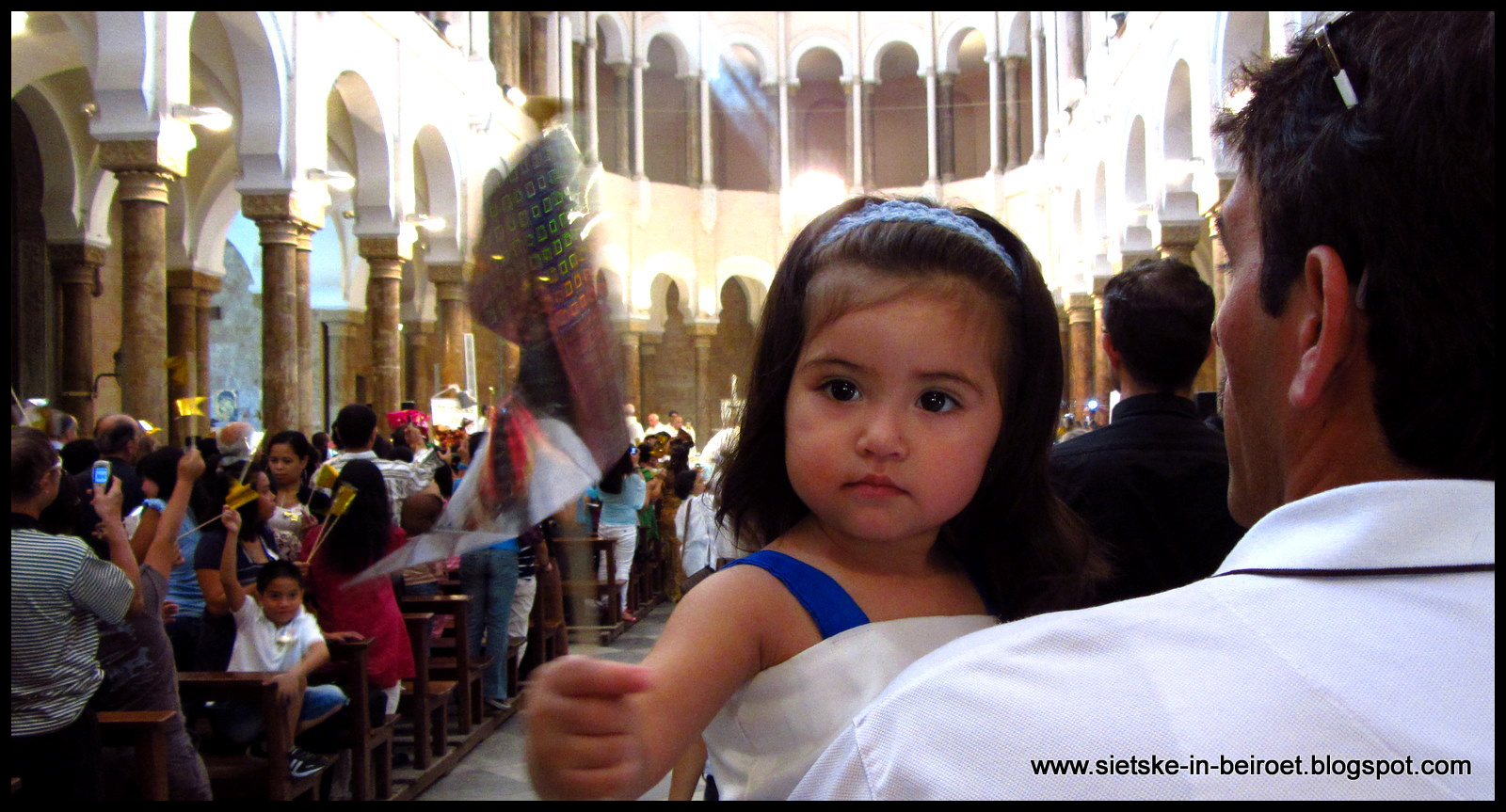
The man, although 82 years old, still serves a community of some 200,000 migrant workers. And so the migrant community came out in force – at the Saint Joseph Church in Beirut – to celebrate this priest. I tell you, these ladies (they are mainly ladies) know how to sing and smile. The African ladies came with fantastic head dresses, the nuns of Mother Theresa were there and the Filipinos (those that are allowed out of the house on Sunday) all came in white. What a lovely sight, quite a difference from the austere masses I am familiar with. And so, I spent (part of) this Sunday in church to celebrate this remarkable man.


Here’s a nice interview with him in Dutch

The ladies of the incense


October 12, 2011

Not Much . . .

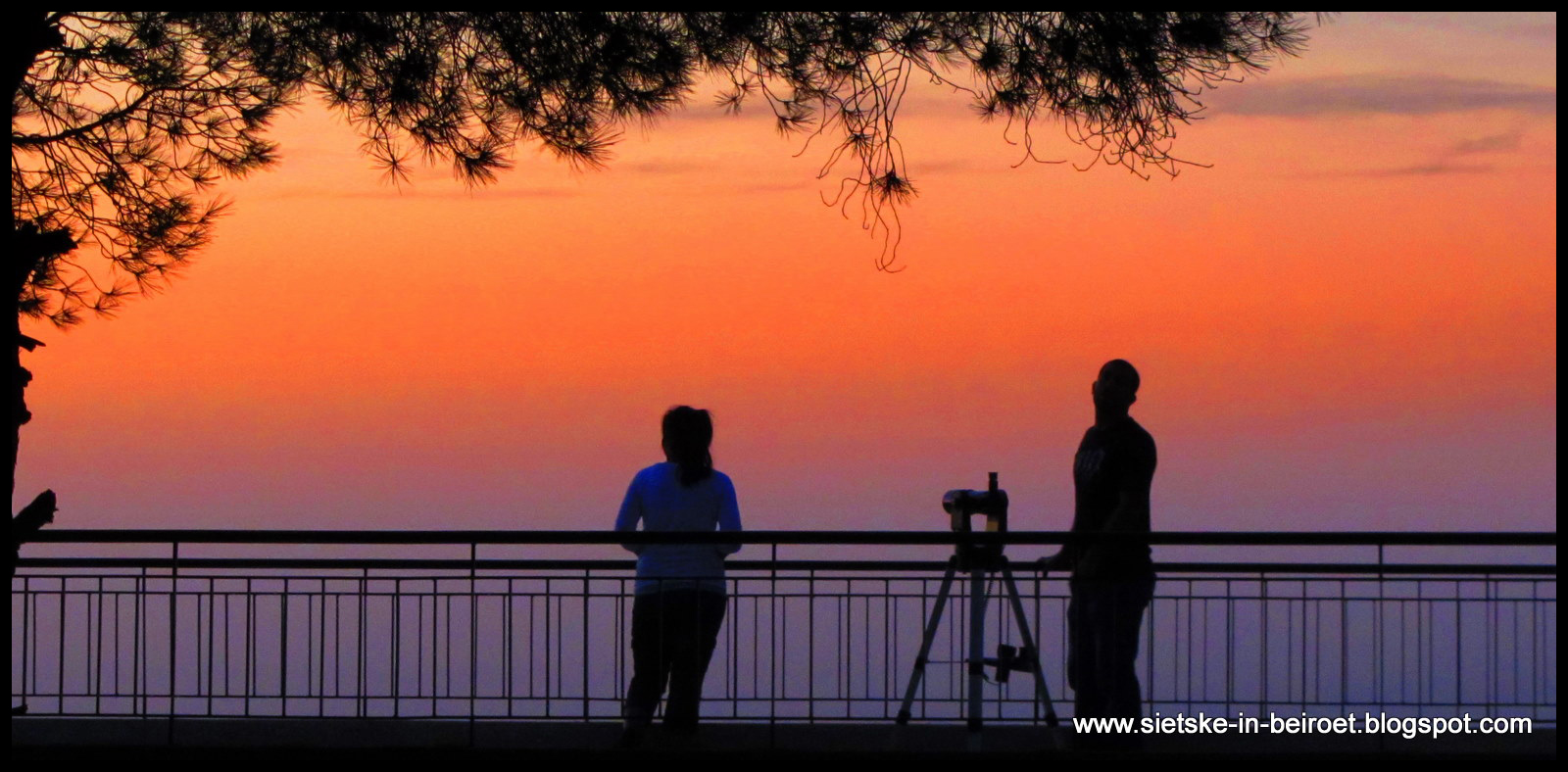
to say . . but it was so beautiful, that I want to show you. I took these photos yesterday evening while I was in Deir el-Qammar (up in the mountains)  for work. The sun set was soft and quiet and simple and slow and amazing. A friend set up a telescope so we could watch the moon.


The pace in Beirut is fast and furious. But life should be like this every day; Simple and slow, like it is in the mountains.
Gosh, how contemplative. And no, I have not been drinking. :)


October 08, 2011

I See I See What You Don’t See

I had to take care of some paperwork on Saturday at the Amn el-Aam, the Office of Internal Security.

They have done some re-organization, and these days it works like a long assembly-line. You go in and a man writes you a paper on what business you are allowed to enter the building. You drop this paper off at another desk, who keeps track of who comes in, and he will call out your name when it is your turn to go to man #3, who will fill in the paperwork, and who directs you to man #4, who writes you a receipt for paperwork done, which needs to be signed by man #5, and then you go on to man #6, who takes your paperwork and out the door you are. Takes about 30 minutes, which is not half bad.
These pictures were not recently taken, but have appeared on my blog before. This is my mom's bodyguard squad (mom on right)

Now during the week, all these men wear uniforms. Most of them are in full-fledges camouflage battle fatigues, ready for Desert Storm or the likes. No matter that this ‘Chairborne’ Army will most likely never engage in any combat other than dealing with irate civilians such as me.

And there is something about men in uniform. No matter how unlikely the appeal of a man may be, any man; stick him in a uniform, and he looks handsome.
A journalist friend of mine, a man, once remarked on this habit of mine of ogling soldiers in public. “You (I think he meant it as in ‘all foreign women’, or at least I hope so) are just so shallow. Stick a guy in a uniform and you’re gone.”

These pictures were not recently taken, but have appeared on my blog before. Soldiers near Nahr el-Bared

But I grew up in a country where you hardly ever see a soldier in public. The only men in uniform are what you see on the big screen, where they invariable play the handsome hero. And so for me, ‘uniform’ equals ‘handsome hero’. Stick a Lebanese head above it, with slick hair, dark eyes, long lashes, a lovely smile and olive colored skin, and voila, the package is complete.
A Dutch friend of mine here, also a man, but on ‘my’ side of the game, loved ogling soldiers with me. We’d be driving the car and suddenly it would be “Oh my, did you see that one! Wow, that was a good one!”


My Lebanese friends laugh over this issue. So used to uniforms, they can see right through the long lashes.
My inability to distinguish between a high-ranking officer and a regular grunt never seizes to amaze them. “Why did you talk to that dumb soldier for,” they’ll ask me, “Go talk to the colonel standing next to him.” Colonel? What colonel?

They can pick out background, financial status, level of education and religion in a matter of seconds; all the soldier needs to do is open his mouth. “Oh god no, this guy’s from the sticks, how can you even consider him handsome, he’s a peasant,” my friend will tell me as I pass by a check point and remark what a particularly handsome soldier was standing guard.

I don’t see what they see, and they clearly do not see what I see.

These pictures were not recently taken, but have appeared on my blog before. More Nahr el-Bared (sorry, there just wasn't much else to photgraph)


Except on Saturday at the Amn el-Aam.

On Saturday, it apparently is ‘Come Casual’ Day for the employees at the Amn el-Aam. And all this military personal can come ‘as they are’. And boy, I’ve never seen so many oddly-dressed Lebanese men together in one place. It’s Fashion Alert all over the place. Bizarre silk pants, oddly colored shirts in a tissue that looks plastic, strange cuts, crumpled and ill-fitting suits, jackets with strass stone spiders stitched on the back, belts with studs, pink T-shirts 3 sizes too tight, sweaters obviously geared for women (?), it’s a strange lot.

Men in Lebanon in general dress well. Whether it’s business attire or casual, they do a heck of a better job than Dutch men (in general). Given that they do not have access to the same funds, that’s pretty awesome. I’d say they look good.

These pictures were not recently taken, but have appeared on my blog before. Some sodiers at the Beirut Marathon


But the ones at the Amn el-Aam, well, that’s a sight to see. There must be a reason why they decided to sign up for the job, and I’d say the main reason is their lack of . . . , I’m not quite sure what lack it is. And suddenly I see what my friends see; a man out of his uniform.

So for any foreigner who has difficulty looking through the uniform, go to the Amn el-Aam on a Saturday. That should cure it.

October 01, 2011

Rafting on the Nahr el-Assi

Rafting Hooligans

I had promised my daughter and cousin O that we’d go rafting this Saturday. They talked about it the entire week. She even brought in a friend. And then, on Friday night at 10 PM, just as I had managed to get them in bed, the rafting guy calls. “It’s going to rain tomorrow so we’re going to cancel.”

Labweh, in the middle of the semi-arid plain, the source of the Assi River

Do you have kids? Then you can imagine the scenario that was going to play in my house. There is no way on Earth we’re going to cancel this event, I told the man. I don’t care if we have to raft in a storm; wet we’re going to get anyway.

Another party of rafters passing by

Okay, he said. And so we went to the Orontes River, (Nahr el-Assi in Arabic, and I don’t know anyone who ever used the English name), way up North in a very far corner of the Bekaa Valley, some 10 minutes from the Syrian border (for a change). The Nahr el–Assi is the only river in Lebanon – I know from my son’s Arabic history lesson – that runs in northern direction. Hence the name, ‘Assi’ (rebel). It goes all the way through Syria and ends somewhere in the Mediterranean Sea in Turkey.


There’s quite a number of rafting companies on the river, because it’s the only one that has some rapids, and flows all year long. It’s not Grand Canyon stuff, but still fun.

The river is not known for its great beauty, unless you like desert landscapes. The entire upper part of the Bekaa Valley is basically desert-like, with little agriculture going on that part of the plain. People live off a small trout industry, but there’s a lot of poverty. The river runs through a very an arrow valley, and beyond that valley it is just rocky and dry. The river is apparently also seen as the main method of getting your garbage out of your house; it’s quite littered with all kinds of junk.


The one and only challenging waterfall. I guess it’s about 6 meters high.

The Assi starts in Labweh, some 60 kilometers north of Baalbeck, and the water comes flowing straight from under the sedimentary rock. It gets its water from the rain that falls in the Northern Bekaa Valley and the western slopes of Mount Lebanon. It’s funny how all this water runs underground, right through the dry landscape, and at one point just comes pumping out of the ground. There’s evidence of Neolithic settlements at the source, and I can see why they settled her, because the source looks a little bit like an oasis to me.

Some pictures were like this . . .
..... but most were like this. One drop of water on the lens and they're perpetually out of focus


The climate is totally different here from Beirut and the coastal climate. Beirut has a sea climate; here it is a continental climate with much less rain, hotter summers and colder winters. This part of the Bekaa Valley is impressive because it is vast, empty and barren. There are no trees, very few houses or villages, the Assi that snakes through in a narrow valley, and an occasional archeological object.

The building is made of local sandstone, built upon a base of basalt, so this region has known volcanic activity as well. The building dates from 200 BC, the graffiti from 2,000 AC


There’s an odd looking monument – a sandstone block with a pyramid on top - not far from the river; it is called the Pyramid of El  and its origins are not quite clear. It was built by a people who did not use writing, some 200 years BC, but the exact purpose is not known. Visitors have made a concerted effort to bring the monument into the 21st century by spraying it profusely with graffiti.

Chilling on the Assi River

Another old construction that ran parallel to the main road for a while is the (I found this out when I got home though, so I didn’t’ know what I was looking at at the time, otherwise I would have made pictures) is the Canalization of Queen Zenobia. Zenobia was queen of Palmyra, and had a canal built in 200 BC, to get water from the Assi to her oasis in the Syrian desert some 180 kilometers away in a straight line. I do not know whether the water ever made it to Palmyra, but after 2,200 years there’s still a lot of the construction left.


This area was – some 2,000 years ago – obviously more important that it is today. The Egyptians  fought a battle here, the Assyrians  went to war, the Arabs and the Byzantine Empire came head to head  and of course the Crusaders hung around here as well.

At the source of the Assi River. It may be hard to see but the water comes here - literally -pushing out from under the rock on the right.

Today it is considered a bit of a backwater, and one of the most deprived regions in the country, and I wouldn’t have gone there if it weren’t for the rafting. Which is a pity, because it’s a beautiful region.

Enough Northern Bekaa promotion, I’m going to bed. This rafting is exhausting.

Don't you wish you could squeeze your way through a fence like this again, instead of walking around it?