September 26, 2011

Swimming in the Nahr Ibrahim

A well-kept secret (for me, at least). The color is almost fake, but in the deep part, this is the actual color.

Fall is in the air. This place has four very distinct seasons, and fall has started right on time; the rains have come, and the temperature (in the mountains at least) has dropped a good 6 degrees overnight. It is one of the best times to go out into the country (well, spring’s pretty good too). And it surprises me that – after so many years in this country – there are still places that manage to surprise me. But somehow there are still areas that do just that. This Sunday I went to such a place, quite by accident.

Swimming in the misty Nahr Ibrahim

I had wanted to take my BIL, SIL and kids for a picnic to a little waterfall I had visited last spring. Of course with my GPS, you never ever find anything back, except your way home, and so we got lost. And while we were driving along the Ibrahim River, about to go through a little tunnel, the road was suddenly blocked off by this gate.

The gate that blocks the road

It’s quite odd; there is nowhere an indication that this is a dead-end road, and the road actually continues, you can see it. But there’s this iron gate, right in the tunnel, with a padlock, and that’s the end of the public road. Apparently the electricity company uses this part of the river to generate electricity, and it’s not open to the public. It’s a puny little power plant, and I cannot find anywhere how much electricity they generate.

Plenty of long and dark tunnels to hike through
But with a little ingenuity you can walk around the tunnel. So we left the car behind, and climbed past the tunnel, back onto the main road on the other side of the grill. And then there’s . . . another tunnel. This one is pitch dark, and quite long, and then when you walk through it, there’s . . . another even longer and darker tunnel. Once you get through that one, you arrive to a place in the river that has been dammed off and is a little lake. This part of the river runs through a narrow gorge, and there’s high mountains all around you.

Olympic diver ?


The color of the water was so fantastically turquoise that it almost looked fake. The place was totally deserted safe for one lone fisherman. We sat down for a picnic, and when it started to rain, the trees overhead kept the rain away. We swam in the mist. The water was nice and crystal clear, and fall leaves were floating on the surface. What a surreal and beautiful place, just forty kilometers away from Beirut.

Muddy kids

Later on two hikers came crashing down the mountain, swam across the river and moved on.
I assume the electricity company opens the gates a little wider every now and then, and although we were not swimming right near the dam, I guess an extra power surge would have sucked our entire family into the turbines, or whatever you call that pipe in the dam through which the water runs. But if you don’t risk anything, you do not experience anything either.


Nahr Ibrahim

Now I had actually seen pictures of this particular place, but never knew where it was and how to get there, and sort of figured it was something that had existed during the war, or before the war, but was no longer there. And now we sort of stumbled upon it.
The road continues after the lake, but apparently it’s closed off from the other side as well, according to the fishermen. So here’s a stretch of previously public road, along one of the most beautiful swimming spots ever, and it’s blocked off.

But it is probably the only reason why it is still – relatively – clean. Obviously we were not the first people to picnic here, but from the look of some of the trash, we may have well been the first one to haul are own garbage back home again. I don’t get that; going to a place that you obviously choose for its beauty, and when you leave, you have no qualms whatsoever about leaving all your trash behind. I  say; ‘keep that gate in place’.
Little frog on a rock. It’s hard to see, but his little hands and feet are almost transparent.

And I’m not going to tell you where it is either.

September 24, 2011

The First Rain

I know this is a bit of a non-event for most people, especially those living in Northern Europe, but the first rains came yesterday.


It basically doesn’t rain here between April and October, that’s some 7 months a year. Now that is not to say I haven’t seen rain these past 7 months; I spent the summer in Europe,  one of the wettest summers on record.  'July was the main culprit, bringing an amount of precipitation rivaled only by July 1966.'

But rain in Beirut is different. The first rains are violent, causing major traffic jams and floods, and nobody is prepared for them, including me. As such, all the cushions and pillows and foam seating of the outdoor furniture are now soaking wet, I lost half of the laundry on my laundry line - since the rain comes with quite a few wind gusts –and our two canaries sit there in their cages, looking slightly disheveled, and will probably die of pneumonia.

But the temperature has dropped a few degrees, the air has cleared up, I can see the mountains again at dusk, and the horizon is now a clear sharp blue line. And we’ve got beautiful cloudy skies.


And so here's a picture of Beirut after the first rain.

September 21, 2011

'Strangeness’

Having lived in Beirut for such a long time, the place loses some of its ‘strangeness’. That’s a pity, because it’s the ‘strangeness’ of things that gives you this holiday feeling. And I am not talking about lounging away on the beach; you can do that in Holland too (provided the weather & traffic cooperates). It’s the odd things, the non-Dutch, and usually very small things.
Once the routine of daily life sets in, you slowly loose that feeling. But every now and then, it suddenly pops up. It is unpredictable – a bit like a Proustian memory – but the sudden holiday rush is quite pleasant.
 

It could be the shade of the iron wrought balconies on a yellow wall in the sunlight of the afternoon while you sit in traffic, (No iron-wrought balustrades in Holland), or the cricket on my balcony; anything that breaks the routine and is unusual to me in Beirut, or Lebanon.

Today, while picking up my daughter from school, some men were trimming the palm trees by the side of the road. The ground was covered with palm branches and dates.
In Holland, you only buy dates with Christmas, and they’re always dried; you cannot buy the fresh version. Heck, I never even knew what kind of trees dates grew on before I came to Lebanon. Now I know there’s ‘balach’ , the fruit that grows on the date trees, and ‘tamar’ which is the dried dark version.

My daughter dragged a branch with ‘balach’ with her, sweeping everyone off the pavement as she made her way home.

My daughter noticed that if you keep the branch against your ear as you walk, it sounds just like when heavy rain falls on a tin roof. (you gotta try this, I tried it and she’s totally right!)

And suddenly this holiday feeling popped up. So unreal! So un-Dutch, a little school girl walking through town with a palm tree branch with fresh dates on it. It was good.

September 20, 2011

First Tears of the Year

School has been in progress for 2 weeks now, and the first Arabic homework has come home. The result: total meltdown in our household. A girl in tears over her inability to decipher 12 lines of probably the most boring dialogue ever between Jad and Dounia.

What is it with the classical Arabic program in this country that makes it so difficult and unappealing to learn? Her Arabic teachers say she needs a tutor, since her parents won’t help her with her Arabic homework. I’ll be darned if I get a tutor for an 8-year old. I though the teaching of Arabic was the teacher’s job. It seems it is taken for granted that at home the parents teach as well. And if they do not, then the child is shipped off into the ‘Arabic for foreigners’ program, a road my 17 year old has gone, but which prohibits him to become a lawyer, an officer or take up any government position. Well, nothing lost there, you may think, but taken that the job of ‘President of Lebanon‘ is also out of his reach because he’s got the wrong religion, we’re developing here something akin to a caste system. Only if you have the right religion and only if your parents taught you Arabic at home.
Hmmmm, me thinks I should go out in the country this weekend, for a more positively inspired post. My hike to Jebel el-Sheikh was canceled because someone got blown up by a landmine there. Not fatally, but you know, if you go for a nature hike, you want the landscape to blow your mind, not the mines.

Anyone any ideas?

September 19, 2011

On Bears and Beirut Electricity

A friend of mine moved to Canada last week.

She’d had it – among other things – with the instability and constant threat of violence. She’s lived through 15 years of civil war, several Israeli invasions, and numerous bombardments, uncountable hostilities between factions for one reason or another. She needed civilization.

On her very first week in Canada, a bear wanders into her back yard. A real bear! She had just brought in her dogs, and there she sees – in her backyard – a bear!

I was going to make all these snide remarks (I think I still may) of how her escape to ‘civilization’ will force her to - finally - buy a shotgun for her safety, her very first a shotgun ever.
And that, after surviving Beirut for so many years, you end up getting mangled by a bear, the irony of it all.
But then, while scrolling down the free section of the ITunes App store, I stumble upon this app: ‘Beirut Electricity’.   
Tired of forgetting electricity cutting hours in Beirut, Lebanon?’ . . . Only those living in Beirut will appreciate ‘Beirut Electricity’ because they daily suffer forgetting when the electricity is off.
Sigh. He’s right (the guy  that constructed this app). Here we are, some 20 years AFTER the civil war, some 7 years AFTER our last major bombardment, some 3 years AFTER the latest grand scale street fighting, and we still do not have 24/7 electricity.

Maybe I should opt for a bear in the yard. It’s worth the trade-off.

BTW H, I want a picture of that bear!
 

September 17, 2011

Lack of Respect

I’m driving in the evening in Sour (Tyre) with a friend, and we end up somewhere in the old port. The streets are quite narrow, there’s no government electricity so I have to drive without street light, and on top of that, there’s some serious construction work going on in the port. There’s heavy machinery, big blocks of concrete everywhere, and no discernable road to speak of.

So here I drive, and there’s this car behind me.

Beep beep’, it goes. I cannot go any faster because I do not know the road and cannot see it either.
Beep beep,’ it goes again. Really, there’s no space anywhere to let him pass either.
Beep beep beep,’ I hear now. I am getting annoyed. Where does he think I should be going? I cannot go aside, I cannot go faster.
Beep beep beep,’ it continues. WTF!? I am very annoyed now. This guy is going to get shot. The beeping continues.

Some pictures of houses that have nothing to do with this post. This one is somewhere in the upper Basta area, somewhere on the Independence Avenue


I get to a fork in the road. To the right is with traffic, to the left is against. I decided to go to the left, in order to let this @#$*&%$ take the right side and pass me, since he is obviously in such an incredible hurry.

But he follows me, and now the beeping is more urgent. He's obviously trying to tell me that I am on the wrong road. Well, yes, I know that, but that's because he's on my tail all the time; I wouldn't be on this road if it weren't for his incessant beeping and honking! 
That’s it! I stop my car, roll up my sleeves (figuratively speaking), get out of the car and smack my door really hard. What infinite idiot is honking all the time?

The infinite idiot turns out to be a . . . Lebanese patrol car, with 2 policemen inside.


Now I know what his issue is going to be; He’s going to tell me I am driving against traffic.
Ya madam, hon akse-ser’ (Lady, you’re driving against the traffic)
But my issue is; what was all this stupid honking about before, while I was driving in the correct lane? This annoying ‘beep beep, beep beep’?

And with my hands on my hip, I walk to the window of the by-rider, and say: “Shoe ya’ani? Shoe fie? Maoule? Koul al watt btamel ‘beep beep, beep beep’! Mishmaoul!!!!!”
(What do you want? What is this? Are you serious? The whole time this honking, beep beep, beep beep? You are incredible!)


Some pictures of houses that have nothing to do with this post. This one is near the Hard Rock cahe in Ain em-Mreisseh.

They look at me in surprise. Then the by-rider says: “Ya ma twekhezne, madam” (I am sorry, Miss), and I stomp back to my car.


Hahahaha. In Holland, they’d be escorting me to the station, and they’d present me with a big fat fine for insulting the law.
I love the Lebanese police! I show total lack of respect, and they apologize!! I never did find out why they were beeping so annoyingly though. I did drive on the right road (at the beginning).
I have another good police story like this one – with a slightly less intimidated police man - but that’s for another day. Maybe tomorrow.
Some pictures of houses that have nothing to do with this post. This one is on the Sodeco crossing

September 12, 2011

The Plumber

Now that we’re talking design flaws anyway (the 100,000 bank note), here’s another issue I have. It’s with the plumbers in town.

When I just moved here, it happened quite frequently that the sink would get clogged (Well, it still does). You fix that problem with a plunger for a while, you unscrew and clean that silver colored swan-neck thing under the sink a couple of times, then you resort to harsher measure by buying some really vicious liquid from the supermarket that will bite its way through any obstacle (including your pipes, of course), and finally you call in the plumber.
Just some pictures I took over the weekend (and not related to this post): A bride in a convertible, somewhere in the mountains near Saida (Sidon)

 Plumber comes in and looks at it. “No problem,” he says, and he leaves again, because he needs to get the material to fix the problem. If you’re lucky, he comes back the same day.

And then, invariable, they replace this smooth metal swan-neck with a flimsy plastic harmonica-like contraption. The first time I saw it, I thought it quite odd. If there’s anything that will help clog your drain any faster, it’s a plastic, bendable, harmonica tube; there’s innumerable little barriers behind with dirt and grease can stick. But hey, he’s the plumber, and I’m the housewife here.

I did question the design, but the answer was, “they do not make those metal swan-necks anymore.” I thought that quite odd. Why would they trade a perfectly workable design for something inferior? All I could think of was that maybe it was a cost issue. Plastic is cheaper than metal.

Just some pictures I took over the weekend (and not related to this post): Some road my GPS suggested I should take near Saida (Sidon)

But then when I’d go to Holland, I’d see this shiny metal swan-neck under everyone’s sink, not the flimsy plastic harmonica hose. And Dutch are cheap. If they can get something cheaper for the same purpose, they will.

Now I have l become wiser since. They DO sell the real deal in Lebanon. But the plumber would need to measure, and saw, and it takes a lot more work because here they do not work with standard measurements, and in every house the sink is at a different height and distance from the drain pipe. Thus, it takes some puzzling and thinking. That is obviously something that is not required of plumbers.

And since the plumber is not going to explain this to me, a “they do not make those anymore” would be an answer that apparently many people accept.

Now this morning, I called in the plumber because I want an extra water tab on my balcony. This would require from the plumber that he somehow gets that water from the main line, and directs that to this particular balcony. “No problem, sidna, I’ll do this and this and this,” and he waves a little with his hands.

Just some pictures I took over the weekend (and not related to this post): The old Port in Sour.

But I have become wiser, so, no, please explain ‘this’ and ‘this’ and ‘this’.
How on earth do you get it from there to here? I ask, as I point at the main line.

“With a pipe.”
“What kind of a pipe?”
“A white pipe.”
“White?”
“Yes.”
“Never heard of white metal.”
“No, it’s plastic.”
“Plastic?”
“Yes, everyone uses it these days. They don’t make the metal pipes anymore.”
“No, no plastic.”
“But it has metal inside it!”
“Is it bendable?”
“Yes!”
“You’re trying to use a plastic hose?”
“Yes. No. Uh, everyone uses it.”

Hahaha, sorry dude, but ehhh, no, I don’t think so. I don’t care what everyone uses, I want a decent looking pipe on this balcony, not some bendable shit that is constructed in this Arabacho style.

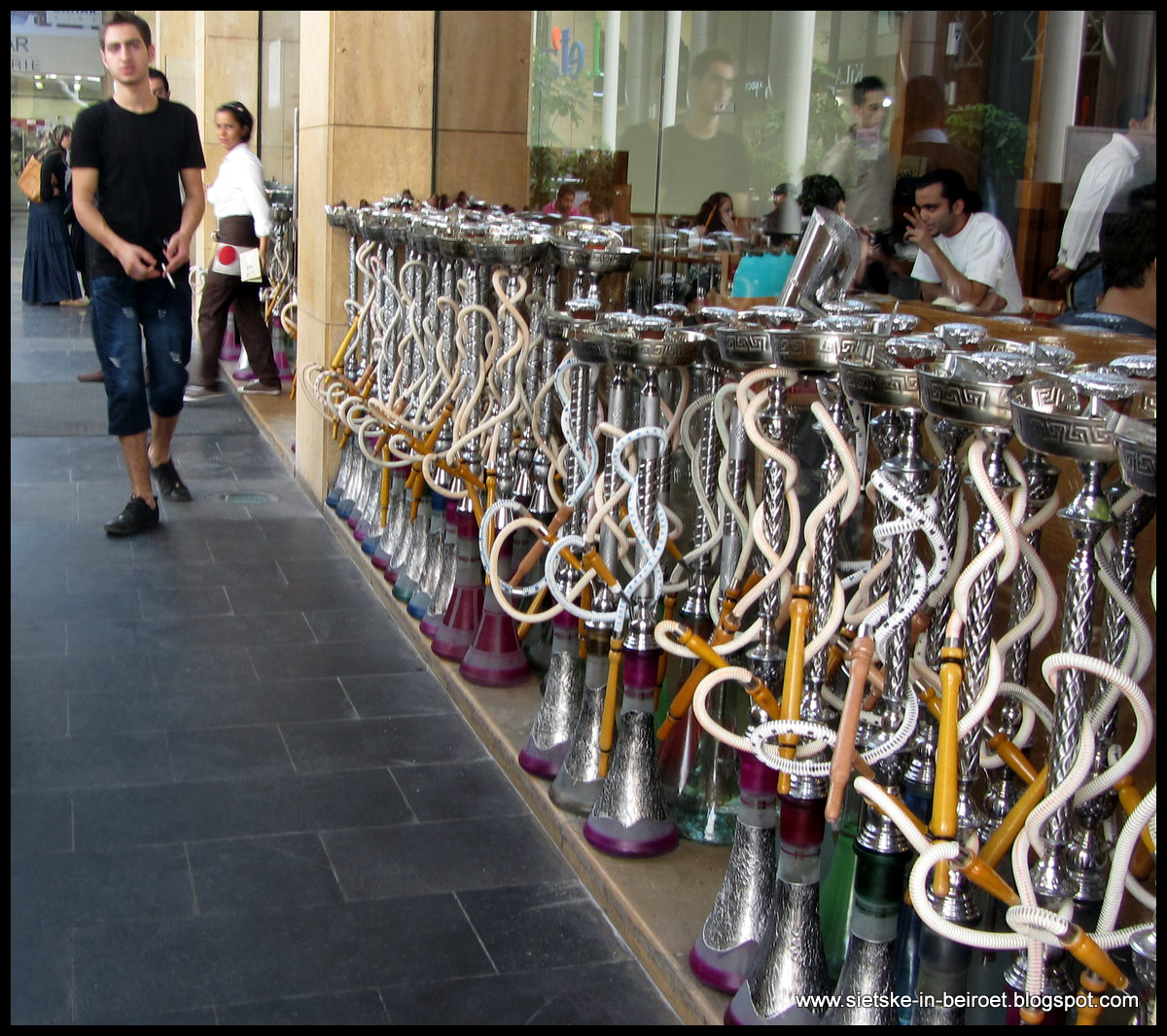
Just some pictures I took over the weekend (and not related to this post): A bunch of water pipes waiting for customers in the Saida Mall in (Yes, you guessed that right) Saida.

I want metal, I want it straight. I want it done properly. You can install that plastic plumbing stuff in your own house. Not in mine.

Boy, did his face drop! He thought he was going to get rid of me with some plastic hose contraption, and the woman wants a serious metal pipe! That involves a good full day of work, with welding (which he may not know) and measuring, and sawing. You should see his face!!! Priceless.

But in the end I got what I wanted. A straight, metal pipe.

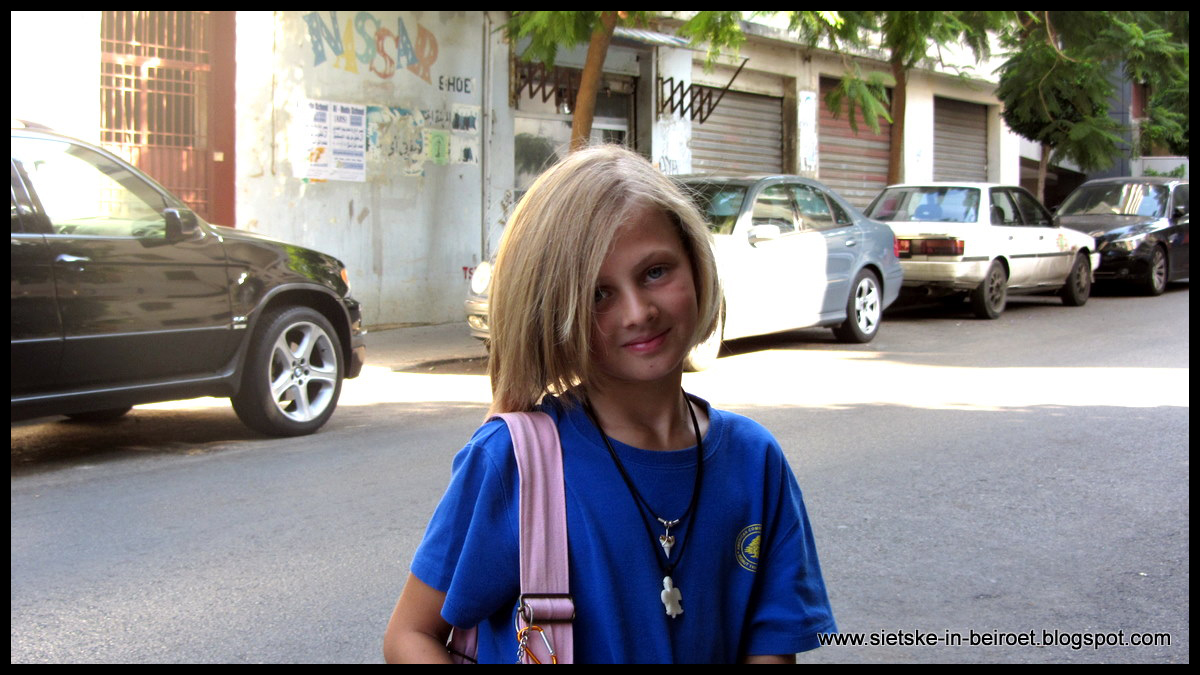
Just some pictures I took over the weekend (and not related to this post): A girl with an attitude on the streets of Beirut. (H, she just cut her hair!!!! )


September 05, 2011

A Weekend at the Orange House


I spent a wonderful weekend way down south, under Sour (Tyre), some 15 kilometers from the Israeli border, in the company of a lovely lady, Mona Khalil, who dedicates her life to the preservation of sea turtles.

After the cliff there’s Naqoura, a small village, and then there’s the border fence with Israel.

The place – The Orange House  – is a Bed & Breakfast situated among date palms and banana plantations, on one of the nicest beaches in Lebanon. It is nice, because it is pristine and deserted. We were pretty much the only people on a 2 kilometer stretch of beautiful beach.

Mona leading the kids, at 6 in the morning, checking on the turtles.

These beaches are not as busy as the ones in Beirut because for one thing, the ladies in the south just cover up more, and you don’t see as many women on the beach. And there are just not that many people down south anyway, since the Israelis have made living down there quite difficult at times (although some people will argue that Hezbollah add to the hardship factor. Finding a bottle of wine turned out to be quite an expedition. Spinneys sells alcohol, but in a little room on the side).

She educates children before adults.

Mona Khalil, the owner of the Orange House, has turned her house into a very pleasant Bed & Breakfast, and invites her guests to actually observe sea turtles hatch (“but I can’t promise anything, you never know when they will hatch,” she says).

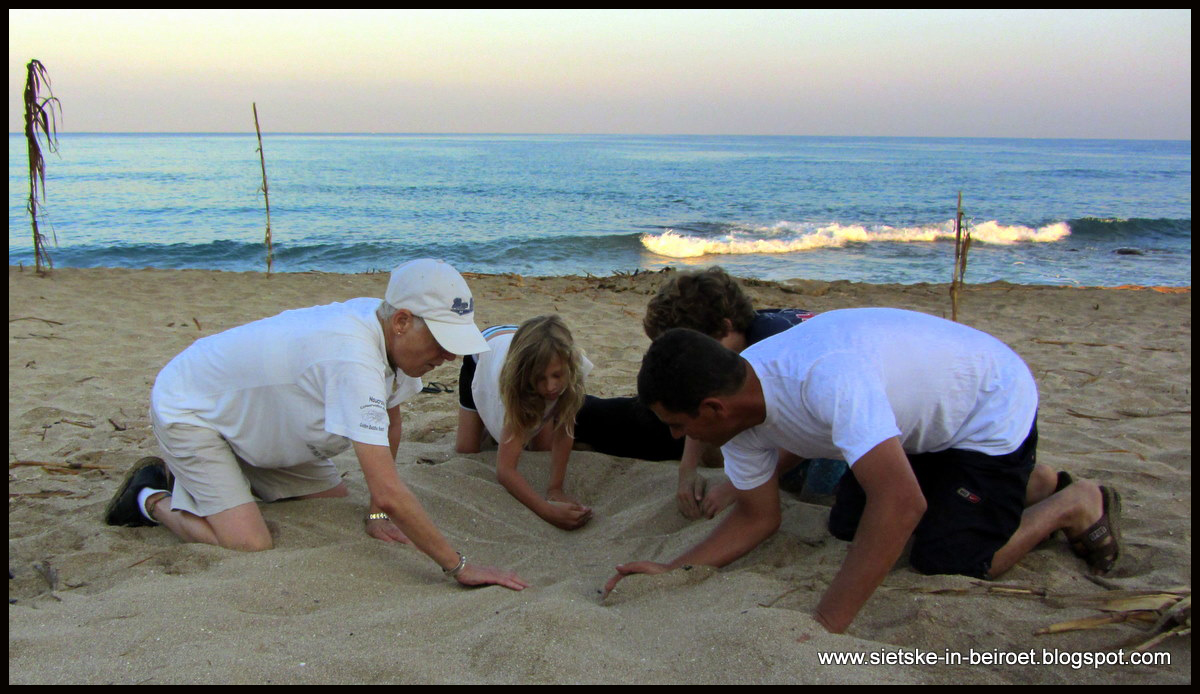
Mona uncovering the nest that has been hatching.

She happened to inherit a house on a beach that – she found out some 10 years ago – was the traditional nesting grounds for loggerhead turtles. And since then, she has been going to the beach every single morning, very early, to clear the garbage, because sea turtles love jellyfish, and plastic bags, and other garbage, are often mistaken for jellyfish. In addition to that – 6 months a year – she keeps track of the nests and the hatchlings. She marks where turtles have made nests, relocates them when they’re too close to the shoreline, covers them with wire mesh so that foxes and local dogs don’t dig up the eggs and eat them, and tracks when a nest needs to hatch. Once hatching, she tries her best to make as many turtles reach the water.
She doesn’t get paid for this, she isn’t supported by an organization, and she finances it all herself. And she does it with great passion.

The metal grid protects the turtle eggs from predators such as dogs and foxes.

Loggerhead turtles are the main turtles that come, and they make their nests on the beach where – it is said – they were once born themselves, but this year she saw some green turtles nesting as well.

Here goes number #1

Sea turtles take 20-30 years to mature and may live up to a 100 years. Tagging programs show that female turtles return to the same beach to nest. The mother turtle nests at night, up to 4 times a season, every 2 to 3 years. The 40 cm deep nest contains 100 soft-shelled eggs, like ping pong balls. Two months later (between 45 to 60 days) the hatchlings emerge at night.’ (Orange House Website)

The kids were eager to pick up the turtles and put them into the water.
No, they need to do it on their own,” said Mona “They need this time to orientate themselves, so that in 20 years time, they can find their way back to this same spot.”

And so, at 6 in the morning, we went, with 4 kids in tow, to search the beach for signs of nest makings and hatching. "I can’t promise anything,” Mona had said, but at the end of the beach the traces of little creatures waddling into the surf caught her eye. A nest that had been hatching before, and was now releasing it’s very last baby sea turtles. She helped them out of the nest, as they were the last ones, and covered by many layers of sand, which makes them often the weakest ones.
Totally fascinated.

And so we saw 6 little loggerhead turtles crawl their way over the sand into the sea, and off they were. If they are female (gender is determined by the temperature during incubation), in some 20 to 30 years – and if they make it, since they have many predators, men being the most important one – they will return to this very beach and lay their eggs in return.
Almost there. This was the nest of a young female, who do not lay as many eggs as the older ones.

It’s the kind of stuff you see on Discovery Channel, and to actually see it for yourself, in Lebanon, is quite an amazing experience. The children were initiated into the Turtle Club, and have promised that from now on they will do everything they can to preserve turtles. I am waiting for a Minister of Environment who has the balls to outlaw plastic bags at the supermarket.

Watching them go off.

And that, was my amazing weekend at the Orange House.  It’s quite humbling to see how one person can make such a difference.
If you’d like to contact Mona, you can mail her. Orange House has a Facebook page as well as a web site. It is in the former Security Zone, and if you are not Lebanese, you’d need to ask permission from the Lebanese Army. Organize a stay at her place well in advance; it's often fully-booked.

September 02, 2011

End of Summer

The summer is running to its end. People are coming back from their travels or coming down from the mountains, and stores are stocking up on ‘back to school’ supplies. My daughter goes back to school this Monday, one of the first in the country, but by the end of September everyone will be back in school or university.

The beaches are slowly emptying. The season wasn’t that busy anyways, now that Ramadan falls smack in the middle of the summer season. But this ‘late summer’ is one of the nicest times to go to the beach. It’s relatively empty and not so hot, and the children catch up with the friends they haven’t seen the entire summer holiday.

A group of mixed Dutch/Lebanese children, with some Lebanese/Tunesian mixed in as well.

I went to one of the older beaches in Beirut, Sporting Club. It’s probably one of the few beaches with a down-to-earth-atmosphere. Not everyone is a size 6, and not everyone’s cup size is an upsized double D. It’s filled with normal Beirutis.
It’s one of the very few that remain intact from the 60’s; all others have been upgraded to white plastic lounge platforms with loud music and complicated cocktails.

This website  calls it ‘A Seaside Getaway to Lebanon's Beacon of Faded Glamour’ and I agree. (Check out the slide show of photographer Rasha Kahil on that link. It's quite nice.)

I like faded glamour. That’s what the end of summer is all about; faded glamour.

September 01, 2011

In Which I tip $66.66

Here in Lebanon I dole out 1,000 banknotes on a daily - and some days on an hourly – basis.
2,000 LBP for the parking, 5,000 LBP for the valet parking, 1,000 LBP for the boy that packs your groceries, 3,000 LBP for the man that brings a gas tank to your house, 2,000 LBP for the Burger King delivery boy (yes, you can have Burger King delivered to your house here), and on and on you go.

It’s the economy of the thousands. A thousand, for the non-locals amongst you – equals 66 US cents, or €0.47. A 1,000 pound banknote is small, a bit like Monopoly money, and green. And I got my wallet full of them.

Now yesterday I noticed, while organizing my wallet, that one of the green bills was slightly larger. Just a tad bit. And a bit darker green. Just a tad bit. I’m thinking, ‘Wow, I’ve got a misprint.’ And misprints are worth money.

Upon further inspection however, I noticed that it had a whole lot more zeroes too! It turns out it is our new bank note of 100,000 Lebanese pounds.

I think you know where this is going, right? Need I explain much more?

Yesterday I handed out a 1,000 to the supermarket boy, who packs my groceries, 2,000 to the parking attendant at the Alfa company, 3,000 to a donation box for orphans at the crossing from downtown into Hamra (they caught me at the traffic lights) and 3,000 tip for a dinner outside.

This morning, I am going through my wallet. I cannot find the 100,000 bill anymore, and I am absolutely certain that I did not pay with a 100,000 note yesterday.

Which makes me come to the conclusion that one of the 1,000 pound (or 66 cents) bills I handed out, was actually a 100,000 ($66.66).

Now which infinite idiot designed that new 100,000 Lebanese pound bank note? Which ape, which notorious imbecile? How on earth could he (has to be a man, women would have figured out this dilemma) make it identical to the 1,000 pound note, both in color and size?

Choose another color, will ya!
This picture is not related to this post. It is a picture my dad took in Beirut somewhere in the fifties. Who knew that his daughter, who wasn’t even born yet, would eventually end up living here? Does anyone have any idea where this is?