October 31, 2010

Fall Colors Because . . .

. . . . because I’m a little too busy, and because next week promises to be a difficult week, and because I am still not sure whether it is actually 20:10 PM or 18:10 PM, and because my daughter had a melt-down because her silly bands got stuck in the silly putty and we can’t clean it off and because my son announced at 20:05 PM (or was it 18:05 PM) that he has an 11 page report on euthanasia for tomorrow, and because of many more reasons . . . .
 I leave you with a picture with beautiful fall colors. Taken today near de lagoon in Baaklin. Oh yes, my GPS broke down while I was there, so I had difficulty finding my way back to Beirut as well. Some weeks . . .

October 28, 2010

The Village Manakish Shop

Another still life on Lebanon; the village manakish shop. This particular one is run by a lovely old couple, somewhere in their 70’s if not older.  Isn't it romantic to grow old this way? Maybe not.

Every village has at least two, if not more. Each neighborhood has a couple of them. Everyone has a favorite. Personally, I’m a zaatar fan (although I was into cheese for years!), and I prefer the ‘saj’  (an inverted wok) over the ‘furen’ (oven). My favorite address? That would be the one at the bottom of the Wardeh ski slope up in Feraya, but that one only operates in wintertime.

The manakish is the early morning address for what in the States would be your donuts or your bagel. In Holland we don’t ‘do’ breakfast out the door. But in Beirut, I do.

October 26, 2010

Shoot Those Potholes

I got this web site  of this blogger , and had to share it. It's fantastic. Come one everyone, get your cameras and Iphones out, shoot those potholes and upload them!!

We need some civil movement in this place.

October 24, 2010

Biking in the Beqaa

This could be Holland. But it is not. T0 remedy nostalgia, one rents a bike,
and bikes all over Taanayel, in the Beqaa Valley.

When I lived in Holland, my secondary school was 7 kilometers away from home. We did not have parents that chauffeured their kids to school (not then, at least), nor did we have school busses; we had to bike the 7 kilometers, every morning, and every afternoon, come rain or shine. Friends of mine had an even longer stretch to ride to get to school. I remember sunny summer days on the bike, along the poplar lined roads, but I also remember rain and hail, and blizzards, and days it was so cold you couldn’t feel your fingers anymore, and you couldn’t articulate your speech the first 30 minutes in class because your lips were so cold.

I was reminded of those days last Sunday when I went biking with my SIL in Taanayel. Not of the cold though, just of the biking along the poplars. Several people had already mentioned to me that you can bike on the Jesuit farm, but I don’t get to the Beqaa Valley very often.

But near Taanayel, which is right in the middle of the road from Beirut to Damascus, is a Jesuit Monastery with farmland and a small lake. The land, some 200 hectares, was given to the Jesuit fathers in 1860 by Napoleon III. Originally it was marshland (nice guy, this Napoleon, handing out crummy land for free), but the monks, with their proverbial patience of a monk (That’s a saying in Dutch; ‘monikkengeduld’), transformed the area into agricultural land. They established a large farm, a school, a seminary and a church.

It is nice to walk there, because they way it is set up is very European, and thus feels like home (see my last post). The Jesuit monks planted poplars and willows to help dry the marsh land, and dug irrigation ditches to dry the fields. Everything is in neat rows, and with little tree-lined lanes in between the fields and the orchards and the vines.

These days they have some 75 milk cows, a herd of goats, pigs, they produce milk and cheese and they cultivate wine, nuts and honey as well. The farm also serves as a teaching facility for the Faculty of Agriculture at the Saint Joseph University in Beirut.
I know, it borders on animal abuse, but I'm afraid she insists he goes everywhere with her.

Actually, there is an interesting story about how these Jesuits ended up with the land. Apparently, in 1857 they discovered that the Bekaa Valley is an ideal place for growing grapes and producing wine. Business was good, but somewhere at the end of the 19th century, some French priests were killed. The Ottomans, the rulers at that time, did not want to have problems with France, so they compensated for the death of these priests and offered the Taanayel property. (source)
Popping wheelies with the Lebanon Mountain Range in the background

The farm is still in Jesuit hands, and as such, nothing has changed much in the lay-out of the land. No trees have been cut during the war, no ugly buildings went up, and it was not used as garbage a dump. These Jesuits are old school, and very much into the ecological side of agriculture. A Dutch priest, Father Brouwers, has been part of the agricultural team on the farm for as long as I have lived in Lebanon.

The farm has seen its fair share of sadness during the war. I remember visiting them one December, and was told that over Christmas someone had stolen the major bull. “It’s probably someone’s Christmas dinner now,” said Father Brouwers, “but I doubt it’s very tasty. The beast was old. Why would you want to steal an old bull? It’s clear the thieves do not know much about the meat business.” Another year they got stuck up with a small trainings camp of young Palestinians which the PLO had set up on the domain. There was nothing they could do about it. It wasn’t anything really serious, more like a Boy Scout venture, but the Israelis didn’t want any of it, and dropped an airplane bomb on the 4 some ram shackle tents which housed the boys. This saddened the priest greatly. “They were just young boys; it wasn’t worth an airplane bomb.” An even sadder event was when another Dutch Jesuit priest from Taanayel, Father Kluiters, was shot twice, hanged and impaled during the war, in 1985. He’d been in Lebanon since 1974. (source)

A. and cousin O. on the lanes of Taanayel

These days are more joyful however, and the farm is open to visitors. You can rent bikes on the farm (go through the gate, park your car near the church and walk to the milk farm (laiterie), where they rent them in the courtyard), and bike all around the farmland. If you are around the milk installation around 4, you can see them milk the cows.
More on Taanayel here.

PS. You can even sleep there: Deir Taanayel Jesuits, Tel 08 543 101 // 961 3 469 620 (Father Samir). The eco-lodge is located in the heart of the Bekaa valley, at a distance of 50 km from Beirut. Prices starting from 12 USD per person per night (Source)

October 23, 2010

Nor This, Nor That

You’re an expat?” I was asked the other day in the line-up of the supermarket. No, I’m not an expat. Expats come for a limited amount of time, and then leave again. They work here, but do not speak the language, see the country as a ‘host’ country only and in general do not integrate well.
But I am not an immigrant either. (or emigrant, if you look at it from a Dutch perspective). For immigrants it is usually a one-way ticket only. They will learn the language of their adopted homeland, their children will marry there and their grandchildren will probably not speak the language of their grandparents anymore.
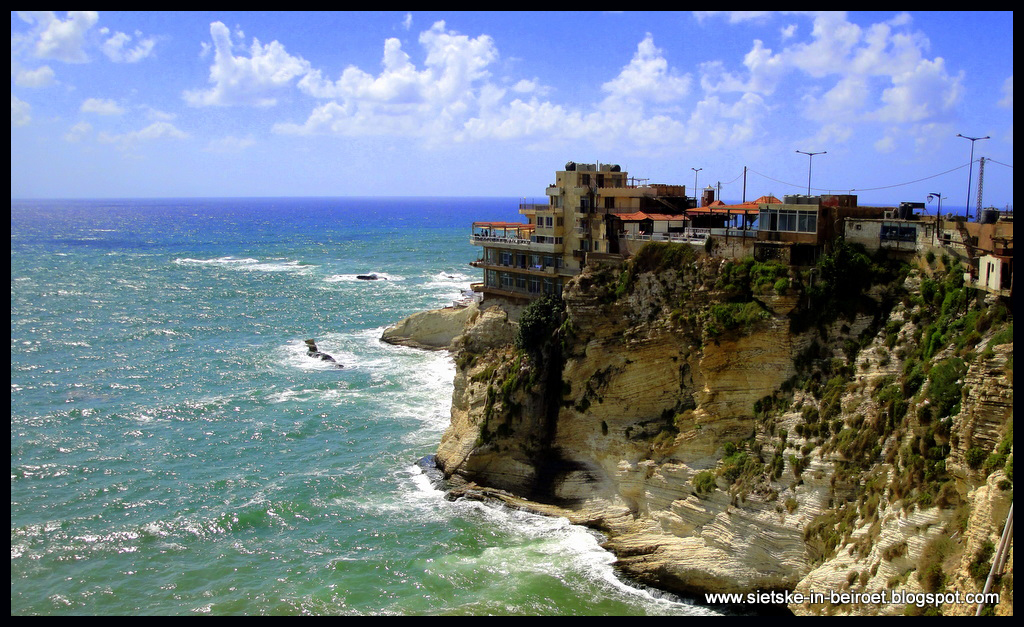
Still life: One of the few 'old' houses left near the Beirut Corniche

I’m nor this, nor that. I’m sort of a hanger-on. I came here to work and got swept off my feet by a gallant gentleman with long velvety eyelashes. You know the kind. So I hung on. I think that about 80% of the Dutch community here in Lebanon must be ‘hangers’. There’s an anthropological term for the likes of us; ‘ trail partners’. Most of us met our partner abroad, where he/she was working or studying at the time, and then moved back with him/her. In a few cases we met them here.

Scientists do all kinds of research on expats, and how they fit in. An awful lot of research is done too on adaptation and the success of emigration, but I wonder if anyone has ever researched the trail partners. I wonder how we – in general and on the long run – deal with life abroad. I know of several Dutch ladies who have lived here for more than 40 years now. Once they get older however, they tend to disappear from the ’Dutch circuit’. They do not show up for Queen’s Day and Sinterklaas anymore. It’s harder to get around on your own, and I guess friends/family are not always ready to chauffeur them around.
Still life; Behind the Mahfar Hobeish (a police staion on Bliss)

We once had a Dutch ambassador here who characterized the Dutch community as “69 unhappily married women and 1 working man.” We thought that was quite funny, although I did not agree with him. I’d say the divorce rate among our community is probably lower than in Holland, yet we have quite a few more problems to face. Granted, unlike our Dutch counterparts, we don’t have to do the cleaning, scrubbing, washing, cooking, baby-sitting and ironing ourselves. And the weather isn’t a cause for depression either.
But there are those days where you really feel like a ‘patatje met’, or a bag of ‘dubbelzout’ or a visit to the Hema  or ‘t Kruidvat. Luckily I know how to make wentelteefjes now .

Where am I getting at? Nothing really. But I just stumbled upon this research on Dutch people and homesickness.  If you want it in English, pull it through Google Translate.
Still life: coming down from the mountains after a weekend, dexcending to the sea and Beirut.

They call it nostalgia rather than homesickness and I think the term is accurate. But it shows that what Dutch expatriates and emigrants miss, is exactly what I miss; family, friends and food (yes, in that order).  And bad weather. Just now and then, of course.
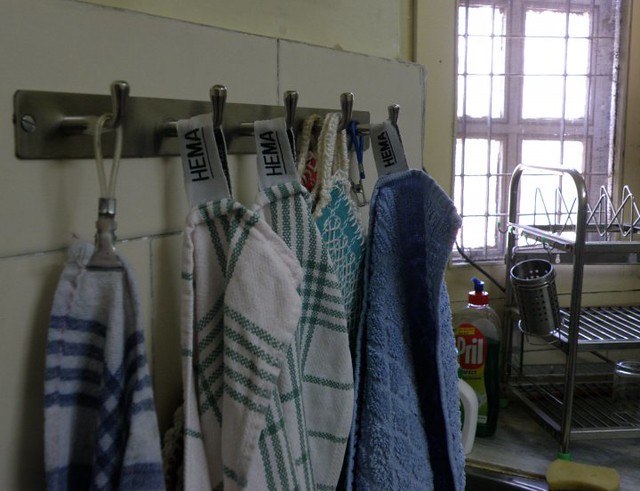
What do we (Dutch) do to deal with this nostalgia? Well, according to this research, we keep certain items in the household that apparently are typical Dutch, and that make us feel better. Which ones? Well, there’s the kaasschaaf  (don’t ask, I don’t even think it exists here) and a separate towel  for drying hands and dishes in the kitchen (I assumed everyone has that, but it seems to be typical Dutch), cloth for drying. I’m guilty on both counts. And we wear orange during soccer matches. Yep, guilty too. 
Still life; Rauche, with the old Dbaibo restaurant (no longer operating)

And with the internet, you can now virtually shop at the Hema  or ‘t Kruidvat . I remember the early days when I was in Lebanon, and the only thing that worked was the telex. And the fax, sometimes. For an international phone call I had to go to the Ministry of Information. Now I can surf my own hometown’s newspaper, call my brother on Skype and see his ugly face (sorry Y), or zoom into my house with Google Earth.

And while reading, I was thinking about this: most of my readers are from the US (or so says Google analytics). My guess is that it’s this huge continent of ‘nor this nor that’ Lebanese whom, in order to ‘remediate’ their nostalgia, surf their hometown, in hope of pictures they recognize, scenes that make them feel like ‘home’, people they remember, or just to get a sniff of the atmosphere.  
Still life; Street signs. The rain pipe obviously came later.

And hey, I feel with you. What I wouldn’t do for a walk from my old house to the supermarket in my village , past the trees (that should be losing their leaves right now), my old elementary school  (specifically the 6th grade class with Mr. Oosthoek), and the bicycle shop, Coffeng, which has been there longer than I have been alive. Nothing is as it used to be, of course, but in summer, I reminisce with old friends  from those days about the old town, and how it used to be.
So is that you, the ‘nor this nor that’, reading this?

October 19, 2010

A 10K hike

I went on this hike last Sunday. A lovely hike. Fit for ‘moderate walkers,’ it said. Only 10 kilometers along the Tannourine mountains range, from Laklouk to the Balaa sinkhole. I’m a moderate walker. After 8 kilometers, all sorts of hip joints fall out of place, but I can manage 10 K, I just get a little less ‘agile’, so to speak. I decided to take my daughter’s dog along. The poor mutt doesn’t get to see much nature, apart from the 20 minutes in the mornings and evenings along the neighborhood sidewalk. My daughter however, upon hearing the 10K, quickly opted out of that adventure. “10K? No way!”

And so off I went, with dog in tow. I have to say; the panoramas were breathtaking. There were vistas all over the place. And over rugged mountain ridges and rocky outcrops we went, through thorny thistles, fields of grass, herds of goats, passed authentic Bedouin settlements, water reservoirs, old stone houses and through apple orchards (harvest time is right now!!). The walking was no mean feat. There was no path, and we had to do a lot of downhill scrambling and sliding.
And did we hike! And hike. And hike. My knees hurt quite a bit after a while, I ran out of water not long after that, and most of the hike was walking perpendicular to what felt like a 45 degree slope. And I hiked. And hiked. And hiked. Somehow it seemed a lot longer than 10 kilometers but I figured I was just out of shape.
It’s just that there seemed to be no end to it. But hey, you can’t complain, because you’re supposed to be the ‘fit foreigner’. But then suddenly my dog decided it no longer wanted to walk anymore. On the path it stayed. I had to carry to dumb beast in my backpack. That’s when I knew we somehow had surpassed the 10 K.
We did get to Balaa, in the end. At sunset. I don’t know what went wrong. A GPS error or something. Someone told me we did over 16 K in the end. I tell you, I’m still limping. Next weekend, I'm staying home!

October 16, 2010

And That Was The End . . .

. . . . of the neighborhood Manakish shop. It went out with a BANG!
 
I must say, my first thought was that it was a car bomb. I guess a mindset like that comes with the territory.
Considering that everyone has been predicting that things will go wrong soon (although I haven’t gotten an exact date yet, so much use that one is), and that Ahmaddinnejad has just left town, and that I live near one of the bigwigs in politics who already had a number of his disciples blown up, any bang will get your attention. People are a little on edge, so to speak.

It sounded like the real thing, not like an ‘exhaust pipe’ bang. Although I must say it was a little on the ‘light’ side. I was thinking it was probably more like a ‘warning bomb’ rather than an actual ‘kill bomb’. It’s amazing how you analyze things in a split second. Even my 7-year old is becoming a regular. When she saw me leave the house with the camera, she quickly connected the ‘bang’ with my camera and asked “So does this mean we will not have school on Monday?” Wicked girl.

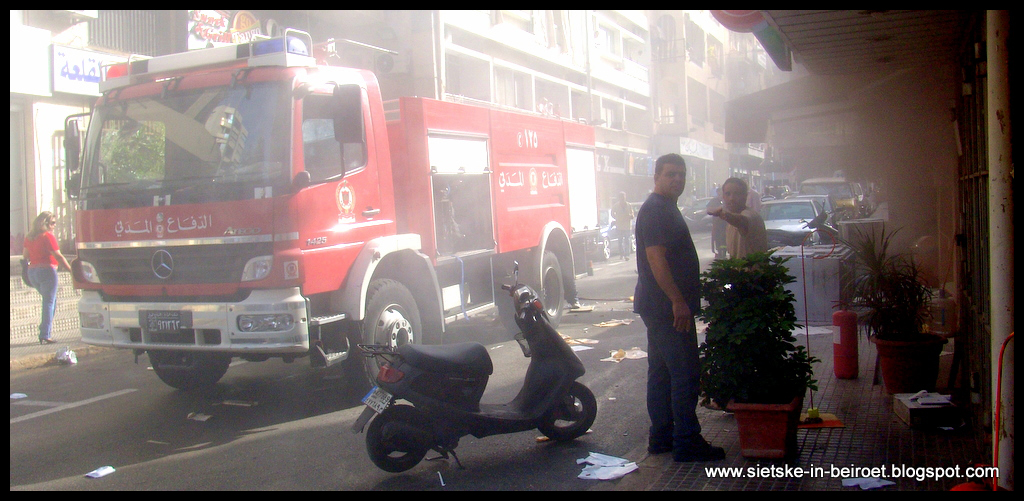
No, there will be school on Monday. It’s just that the neighborhood Manakish shop won’t be selling manakish for a while. The gas tank blew up, and the ‘fatayer sbanich’ (spinach pastry) was blown all over the street, together with his stock of straws and paper sandwich bags. Nobody got hurt, and the fire department was there within 5 minutes.
It is kind of cute to see these firemen in action. They are without an exception out of shape, and wear no protective gear whatsoever. They probably have to work with equipment dating from the 80’s. Yet they manage to get the job done. Amazing how some things function so well.

October 13, 2010

On Fall (and not on Ahmadinejad)

Since everyone is all nervous about Ahmadinejad’s visit to town, and all roads are closed (which resulted in a wonderfully quiet Ras Beirut this afternoon!), I figured I’d entertain you with some more relaxing stuff.
I went on a wonderful hike last Sunday, all the way from Baaklin  (also spelled Baakline or Bakleen) to the village of Gharife. They’re both in the Chouf. I always thought I had been to Baaklin numerous times, but quite obviously I must have had some other town in mind, because I hadn’t. I decided to go with a guide for a change (And I just realized that I started 75% of my sentences with ‘I’. Now I know this blog is about me in Beirut, but maybe this is a little too much), because I can’t find anyone to hike with me &  who knows the area. There are several outfits in Lebanon that organize outdoor activities (see side bar).
What struck most of us was that of the some 20 people that had heeded the call for a mountain hike, only 3 were home-grown Lebanese. The rest were either foreigners, or Lebanese visiting Lebanon on a holiday. It could be that as a Lebanese you know your country so well, that you really don’t need a guide to go on hikes like this. But I seriously doubt it if you had seen the jungle we had to slash our way through; it was almost ‘machete work’. It could be that as a Lebanese your Sundays are filled with family obligations and that you cannot go on hikes like these. It could also be that as a Lebanese you probably do not visit these areas, just as I haven’t see half of the things in Holland that any old tourist probably has 27 snapshots of. Or it could be that as a Lebanese you really have better things to do that hang out with a bunch of foreigners like us that like to hike through the mountains.

But I can tell you; it was fantastic! They always say that Lebanon is the country of 4 seasons. I used to disagree with that, because it is either hot-hot-hot, or it rains-rains-rains. But now that I spend more time outside Beirut, I notice that there really are four distinct seasons. Just not in Beirut.
Fall has started, and the woods were changing color. When I was young, we’d go to the forest in the fall and gather colored leaves and acorns and buck eyes. I didn’t see any buck eyes, but plenty of acorns and colored leaves.
I love fall, probably my favorite season. It reminds me of back home. Fall is when it gets dark earlier, and I’d walk home from my elementary school, and the street lights would be on, and all the living rooms were lit, and you could look inside the houses and see families sit together. Fall meant that Sinterklaas was on its way, and Christmas too.
We had this guide with us who was a real tracker, a regular Sherlock Holmes of the woods. Constantly with his nose on the ground, rubbing leaves between his fingers, sniffing everything and gazing absent-mindedly in the distance, spotting foot prints on our path and what not. It was kind of funny; he reminded me of those old cowboy & Indian movies where a posse of cowboys are chasing an outlaw, and every now and then the Indian in their midst would get to the ground on all four, sniff the air, and say cryptically: ‘Four men, going east, 50 minutes ago, one horse is lame on the left front. They have no more water.’

I shouldn’t make fun of the guy, because he showed us spots where porcupines had passed (didn’t even know we had them in Lebanon), where wild boars had scratched their butts, and partridges were hiding among the bushes. And I’ve expanded my array of medicinal plant tricks, so if ever you go into the wild with me, I can now cure your tummy ache, or stop the bleeding and heal a cut without scar tissue. How’s that a city slicker from Beirut, eh?
We hiked through valleys where cars cannot come. We passed by an enormous sink hole that’s not even on the map or in the tourist guide. Only locals and speleologists know of its existence. And I can vouch for that because I walked right past it and didn’t see it; he had to point it out to me, some 50 meters deep (150 feet) if not more.
And for lunch? Well, make sure you get some genuine French on your team. They do not 'do' crummy sandwiches in cellophane and luke-warm water. They come with a Medoc ’85, smoked pork sausages and 3-year old blue cheese, and they 'pass the bottle'.
What’s the moral of this story? If you don’t have anything to do, call one of these outfits. (I went with Lebanese Adventures on this one); they plan cool stuff every weekend. And they really show you the nooks and crannies of this country.

October 08, 2010

The Rains Have Come

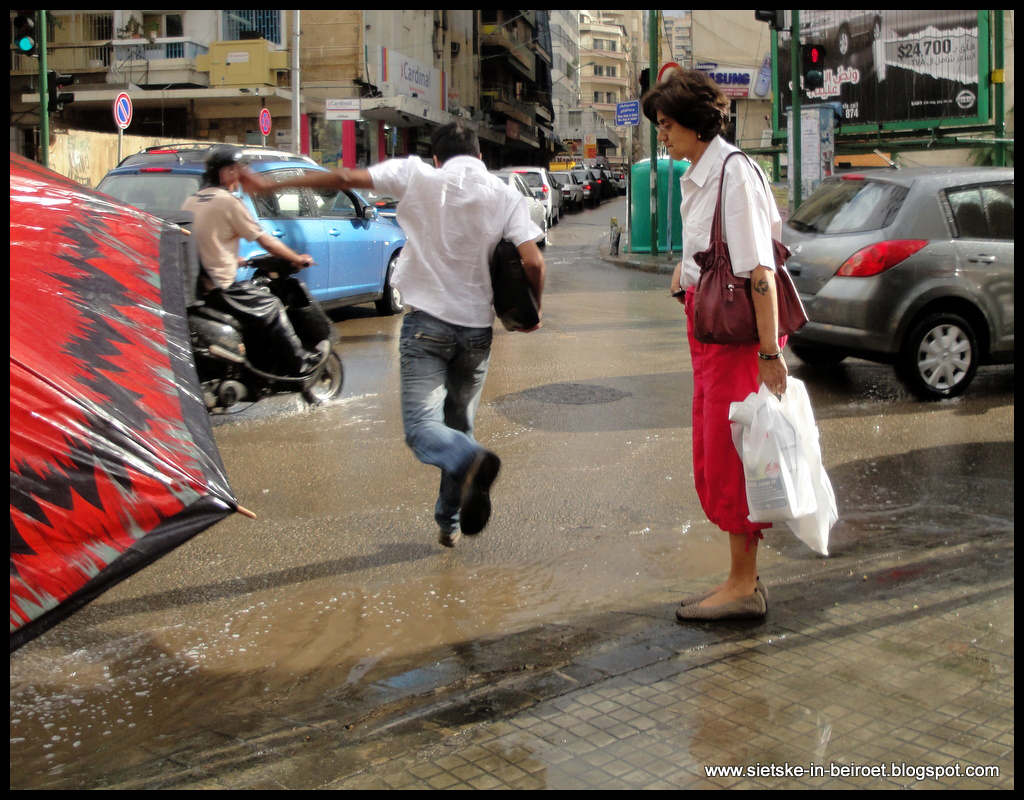
The rains have come. October has not let me down. It probably is the Dutch in me, but I love it when the rains come. We’re so horrendously unprepared for it that it anyone who gets caught in it can’t help but laugh. I mean, come on! One shower and everything floods? Yes, everything floods. The sewer system just can’t drain it fast enough. You’re wading through the streets. And Beirut being built on a hill (or two) makes all that water run in one direction; downhill. I, however, had to walk uphill in that same moment. And so we met. You want to see what I had to walk through? I had an umbrella with me, but that really was a bit of a joke.
Why do I like it when it rains? Rain reminds me of home. But apart from the Dutch side, there’s got to be some primordial instinct flaring up at the sight of water coming from the sky, because water means life (in days when it did not come out of a tab, that is). However, it’s only the first month I like. By the time we’re into rain for days on end, I pine for sunny skies again. 
But for now, I am happy that the rains have come.

October 06, 2010

Fhloston Paradise

 Dubai Metro
 I was in Dubai over the weekend for a writers workshop. I was kind of late in going to Dubai. Everybody and their grandmother has been to Dubai these days. I kept putting it off. I had been to Abu Dhabi, which I imagined to be similar, and I was not greatly impressed by that place. But this weekend was a work engagement, so there I was.

Do you know this scene  in the Fifth Element, when Bruce Willis (Korbun Dallas) arrives to the resort planet Fhloston Paradise? Uhuh. Well, that was me when I got off the plane in Dubai.
 
An aquarium in the Dubai Mall

The first thing what happens is that my glasses fog up once I got out of the airport. It took me a moment to realize that it was the artificial atmosphere that did not quite align with the actual air.

Next thing I notice is that I am actually the only person walking. On the street. Well, besides a few migrant workers. There are no actual residents in sight. Those move around in SUV’s with tinted windows, like little aliens in pods, from safe haven to safe haven (read ‘malls’), as if the life in between cannot sustain them.
Downtown Dubai
 I felt like I had arrived to Fhloston Paradise. It was not that there was one alien species, no, there’s hundreds of them. There’s of course the obvious Pilipino contingent, and the Indian one, specifically the Sikh kind with the little hairdo’s knotted on top of their heads. But then there’s this huge array of Arabs that are totally new to me. There were Yemini Arabs, with colorful head dresses in paisley print, great groups of Osama Bin Ladens, slippers and dress and broom beards and all , and of course the local ones in dishdash and white head scarves. A sizeable amount of Europeans, of which the Slavs stood out the most. What were they? Russians? Ukranians? I don’t know, but among the Caucasian race, some are just not as ‘good-looking' as others. Their eyes are so light-blue; it looks like they contain water. And then the ladies in black.
But the ones that really appeared ‘out-of-this-world’ to me were the ladies with the headscarves that were elevated some 20 centimeters above their heads. What is it that they wear under those scarves? It looks like they have their hair piled in great bunches, with elaborate hair clips. It looked like they had elongated heads, judging from the shape of their veils.
The thing is so big, didn't even fit in my screen
 
And so I am sitting at the bottom of a ski slope, while in a desert, eating sushi, and I’m drinking my beer behind a curtain because no one is supposed to know that I am drinking, and I am thinking "I've arived to Fhloston Paradise."

Boy, was I glad to get to Beirut.