April 30, 2010

The State of Electricity

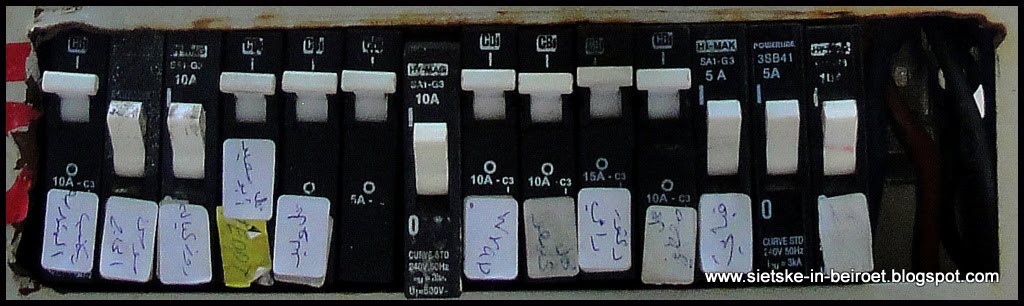
One of the things I see on my way to work. These switches are called ‘digenteurs’, taken from the French language. I’ve got them in my house, but also at the bottom of my building, which the janitor flips every time there’s a change between government electricity and building generator. It’s supposed to switch automatically, but often there’s a glitch, and then you have to call the guy (hope he’s home) and ask him to do it manually. Then you hear outside, from several floors, women calling out, “Ibrahiiiiiiiiiiiiiiiiim, Ibrahiiiiiiiiiiiiiim!” (His name is Ibrahim). He must be the most wanted man in my neighborhood.
I wonder what these switches are doing in the middle of the street though.. And what happens when it rains. I feel like flipping hem all sometimes. See what happens.

April 26, 2010

Pic(k) 'Tick' on Sunday

So we went on this picnic this Sunday. I could tell you lots of nice things about this picnic; the alpine meadow with wild flowers, the crystal clear waterfall cascading down the mountain, the fresh air, the cool summer breeze, the multitude of little butterflies fluttering over our wicket baskets, the soothing sun, the lovely walk uphill (say again?), the food, the wine, the company….. I could go on and on.

But what it boils down to in the end is this; The ticks. Thousands of them. What? Millions of them!
This (yes, you see that right) is what I plucked off my dog this morning. To be more exact; this collection comes from the nose section only.
I haven’t done his ears yet, the armpits, the legs and the rest of the body. I washed him, I sprayed him with tick spray, but these are nasty suckers.

I put my kids in the tub, scrubbed them, inspected them, but didn’t find any, so I assume we're safe there.


I keep telling everyone that we do not have Lyme disease in Lebanon. I googled it, you see. And when you Google, you become an expert. They all believed me (sorry, Allyson). But I really cannot find anything on cases of Lyme disease in the Middle East. I know the disease is uncommon in Israel (Source), so I assume it is uncommon in Lebanon as well. Define uncommon, Allyson? Hmmm, good question.

And you’ll see; those that worry are the ones getting it. So I’m not getting it.


My dog, poor thing, is probably more at risk.
A dog can start to limp on one of its front legs in as little as a 3 hours following an infection. Eventually, all limbs will be affected to the point where your dog doesn't want to move. Swollen lymph nodes may also occur with the joint pain. (Suurce here and here)
But really, after such a lovely picnic, is Lyme disease something to worry about? While checking up on Lyme, look what other diseases I found that you actually can get while in Lebanon: Hepatitis A, Hepatitis E , the overall hepatitis B , Hepatitis C, Cutaneous and visceral leishmaniasis (transmitted by sandflies), Mediterranean Spotted Fever (okay, low risk), Brucellosis (from consumption of unpasteurized dairy products), echinococcosis (usually transmitted by contaminated fresh vegetables), rabies (no recent cases though), tuberculosis, parasitic infections (giardiasis, amebiasisis, and roundworm and tapeworm infections), and schistosomiasis (transmitted through exposure to contaminated water while wading, swimming, and bathing),  Travelers' Diarrhea (don’t we all know that one?) and Typhoid fever (source)

April 25, 2010

3 Temples on a Saturday

Mount Hermon in the south-eastern part of the Beqaa Valley

My friends & acquaintances are not of the cultural kind (“or maybe you do not inspire us to cultural activities,” says a friend who is sitting next to me here). Their interests lie in other areas. They can be found either at burning barricades and demonstrations, in a bar, on 30 kilometer hikes through underbrush filled with ticks and gigantic hairy spiders, or lounging at outdoor picnics. But not one of them will go out and drive 3 hours off-road to see a hump of stones that were once a Roman temple or a Neolithic settlement.
If it is old, we'll visit it & Co

My parents are the opposite; they will visit any lump of stones, regardless of what it once was. And since they are here & stuck because of the Icelandic volcano (“don’t bother calling us for reservations before Monday afternoon”, the airline company said), I intend to make the most of it.

So stone lumps it is. This web site indicates we’ve got 21 Roman temples in Lebanon. I have visited 7 of them, and so am left with a choice of 14 temples. The site gives them a grade; 4 being very well-preserved, 1 being nothing but a pile of stones. However, this gentleman speaks of many more.
Very few cars, no party flags, no campaign posters, no martyrs on the electricity poles, no high rise. It’s heaven out there.

We decided on 3 Roman temples in the southern part of the Beqaa Valley (Baalbeck lies in the northern part). I always thought the Bekaa valley was one large flat valley. Today I found out it’s got lots of little ‘side’ valleys, so to speak, separated from the main valley by hills. And these little (v)alleys are much more beautiful than the Beqaa. Less garbage, less urbanization and almost no traffic. Very authentic agriculture, with little fields separated by stone walls. Pretty much the only traffic we got stuck behind were tractors. And the most liberating part? No party flags on every single electricity post and no campaign posters with pudgy middle-aged man in suits. It looked like a normal country side.
The Beqaa Valley (I hink)
Majdel Anjar Temple
The first temple we visited, the Majdel Anjar Temple (33°42'43.54"N & 35°54'4.95"E) , is pretty well known, and not very interesting. I had already visited it once, and I was more struck by the intricate debris lying around than the temple itself. It is big and all that, but rather roughly hewn and not very refined. At one point in time it was converted into an Arabic fortress, hence the refurbished look.
They don’t get a lot of foreigners there. At the bottom of the village we already heard the little boys on the street shout ‘ajaynab’ to each other, and the track to the mountain top, where the temple lies, began. Seeing foreigners has so much more appeal than a 2,000 year old building.
I didn’t find much information on the structure: ‘1st Century CE Greco/Roman Style Tempel in near North South orientation measuring about 40 Meters by 20 Meters. The remaining walls are nearly 10 meters tall. The columns are all gone. The deity this was dedicated to is not known. (source )

Dakoue Temple
The second temple, in Dakoue, (33°41'29.12"N & 35°52'36.35"E) was much more fascinating. The thing, not that big, is basically lying in some else his garden. Can you imagine putting that one on the market? ‘For sale; house. Comes with 2,000 year old Roman temple in the yard.’ There isn’t much information on this one either.
Again, very little information: 'Small 12 Meters by 7 Meter Temple dedicated to unknown deity. It is in relatively good shape on account of having been used as a house for many centuries'. Source

It is an ‘prostylos style’ temple. Apparently, according to George Taylor, the Roman temples in Lebanon are of three types: the antae, the prostylos, and the peripteral.
In the prostylos temple, the porch is lengthened and the two columns noted in the antae temple are brought forward beyond the line of the side walls. Two more columns provide the corner supports for the beams and the roof, and an architrave joins these columns to the pillars of the side walls.’ Source

Ain Hirshe Temple
The third temple (33°27'13.29"N & 35°47'19.71"E) would have been worth the trip alone already. Set somewhere at the end of the world, near Mount Hermon, the thing is near the village of Ain Hirshe, a town that has streets so narrow and steep, I wonder how come they don’t all have 4 x 4’s. In wintertime, they must be totally isolated from the rest of the world because there is no way a snow plough can negotiate these alleys.
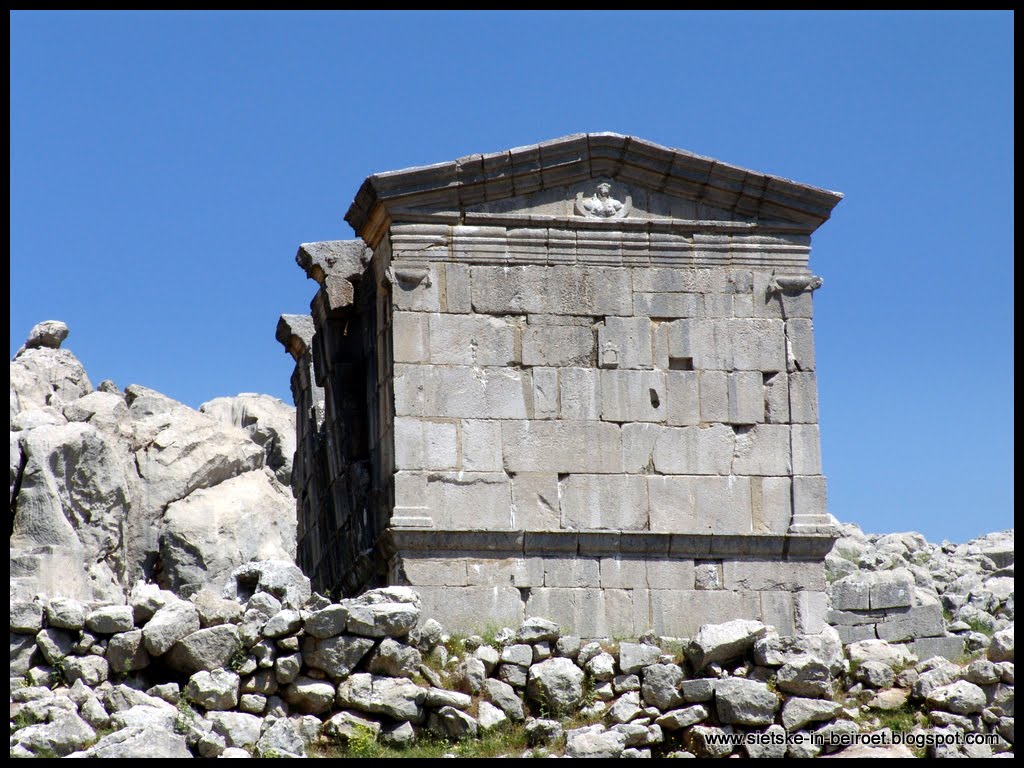
The temple is made from the surrounding rocks, and blends right in. The entrance is facing Mount Hermon

It took us quite some time finding the thing, and people suggested that we wake up the ‘rais el baladiyeh (something like a major) from his afternoon siesta and have him guide us there. That was a bit too much of a good thing. We finally got instructions from a soldier who clearly is used driving a tank, because although he mentioned that ‘the road is easy for your car’ we probably lost every loose part on my vehicle. Sports bras would have been helpful as well. It is a small temple, dating from 115 AD, but in very good condition due to restoration work done on it in 1939.
But the thing is stunning. Funnily enough, it stands with its front to the mountain, and its back to a stunning view over the Beqaa valley. This has a reason  (again, I’m quoting other people here)
The orientation of the temples in the Mount Hermon region is particularly interesting. It has been asserted that the Roman temples which circled Hermon were oriented to the cone-shaped tip of Kasr es-Sebayb, the highest point of the mountain and the site of a sacred enclosure in Roman and pre-Roman time. Source
Small 13 Meter long East West Oriented 115 CE temple dedicated to unknow deity (source)

It seems Mount Hermon, or Jabal el-Shaiykh as it is called in Arabic: جبل حرمون was quite important in (pre)Roman times. The mountain is in the Anti-Lebanon mountain range, and the highest point -2,814 m above sea level - is on the border between Syria and Lebanon, and is under Syrian control. The southern slopes of Mount Hermon have been in Israeli control since the Six-Day War in 1967.
Ain Hirshe is an example of an antae temple, the Roman templum in antis. ‘ The side walls extend the full length of the podium, and form the corner supports for the beams and the roof. Two columns, spaced between the side walls, provide the centre support for the beams and roof; these columns lend considerable dignity to the entrance façade. At Ain Harsha the columns have gone, but their bases can be seen clearly. Source

And that was how far we went. Any further and we would have ended up in Syria. My navigator was giving me ‘unchartered’ territory. One of my readers, I think it was Simon, mentioned that my GPS system is using maps provided by the Lebanese army. Well, that explains why we’ve never won one single war – apart of course from the superior fire power of the other side – it is because we don’t know where we are half of the time.

My Dad checking out a sarcophagus. At the age of 95, you’ve got to be prepared. He particularly liked this model, hewn out of solid rock.

April 24, 2010

You Know You’re Getting Old . . .

. . . when you need a multitude of devices to see. Or read. Maybe I should say ‘function’? I know I could get the ‘one-in-all’ version, but mentally I am not there yet. Wisdom comes with handicaps.

April 22, 2010

Missing

April 13 has come (and gone); it marks the official beginning of the Lebanese civil war. Here’s how it officially started, but the drums of war had been beating for quite some time before that.
MISSING & IN A SEA OFOBLIVION; Exhibition in Beirut City Center - Martyrs Square

It was a regular working day. It’s not that I am advocating for yet another public holiday. We’ve got lots of public holidays in this place. And we just got another one  added to this plethora of celebrations & commemoration. We celebrate(d) the Liberation of the South (for a while). We even celebrated/ commemorated (depending on what side you’re on) the Hariri assassination of February 14, 2005 (for a while).

But if there’s one day that should be remembered, then this is April the 13th. I asked my son if he knew what was special about that day. He didn’t know. “An unlucky day or so, because it’s the 13th?” Well, unlucky it was.
My son can tell you when the WWI was, and  WWI. He may give you some estimate on the Vietnam war. But he cannot tell you about the Lebanese Civil War. And it is not like we do not discuss the matter ever in our household. But does anyone really ever talk about it?
It’s a day when we should commemorate all the victims/vanished of the (civil) war. Yet we don’t.

MISSING & IN A SEA OF OBLIVION; Exhibition in Beirut City Center - Martyrs Square
In Holland we remember the victims of WWII on May 4 (dodenherdenking); that’s some 65 years ago! In France and England they still remember the casualties of the First World War on November 11 (Armistice Day ); almost 100 years ago!
I went to an exposition, MISSING & IN A SEA OF OBLIVION, which commemorates the 35th anniversary of the beginning of the civil war in Lebanon with the pictures of people that went missing during the civil war.

I was surprised though that there were not more than that. And you know the funny part? Even at the exhibition, they do not tell you how many are hanging there. ‘Many hundreds of individuals,’ the brochure reads. Well, how many is ‘many hundreds’? Two hundred? Nine hundred. And from stories I’ve done in the past, I know there’s some 2,000 that disappeared in 1982 on empty arrest warrants signed by certain judges. And does that include Palestinians, like the ones in Karanthina? We have a friend who lost his brother there; and he was Lebanese. I don’t think he was hanging there.
So how many exactly are missing. Can’t the population register answer that?

Quite a few disappeared while in Syrian hands, but a huge numbers just ‘disappeared’. They fell into the hands of the wrong militia at the wrong time. Some were taken for ransom, others for revenge, a number was ‘arrested’ by those that were in power at that time, and some just happened to get caught in the crossfire, and were never claimed, because nobody could keep track anymore.

MISSING & IN A SEA OF OBLIVION; Exhibition in Beirut City Center - Martyrs Square

An acquaintance of mine is involved in an organization  that seeks to ‘to preserve and revive fading memories of civil violence and war, as well as to provide a platform for public access to, and exchange of, such memories. UMAM D&R believes that they are essential for building the future - as a key to historical and political self-analysis, to understanding national and individual identity formation, to acknowledgment and recognition of responsibility and blame, and potentially to reconciliation’. The exposition was a project of them.

I hope they are going to work on this April 13 issue day. We can cancel this annunciation day.

April 20, 2010

Ode to the Water Tank

I usually take a shower. This morning I opted for a bath.
Hmmmm. Maybe not, I thought, when I saw what came out of the tab. Looks familiar? Gosh, who knows how long this has been going on for? Imagine I've been washing my hair in this ... I don't know what, for weeks, maybe even months. I think maybe I’d better get on the roof and clean out that water tank. I’ve done it before (maybe in 1997 or so; there was a dead pigeon floating in it then).
Beirut Cityscape; the water tank

That’s part of living in a city where there’s no pressure on the water system. But why is there no pressure on the system? I have no idea. I never did a story on the water infra-structure of this town, otherwise I might have been able to tell you.
And thus, this is an ode to the watertank, for lack of pressure.
The water tank; they’re part of Beirut’s cityscape. Every roof has a few. The old types are the metal containers, welded into all kinds of different shapes, whatever shape the roof required. The newer ones are the plastic ones; less flexible, but maybe easier to maintain? I don’t know. I’ve got an old metal one with one of those lids that fit over the opening. Makes you wonder how that darn pigeon got in. Or all this yellow sand. Maybe an upset neighbor?
Beirut roofs: one tank for each floor

A roof without a water tank is an empty roof. Finding your own water tank is a bit of an issue. With 12 floors, there’s bound to be 12 tanks. But whose tank is which? Some buildings you see they’ve painted the house number on them. Smart. I distinctly remember from 1996 – or whenever it was that I checked mine – that I had a mighty hard time locating it. Maybe I should call the plumber; he should know. He’s up there about once a year to install a new water pump that is – supposedly – going to last me 10 years. That’s what he says each time. And that’s about right for 9 months, until you’re standing in the shower, and the hot water comes and goes in spurts.

Enough said; I’ve got to get working if I want a clean bath tomorrow morning, I know I shouldn't complain. At least I have water. And hot, most of the times. That's more than many of us can say in this town.

April 19, 2010

On Heights (of buildings, incomes, growth and fear of it)

Another 'million dollar per apartment' building going up, blocking my sunset.

I know it is a VERY old cliché about Lebanon, but here it goes again. A couple of foreign economists are invited in the sixties by the Lebanese government to figure out what makes the Lebanese economy work. They get to work, dive deep into the figures, check the books, pour themselves over the banking system and talk with leading businessmen. When they have to report their findings after a month, they have to admit that they can’t figure out how the Lebanese economy works, but “whatever it is, don’t change it.”

These guys (working for about $/$500 a month) adda nother floor every 10 days.


That’s what I have to think off quite often when I look at the high rise mushrooming up in my neighborhood. I understand that we were bypassed by the financial crisis that hit the rest of the world because ‘Lebanese financial model, as designed through the years, does not authorize any excess in borrowing or in the acquisition of “toxic products”. (Source)

I also know that we have had some sort of stability for a while now. No Israeli bombing since 2006, no internal fighting since 2008, and yes, I do understand that the Arabs from the Arab peninsula are spending their hard-earned dollars here, and that Lebanese from overseas send money to their families.
They work under almost no safety at all conditions. In Holland, the union would have stopped the work long ago. This is on the 10th floor. No railing, no safety harnesses, no hard hats (well, once you fall down 10 floors, who needs a hard hat?)

But how do you explain 1 million dollar apartments going up, one after the other, when the average university graduate should be happy with a starter's salary of $750 dollar?


I don’t get this. People in my surrounding explain it to me in detail, (some of them raising their voice in annoyance as it seems to be a question I ponder over quite a bit), but I think everyone is just second-guessing, just like those economists from the sixties.
I don’t think anyone can come with hard proof and figures on paper as to why this economy seems to be growing (some 7% in 2009 ), yet people continue to have shitty incomes.

You see this guy here? He’s standing on a piece of wood on the outside of the building. Not a shelf, no, one little stick. He’s 10 floors up and not attached to anything. I find this amazing. In the Sates, in the forties and fifties, they used to employ Native Americans from a certain tribe to build their skyscrapers, as these people apparently had no fear of heights. It wasn’t in their genes. I wonder about these guys.


I tell you why it bothers me. Because these darn apartment buildings are slowly but surely taking over my view from the Mediterranean and blocking my sunset That’s why.

April 18, 2010

Sunday = Picnic Day

What picture do you choose to express the mood of the day?
This goddamn dog that everyone hates (except its owner) and who ate all my goat cheese and tuna fish salad, ran over the entire picnic and when wet, shook its fur around us?
This lady that assures us she’s not drinking alcohol anymore, and hasn’t done so for 2 months now? You don’t say.
Or the girl power? It’s seems to be the highlight of every picnic, riding the pickup truck.
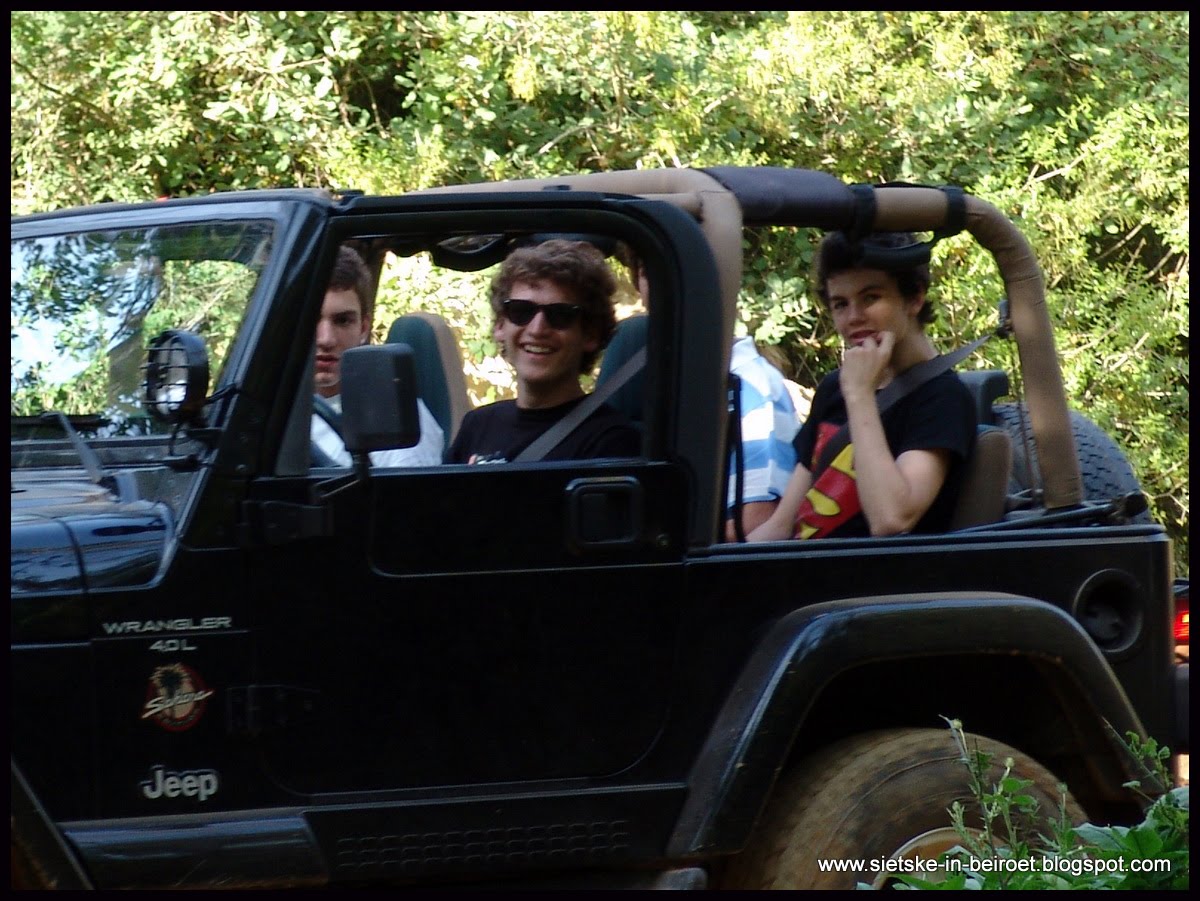
Maybe these boys, who had lengthy discussions about how to convince your mom you should have a blackberry, where to get a fake ID, how to get your driver’s license in one day and then tried out the Jeep off-road.
Or these senior citizens who emptied a bottle (or two) of wine, then claimed they hadn't and (one of them) ended up smoking behind the tree because “my daughter is not supposed to see me; she won’t let me smoke.”  Isn't it supposed to be the other way?
Or this Mom & son team? There were quite a lot of Mom & sons teams, four, as a matter of fact. They drive the car these days (well, those over at least). Some complained. "If I wait for you to let me get my driver's license I'll be 30 by the time I can drive a car."
Or this lovely lady who was so relaxed we had to check whether she was still alive. “I hear you, I’m just not talking.”
I don’t know. You take your pick(nic). Picnic season is going in full force.

April 17, 2010

Beirut - like Nice but safer

More good press from FR2DAY: Beirut - like Nice but safer

True lovers of Beirut will tell you the facts. (...)  That there's valet parking at McDonalds and that the traffic in Beirut is either stationary or like the Monaco Grand Prix. In fact, they'll tell you that Beirut has most things you'd expect from a modern city plus the best nightlife in the Middle- East.
(...)
Forget it's reputation - this is one of the safest cities in the Middle East, especially for a Westerner and you are less likely to be a victim of crime in Beirut than in Paris or even Nice.

On Heterosis and Success

Good news for my children. A university study in Cardiff, England , has shown that
People of mixed race are perceived as being more attractive than non-mixed-race people’.
I guess we already knew that. But not only that;
‘There is evidence, albeit anecdotal, that the impact of heterosis (which is the oopposite of inbreeding, a well-known occurence in certain families in this country) goes beyond just attractiveness. This comes from the observation that, although mixed-race people make up a small proportion of the population, they are over-represented at the top level of a number of meritocratic professions like acting with Halle Berry, Formula 1 racing with Lewis Hamilton; and, of course, politics with Barack Obama’
I would like to take it a step further, to the Lebanese level, and that is that couples of mixed-religion, and children of couples of mixed religion, in general have a much more relaxed outlook on life. They fit better in their skin, so to speak. Which would mean we are all going to have to get married in Cyprus from now on. That will do away with confessionalism in the most natural way. Through selective breeding.

Get your copy of the research here. 

April 14, 2010

Summer

I finally packed & bagged my winter stuff. Summer is here.

April 13, 2010

On Adventure & More Roman Stuff

If you like adventure, I have just the thing to you. Buy one of those car navigators from NavLeb, type in ‘Sfire' and see what happens. I tell you, I’ve been all over the country. What have I seen? Better ask; what haven’t I seen!

I have been dragged through the most shady neighborhoods of Tripoli, got stuck for an hour in some sort of Sunday market for second-hand goods, drove over dirt tracks most of the way, got navigated into dead-end streets more than once, scaled mountain roads, drove close to the edge most of the time, ended up in stone mason yards and my GPS indicated I was in the green (read ‘unchartered’) most of the way.
Impression of Tripoli
Where's the road?
Ah, now we have two roads? What's this, a highway?
And we've got gravel!
Well, here we've got some type of pavement, but it's a dead end.
Uh oh! Better slow down, we've got possible road kill; Crossing chickens. (If I go any faster than 20 k/ph every nut and bolt in my card will come undone)
What do you mean there is no road?! I'm driving on it! It's got tarmac and all. Who developped this stupid program?

But we did get to Sfire, albeit with some diversions. And in Sfire, according to my book on Lebanon, there was a Roman temple.

There was (34°24'4.82"N & 36° 3'33.75"E). In the midst of a violent sand storm, we reached it. We almost got blown of the hill top. It is a bit of the beaten track and you will find almost no visitors there. As a result, you will also find almost no information on the structure. These 6 information panels  were no longer present, and my guidebook had very little to say on it.
What survives of this temple is the ‘cella’, a simple, largely unadorned structure built of hefty limestone blocks, with no evidence of a surrounding colonnade. (…) Much of the courtyard in which the cella stands is still paved, and the whole site is strewn with ruble and architectural fragments. In front of the cella are the remains of a subsidiary building, and to the right another one with four columns still standing. (Source)

The temple was built in the time of the emperor Severius early in the third century; this explains the name, a corruption of Severius through Saferius and now Sfireh. The emperor remained four years in the region and here on a hilltop planted with clusters of oak trees this temple had been put up no doubt to commemorate his name. (Source)

This was the only sign to the temple.

Apparently Severius (October 1, 208 – March 18, 235 AD),  was a locally-born Roman emperor. He was born in Aarqa (Arca Caesarea or Caesarea ad Libanum in Syria, on the western slope of the Lebanon range, a short distance NE of the modern city of Tripoli), and as such must have known the region well.
I’m surprised he’s not more well-known in Lebanon. After all, a Lebanese emperor, that’s just what we like (Was that what caused the downfall of the Roman empire? Oh no, that was much later).
He ended up being assassinated, a tradition we have tried to keep up ever since.

(Here’s a short film of the monument.

Sfire is in the county of Dinneyeh. The Dinneyeh area is stunningly beautiful. Very green, very lush, and very un-urbanized the way Beirut is. This is how you imagine Lebanon would have been 60 years ago.

We passed by fields of wheat, olive groves, forest, and deep dark gorges (34°23'21.00"N & 36° 3'9.69"E) that I plan to hike one day.
Beautiful fields of waving wheat

Dinniyeh rings a medieval bell in my ears; it’s been ages since I have visited the place. I did a story at the end of 1999 about Dinniyeh, because some of the inhabitants in the region predicted doom was coming their way on December the 31st, 1999. A bit like those medieval millennium doom-thinkers that thought the world was coming to an end in 1,000. Well, the coming of 2000 was no different; they barricaded themselves in their houses and stocked up on sugar and rice, cooking oil and firewood for years to come, and waited for the end of the world to come. At least, that was the story.
Dinniyeh

The real story was about a veteran of the Afghan war & buddy of Osama Bin Laden, Bassam Kanj, who had come home from battling the infidels in Kabul, and decided Dinneyeh was as good a place as any to start an islamic state. That of course did not go down well with the powers in Beirut, so Kanj barricaded himself (with his followers, the rice and the cooking oil). The story did not end well for him; he was killed. Some of his followers ended up in jail. The rest ran off the Narh el Bared and Ain el Heloueh, two Palestinian camps. Nahr el Bared has since been obliterated; The Dinneyeh fighters have either been killed or ran off. Ain el Heloueh still has a contingent of them that joined Usbat al-Ansar, an el-Qaida offspring. 

An old water mill?

And Dinneyeh, well, it is still known to be a hotbed for islamic fundamentalists, (or militant islamists, as they call them these days). Poverty is quite abject in the region, but they’re taking a break these days.

I know; I zig-zagged the entire region for a whole day, drove into every nook and cranny, but saw very little bearded men on the road.

There’s still loads of temples left in Lebanon to visit (other than the famous Baalbeck one) so stay tuned for more.