December 31, 2008

Cold

We’re being hit by a northern storm right now. It will be snowing as low as 1,000 meters today (the cedars are at 2000 and above). The highway peddlers in Beirut have resorted to selling earmuffs instead of their usual silly merchandise of CD’s, shaving machines and alarm clocks. Mind you, it is still 12 degrees Celcius here in Beirut, nowhere near as cold as in Holland now. But for Beirutis, that’s COLD!
The ski slopes of Feraya haven't opened yet, but probably will tomorrow morning. My brother sent me a movie of the family skating on natural ice. That doesn’t happen very often anymore, natural ice. We don’t do skating here in the Middle East (although we do have an ice skating rink near Jeitah), but I can offer him a sledding movie instead.


December 28, 2008

New Toy & Qadisha

Qadisha Valley, looking eastwards, towards the Cedars

Looks like I am on the road a lot lately. That’s because Santa (read hubbie) got me a new toy; a Tom-tom for Lebanon; A digital road map, supposedly showing me all the roads of Lebanon. And so I’ve been on the road a lot, not because I don’t know my way around Lebanon, but I want to check if my tom-tom knows the country too.
(And to show you what real photography is like; check out this guy's picture of the Qadisha valley: source) This one is taken westwards, toward the sea.

And I must say it is good that I know this country well, because the past three days the thing has been trying to send me in some interesting directions. Going from Tripoli to Beirut, it steers you off the road into Byblos and back on the highway again. At roundabouts it gets confused and sends you consistently to the right, even if the arrow shows you need to go straight, and one-way streets are a bit of a challenge too. All the new roads are unknown to him (couldn’t be a her, we always know the road), and the road from Beirut to the Cedars goes via … Feraya?
And here are those cedars!

The phonic issue is another problem. If you have a place in mind, try figuring out how it is spelled. Shimlan might be Shimlan, but it could be Chemlan, Shimlan or Chimlan. And as long as you don’t spell it right, it won’t tell you how to get there either. The machine does not abide by popular road indications either. Everyone in Beirut knows where Caracas, Mar Elias and Cola is. Not my tom-tom. Caracas does not even exist. It is ‘Kalaa’.
The road alongside the cedar grove (it's not really much of a forest anymore, just a bunch of trees), where people sell souvenirs made of - what else - cedar wood.

Today, I wanted to go to the Cedars. It took me some time to get that spelled correctly. Want to guess? Ariz. Yep. But other than that, the thing is great fun!Tourza, a mountain village at the edge of the Qadisha Valley.

And there have been so many places in the past that I wanted to revisit, but because I never ever knew where exactly I was – signs in Lebanon are often absent or in Arabic (which this illiterate Dutch cannot decipher) – I couldn’t exactly find them back either. Now I can.
A lone traffic light in Amioun (?).

My Tomtom is not as advanced as the European ones; roads less than two meters wide do in general not appear on the map and it doesn’t have such advanced features such as ‘choose shortest road’, but it does tell me exactly where I am at all times. And that’s what I needed it for. That’s why I can tell you exactly where I went today.
Terraced orchards in snow.

I drove all around the Qadisha Valley with a side trip to the Cedars. I had planned to go over the mountain ridge and back through the Beqaa Valley, but the mountain pass was already closed due to the snow.
Somebody asked me what happened to the 'other' dog; well, it needs to be carried in the snow (it's clutched between two green mittens), it does not like wet paws. Darn, who raised that dog and then kicked it out on the street?

December 27, 2008

And We Have Snow!

And yes, we have ourselves some snow in Lebanon! Not enough to ski yet, but excellent for sledding,
and snowball fights.

Boeff, the bearded collie, 15 years old now. He's practically blind, and totally deaf, but loves to run in the snow. It's easier for him to follow us in the snow, since moving objects are not as hard to detect in the snow as in the forest. According to this article this should be his last year. No signs of it in this one.The Lebanon mountains. And the compulsory family picture in the snow.

December 25, 2008

The Vanished Dutchman

So you want to know about the ‘unidentified bodies’? Well, here is the deal.

There once lived a Dutch family in Lebanon. Mom, Dad, and 3 daughters. They lived here for quite a number of years, and probably would have continued to live here for some more, had the civil war not interrupted that.

And so, in 1975, the family left for Holland. The father would fly back one more time to take care of any loose ends, and that would be it, as far as their Lebanese adventure was concerned. However, things did not go as planned. The plane, flight 204 from the Hungarian Malev company, never made it into Beirut.
Front page of the L'Orient - Le Jour of October 1st, 1975, reporting on the accident.

Five miles outside Beirut, in the very early morning of September 30, 1975, it crashed into the sea. The cause remains unknown, but rumors have it the plane transported PLO weapons, and that the Israelis may have know about it. The black box was never retrieved, conversations between the plane and the tower never recorded and witnesses untraceable.

But what is even more intriguing is that the father, Koop van der Velde, disappeared. Of the 60 people on board, 37 people were retrieved from the sea in the morning. They were all found floating, amidst clothes and foam pillows, in a small area some 5 miles west of St. George. I’ve spoken with two people from St. George and I’ve spoken with men from the fire brigade (they retire at 62, and so they had a number of old-timers who still remember the accident) who helped picking up debris.

Twenty victims were identified by next-of-kin or employers, among them a few French nuns. My husband had a French teacher who was also aboard. But seventeen remained unidentified because next of kin was not present, or they were unidentifiable. Whether the Dutchman was among the seventeen is not known. For some reason, if pictures were made of the victims, they have not been dug up (yet).

However, this was in a time when the civil war had just started, some 5 months earlier, with the Palestinian bus. And fighting had basically not stopped since then. Beirut was literally in flames. The opera house had just burned down, the ship yard of the port had been set on fire and plundered, snipers were slowly creating a physical rift between east and west Beirut as it became harder to move from one city side to the other, religious cleansing had begun, albeit on a small scale still, there were shortages of oil and flour, and power cuts had started. It was in the midst of this chaos that 17 unidentified bodies remained in the morgue of either the AUH or the Karantina Hospital.

And so the procurer general, a certain Camille Geagea (I don’t know if he is related to Samir), gives the order to have the 17 buried.

And that is where the trail goes cold. Because nobody knows where they were buried. Or whether they were buried. Or who buried them. Heck, the two hospitals even deny they ever had the bodies in the first place.
Article in Dutch newspaper Trouw (click on picture to link)

And although a Hungarian autopsy report mentions that there were bodies in the freezers of both hospitals, both hospitals maintain that they cannot verify that. AUH says they have – as far as they know – no files on this particular incident in their archives, and Karantina says their archives got burned, maybe. They don’t even know where their archives are, or are not planning to make a concerted effort to find out. But his daughter wants to know where – or if, he may not have been amongst the 17 – her father’s grave is.

And that seems to be a bit of a problem. As an unidentified person, you cannot be buried at a muslim cemetery, out of fear you might not be muslim, and the same goes for the christian cemeteries. So there has to be a spot where you bury people whose religion you may not know. Well, that’s asking a bit much, it seems. Nobody knows of such a spot. The hospitals send me to the Ministry of Health, who sends me back to the hospitals, who send me to the police who send me to the Internal Security and for every person you want to talk to, you need written permission from another office somewhere in town, and I have been trying to slash my way through this bureaucratic jungle without much avail.

You would assume that a burial, done on October 2nd or 3rd 1975, would have been registered somewhere, no? I mean, if you see the type of bureaucracy you have to go through when doing anyhting in this place, they probably have 7 copies of it too.

And this whole idea of looking for a mass grave seems to get everyone jittery. “You want to dig for bodies?” a doctor at one of the hospitals asked. “My God, you know what will happen? Everyone in Lebanon will start digging! You don’t want to know what is in the ground.”
Better left uncovered, or so it seems. There are an estimated 20,000 Lebanese still missing. I am not sure who came up with that number, but that keeps popping up. I have not been able to find a central registration office for missing persons, so these 20,000 may be ‘guess’-timates. It also seems that the former militias would rather not uncover the victims of their crimes, now covered by the 1991 amnesty law.


And so what happened to this Dutchman remains a mystery. Anyone out there that can help us out on this one?
For more information, check out this web site.

Happy Holidays!

December 23, 2008

Randomn Scenes

Some random scenes of Beirut, as I prepare myself to go into exile (the mountain house) for Christmas. The house is so incredibly cold and damp that you have to have the heater run 24/7, and it takes days before it even warms up. It usually gets comfy just about the time when we descend the mountain again. I guess I’ll be sitting IN my fireplace for most of the time and drink great quantities of eggnogs. See you after Christmas. Walking the Arabian horses from the Beirut Race TrackA (Dutch) lady on the streets of Ashrafiyeh.

December 22, 2008

Busted

I am, as of Saturday, the proud owner of my very first Lebanese speeding ticket ever!
Here is a 50 km limit, I will allow 20 over the limit, but you went 75,” said the policeman in question.
I do not doubt it; it is a very nice stretch of road (albeit only 700 meters long) without any obstructions, turns or traffic, and it’s been recently resurfaced. I like this ‘I will allow 20 over the limit’. Perfectly Lebanese. Even when there is a clear rule, we will still fidget with it.
The paperwork was then handed over to a gentleman of the Darak, the Internal Security Forces, who – while apologizing profusely – wrote me a 50,000 pounds ticket. I didn’t argue, yet he kept saying "sorry, eh?”

I figured that the paying of the ticket – which had to be done somewhere else where you also had to retrieve your driver’s license (yes, they take that away) – would result in a nice blog spot about absolute absurdity and chaos, but no such luck. I came in, paid, got my license (which had been confiscated only 25 minutes earlier, yet had made its way to the station already), and left.
Without a hitch. What a pity.

December 20, 2008

We Buy Our Socks from the Hood of Cars

Not much happening, and so I will share with you a social experience. Poverty is often not obvious here, as the Lebanese are quite the experts on making appearances. I’ve met people who drive fancy cars, sport Rolex watches and wear expensive Armani suits, but when you go to their apartment, they live with their parents, the furniture dates from the late 70’s, the wallpaper is peeling off the wall and only one out of 12 lamps in the chandelier are working. Two Dutch ladies in Ashrafiyah (I'm not in the picture)

And thus, while walking in Ashrafiye, we were accosted by a very nice looking older lady, who asked if we needed socks. Socks? We always need socks. For some mysterious reason, socks seem to lose their partners in the washing machines. It is a well-known phenomenon. I have about 35 single socks on the top of mine. The other 35 have evaporated. And so yes, please, we need socks. And there she displayed her ware, on the hood of a parked car. Socks and shirts and tea-towels and the likes. Turns out she was somewhere in her seventies, living in Furn-el-Chebek (another neighborhood of Beirut) and would take the bus to this more affluent quarter to peddle some items to make money for medications. She was alone, and the state does not, or cannot take adequately care of their elderly people. She could walk, but the moment that she becomes immobile, she will have to rely totally on her children (if she has any, and if she does, if they are here in Lebanon, and not abroad) or on neighbors. And so we bought socks, to get her through December.

December 15, 2008

Lighting Up Beirut.

Here is an absolutely wonderful idea, especially in the time of all these festivities (Adha and Christmas, and Hanukka coming up.) coming from Edwin Gardener, a designer who spend last month in Beirut. It was first published it on this web site. day time & night time

He writes 'All across Beirut you can find walls covered with bullets holes. Reminders of past violence, conflict and war. Moving through the city they are an all too familiar backdrop for any urban scene. This proposal that I called ‘bullet lights’ is reversing the meaning and experience of the ‘bullet hole wallpaper’ at diverse locations in the city. Introducing unexpected poetic moments of beauty. Beauty, ambivalently mixed with the physical testimonies of violence. The project doesn’t want to make a point it just invites people to look at things differently. Seeing things from more than one perspective is the starting point for empathy.'

I’d love to see that one. I’d like to make one addition. The lights should be color-coded, depending on the conflict. So they early holes, from 1975 and later would be green, early 1980 would be red, post 2005 lights blue (just a suggestion), and then the town would be not kust lit but colorful as well. Gives you a better perspective in the history of the conflict.

Now as to where we should purchase these light, may I make a suggestion . . . .

December 14, 2008

You Will Shoot Your Eye Out

Have you heard the fireworks lately? More like massive bomb blasts. You’d think that after so many years of wars, shootings, fighting, blowing up things and bombings, people would prefer a little quiet.

Uhuh. Not in this place. Quite the opposite. It is as if the young are trying to emulate real car bombs with their fireworks explosions. They get you to sit upright in your bed.

No, that’s fireworks, oma,” my 6-year old daughter told her visiting grandmother, who – coming from a small Dutch town – has not experienced anything beyond colorful fire crackers.


When my son was born, some 14 years ago, I vouched I would never ever buy that child a toy gun in a society that was so terribly scarred by guns. It was a battle I soon lost. I think he is right now on BB gun # 864. I’ve got little yellow balls rolling all around the house; the moment you turn on the Hoover, you can hear them ‘ricceticticcety‘ around inside the vacuum cleaner.

Street Fighting

But ever since the May street fighting right at my door steps, and the bullet holes in the façade of my apartment, his interest has gone a step higher. From just target practice in the house, he’s gotten himself organized in a gang of some 20 neighborhood boys, and they roam the street at dusk, running around the parking lots and abandoned old houses in the hood, playing ‘war’. They do it complete with taking hostages and reload pauses. They run in between cars, hide behind bumpers and the Sokleen garbage bins and cross the street in between the traffic in order to shoot each other.
I am not the only one.

Rami of Land and People also remarked that since the street fighting in May he’d seen some disturbing scenes;

‘My neighborhood has been invaded by kids carrying guns, all styles of guns: there's the ubiquitous AK47 (a household favorite), silver pump action 12-gauge shot guns, M16's and even tiny Uzis, specially designed for summer shorts. The armed children patrol the street and give each others orders on the fake Motorola talkie-walkies. Sometimes, they engage each others: they take fighting stances, move cautiously from car to car, then roll across the street and light explosive devices that shake our windows.’ (source)

In discussions with friends the general view came up that today is no different than the ‘old days’. Even in Holland, we’d play ‘cowboys and Indians’, albeit with harmless little toy guns that couldn’t shoot.

Oh, you’ve forgotten the white plastic PCB tubes we used to steal from construction sites, and roll our own paper darts with strips of paper?” a friend of mine reminded me.

Pijltjes blazen’ we called it. It is even an authentic topic on Wikipedia.

Indeed, I had forgotten those, probably because I was one of those poor suckers who couldn’t roll her own darts, and had to pick up the used left-over darts from others. Those used ones never got far.

The real ones, the freshly rolled darts, could really shoot hard. Indeed. I remember. I got one in the eye one day.

You Could Shoot Your Eye Out

And so, when my son started to engage in these evening battles with his friends, and the newly acquired pump action shot gun that went along with it, his father and I have been haggling him about the safety issue.

We’d rather just prohibit the whole things, but that’s kind of hard with a soon to be 15-year old man-child as tall as I currently am. We are hoping he’ll soon grow out of it, and until that time, we’re working on damage control. And so we keep reminding him; “This is very dangerous, you could shoot you eye out, or even worse somebody else’s eye” , “Don’t shoot above the shoulders” and “wear your goggles at all times!”

But I think the problem has solved itself.

I am not going to play BB-Gun wars anymore", he announced as I walked into the house yesterday evening. He had his back turned to me.

Oh really? Well, what caused that revolutionary decision?” I asked him.

And then he turned around. He was hit right on the eye lid. A perfect hit!

He had just lifted his goggles to argue with a friend about the rules of the game when an upset kid raised his gun and shot him Kebeng! right in the face. I guess in retrospect we should be happy that he had the reflex to close his eyes. He really could have gotten his eye shot out.

But somehow I think this whole situation is rather funny. I mean, we’ve been telling him for ages now that he could have his eye shot out, and he actually almost did. A hands-on experience, so to speak. The eye-lid is starting to inflate, and will soon discolor into some fantastic mauve shades. A disgruntled teenager with an inflated eye and a deflated ego, behind his laptop.

He is terribly annoyed over the fact that every time I see his swollen eye, I smile. Hey honey, I told you so!

December 13, 2008

Can You Help Me Out On This One?

Let’s see if you guys can help me. It is kind of hard to slash my way through the bureaucratic jungle we have inherited (and since perfected to an apparatus of a thick rainforest-like stature) from the Ottomans. I have been to the Beirut Municipality, the Fire Department, the Police, Department, the Ministry of Health and two hospital, and everyone sends me in the direction of the others. And so I still do not have an answer.

The case is the following; I am doing a story on a Dutch person that disappeared here in 1975.
We know the date when this person disappeared, and we know that he was among a number of bodies – 17 at least – that were brought to two hospitals; AUH and Karantina. We do know that he was not identified at the time, and that two days later the procurer-general gave the order to have the unidentified victims of that particular accident in which he was involved, buried.

Question is; Where were these unidentified people buried?
Nobody seems to know anything, no one seems to be very willing to go through the archives either, and nobody seems to be able to tell me about the standards and procedures that are in place in case of an unidentified victim.

What does one do in Lebanon with an unidentified victim? Can anyone tell me what the standards & procedures would be, and who I need to talk to in order to find out?

Your help would be much appreciated. Mail me at galama at cyberia dot net dot lb.

Once I find out, I’ll publish the whole story for all of you who must be quite intrigued by now.
Thanks!

December 11, 2008

Why Do You Stick Around?

So Kevin wonders what makes me stick around. Well, there are days that I wonder about that myself too, probably less so than many people as I am in the comfortable position of not only one paid job, but two, and this country is definitely more enjoyable when you have money.

But why do I stick around? I could go on about that one for hours and hours! It was absolutely love at first sight when I set foot on Beirut airport in January of 1990. This place felt real, absolutely real. And when, three years later, I found the man of my life, it was most undeniably to his benefit that he had this country as one of his assets.

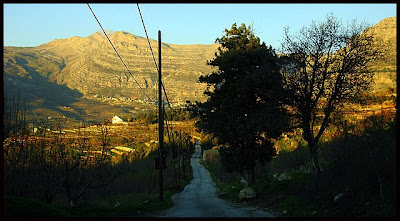
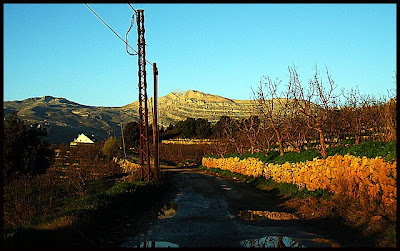
But why do I stick around? Well, to give you a little taste of that, just take a look at what I saw yesterday while I had the day off (another benefit of Lebanon; the incredible number of religious holidays), and went for a random ride through the mountains. Pictures appear in chronological order.
Enjoy! (because I sure as heck did while making them!)
A little road through a forest (we don't have too many of those, hence the picture)

We have a fantastic layered landscape, all sedimentary rock. Those layers are basically all different types of marine animals, mixed in with sea soil. Lebanon used to be a tropical lagoon, but you'd have to be into geology to appreciate that. The colors are not photoshopped; the light is fabulous at the end of the day.

Karstic rocks, they react very strongly to the acid in rainwater (some acid occurs naturally). The Hamas founder (now blown up) once instructed me on that.

You can see the anticlyne in the mountain face (geologist talk). Lots of synclines too.
Life is not too easy in these regions. Some agriculture, but from the looks of it, people make a marginal existence. One side of the mountain has all muslim villages; the other side of the valley is the domain of the christians. The light by now (4:35 P.M.) is absolutely stunning!
Every time I drive here, I wish I could mountain climb. Fantastic rock formations. Actually, I should just quit my job and explore this region. Parts of Lebanon are totally barren and deserted. As if you are in the middle of nowhere, they have an almost lunar quality to them, especially around dusk.
And look at these foreigners; they like it here so much that even at the age of 87 (left) and 93 (right), they still come for their holidays to Lebanon (okay, so they happen to be my parents).
These pictures were taken on the road to and from Afqa, by the way.

December 08, 2008

Sinterklaas

Sinterklaas (the Dutch Santa Claus, who hands out his presents on December 5th, not the 25th) visited the Dutch children in Beirut this Sunday, while he was on his way back from Holland to Spain. The holy bishop drops by on an annual basis to ensure this purely Dutch tradition continues.
I’ve lived here for quite some time now, and all the children that I have known since they were little are getting a little too old to be sitting on Santa’s lap. They still show up for their presents though! But there seems to be a steady supply of new little Dutchmen and –women, as the floor was crowded with new cloggies.
On my way home, a snapshot from the Corniche, and the local mosque, covered with rope light (Which I bet were not installed by a woman, which explains, according to Simon from Azzi, why they still are working).

December 07, 2008

On Customer Service and Women Empowerment

Last week I installed the Christmas decoration in my Beirut house. I do the outside of the house, string it from one end to another with rope light. I’ve been doing this for the past 10 years or so, and 100 meters of this rope light usually last for about 5 years.

And so this year I was in the market for a new rope light; 100 meters of it. My old supplier had hiked the price up with 40% since last time I was there, and as I thought that was a bit steep, I went to the guy next door, who still sold it at the old price; 100 meters for $100.

Home I went with my 100 meters of rope light, installed it, and turned it on. It worked on December 1st. And on the 2nd, and on the 3rd.

On the 4th of December only 5 meters of the 100 meters worked. The other 95 meters remained dark. It sometimes happens that one-meter stretches in the rope malfunction, but the parts before and after still light up. This was a major malfunction; no electricity reached the rest. And so I dismantled my decoration, rolled it up again and went back to the store.

“Your rope light doesn’t work anymore.”
“Well, it worked when you left the store.”
“Yes, for 3 days. But now it doesn’t.”
“Well, did you hang from it?”
“No, it hangs on the roof, how I can hang from it?”
“Did someone twist it?”
“How can you twist it? It is hanging on the roof.”
“Did you pull it very hard?”
“I INSTALLED it. I did not hang from it, pull, push, twist or shove it!”
“Well, did they make a mistake when they installed it?”

And so he was, with all his might, thinking for reasons why it would be my fault rather than him selling inferior products.
Any idiot can install rope light, it does not need a rocket scientist. But when I mentioned that I was the one installing it, his face lit up. He had found the reason why his shitty, inferior and mucho cheapo crappy merchandise was not working. A WOMAN had installed it.

“Ah, that is why it is broken. You must get a specialist.”
“To install rope light?”
“It is electricity, you need an electrician.”
“Are you kidding me?”

As I was telling him that I had been installing my own lights for ten years, and never had a problem, he was plugging in my rope light and fiddled with it.

“Zapp! “, sparked my sparked rope light suddenly. The man looked shocked. Now only 2 meters worked.

“Be careful, you must have an electrician handling that stuff, very dangerous,” I remarked with sarcasm.

“Well, I am sorry, but we do not have warranty on lights. We cannot give you your money back. It was working when you left the store. And we cannot give you new lights,” he replied.
(the house is not mine. Remember,
my lights don't work anymore)
And so it goes. The warrantee lasts until you leave the door, woman!

So remember, when you buy electrical equipment, do not buy it from a place called Azzi in Bourj Hammoud where the salesman is named Simon. Especially not if you are a woman.

December 06, 2008

Economic Euphoria

It seems the economic crisis has not reached Lebanon. Or so they say.
BBC News
The Independent

Well, aren’t we the lucky ones!

No massive lay-offs, no foreclosure on houses, no pension plans that go up in smoke and no recession. This may be of course because we have been in a recession since 1996, and we got used to an economic crisis. We’ve been in a crisis forever.
People don’t really get a substantial pension in this place anyway, so whether it goes up in smoke or not is not that much of a deal, it is not something they rely on anyway.
Foreclosures? I haven’t heard of any, and with most young people out of the country because there are no proper jobs to be had here to start with, what jobs are they talking about? What you don’t have, you cannot lose either.

But today I heard from two friends – separately – that the companies they work for, both Arab-based companies (one in Dubai and the other in Saudi Arabia), have frozen all spending, trips, conferences, workshops, bonuses and the likes. It won’t be long before the lay-offs will start in the Gulf, and then these Lebanese will be heading home.
I guess our crunch time is coming pretty soon too.

December 01, 2008

Archaic II

I lifted this one off a fellow 'Dutch in Lebanon' blog. It is quite funny, in a way. Sad, in others.


My friend visiting me from the Netherlands and I were sitting in the back of the minivan going around Beirut. It was dark and raining outside, and we were the only ones left on the bus – we were getting close to the final destination. The van stopped to pick up another passenger. It was a young woman opening the sliding door, folding her umbrella and taking a seat on the first bench. The bus continued its way, the door still open.
She’s not closing the door! my friend whispered to me. No of course not, I replied no longer surprised at the scene in front of us, women here don’t close the door. They wait for the men to do that. As we were the only other passengers on the van, there were clearly no men to close the door for her. So who’s going to close the door now? my friend asked, while the girl turned to close the small window next to her, still looking where those annoying gusts of wind and rain came from. No one, it will eventually close when we go downhill and the bus hits the brakes, I said. The door indeed remained open until a few minutes later we stopped at a crossroad.
It is something I can’t get used to, this weak attitude of many Lebanese women, and my Dutch friend’s astonished reaction was a nice reassurance that I am not alone in my disdain for the dependency it displays. Why would any girl need to pass the water bottle to her male friend to open it, when she has proven she can easily do so herself when he is not around? Why does he need to carry her bags, when she is the one who wants to take the stuff with her? I simply don’t understand what’s nice about seeing other people carrying my groceries to the car, or having to stand aside while some men are struggling to load my cupboard onto a truck – clearly in need of an extra hand, but unable to accept help from a woman.
Sietske seems surprised that
the bank offers her a credit card and then requires her to bring her husband to sign with her. I say: in a country where women refuse to open or close their own doors, it only makes sense that they are not allowed to open or close their own accounts either. (Source)