April 29, 2008

Quintessential Lebanese

What is quintessential Lebanese, without getting into clichés? Some friends and I were talking about that the other day. What – when you see it – do you directly identify with Lebanon? And don’t use things like cedar trees, or the flag. It has to be something non-symbolic, daily. Everyone had his/her own thing. I couldn’t think of anything. But when I went home, I encountered several things that all made me think; this is Lebanon for me. The little basket hanging down for Abu whatever from the local mini-market to put in the half a pound of sugar. The green color of the iron entrance door to the building. The type of tiles. If I would see these anywhere else, it would all remind me of Lebanon. Or three guys on a scooter, going to the beach. What is it for you?
(This is post #600)

April 26, 2008

Hassab Ras alZboun or 'It Depends on Your Face'

It must be well known to anyone out there that one major tradition in the Middle Eastern culture is to negotiate over the price of certain items.
If you don’t haggle, you will get screwed’, my very first landlord in Beirut told me. (My landlord told me that of course after he had majorly screwed me with a rent of $250 for a shack on the roof, when real estate in Beirut was still affordable, and you could get a 250 square meter apartment in the city center, with a view, for a mere $300.)
You haggle over the price of a ride in a taxi, the price of furniture, the price of labor, how much the plumber should get for fixing the sink, the rent, and you can even barter over the price of a fridge in a genuine warehouse. Little did I know then.
Now I know, but – being from a Dutch culture, where we lack fantasy at times – I still cannot haggle. What is worse, with a foreign face, the price is likely to be hiked up even more. The Lebanese adhere to the principle of ‘hassab ras alzboun’, which translates into the price ’depends on the face of the customer’.

One of the first things I learned when shopping with hubbie for things for the house was; “Do not smile or point at the things you like. What am I saying? Do not even look at the things you like! Keep walking, and after a while you can quietly whisper in my ear what caught your attention. And I will then go back and check it out.”
What he meant to say was that any salesman could read from my face what item I liked and how much I was willing to pay for it, which was at least five times more then it was worth, according to hubbie.
And so I strolled through stores with a face of thunder. I’ve become quite an expert at it. Shopping with me would give you the impression that I thought the entire place stinks.

I was lucky; the husband of a Dutch friend of mine would not even let her out of the car until he had surveyed the store, saw what was out there and what the owner was willing to let go at what price. When that was established, the ‘foreign wife’ was allowed to enter. By that time, the shop owner was stuck, so to speak. Had he known the ‘khawasja’ (gentleman) had a foreign wife, then surely he would be able to pay a good price. Because somehow, many hundreds of years ago, the price of a foreign wife must have been higher than that of a local wife (harhar).

But as any wife must know, shopping with your partner is a pain. And so I shop alone. If there is something that I think is nice, I jot down the logistics, and send hubbie on his way. This also takes care of the bill and transportation. Very handy, if I may say so.

But I was a bit stuck last week. Hubbie was out of town, and I had seen this painting while driving by a store. I must have passed this store quite a number of times, and every time I drove by, I was struck by that same painting. The first time I thought it just looked nice. The second time it looked nicer. The third time I thought it probably had already been sold as it was so nice, and was surprised that it was still there. And this process repeated itself a number of times, until I thought, I’ve got to buy it.

However, in that particular neighborhood, known for its so-called ‘antique shops’, they are renowned for ‘screwing their customers’. It is all about ‘the price depends on the face of the customer’.

Me, being a foreigner, and a bad haggler, would not only be double-screwed, but probably triple-screwed. How much was it worth? I thought it could easily go for $500. Maybe $600. What if he’d ask $700? Would I buy it? I’d have to give up some plans this summer. But it was worth it. What if he’d ask $800? Or more! Hubbie would have a heart attack. Dilemma dilemma.

And then an old aunt passed by. She’s wearing black, as she is in mourning over the recent death of a relative. Her arthritis makes her walk with a slight limp. She is somewhere in her 60’s. And she is a vicious haggler. I hurried her into my car, and parked around the corner of the store. Off she went; a woman on a mission.

She was back within a minute. “He wanted $100. I said: “No special price for me?” so he let it go for $90. I told him he could get $75 for that piece of junk. You want it?”

Do I want it for $75?

You could see the salesman’s face drop when around the corner came the lanky blond foreigner with her car keys jing-jangling in her hand, sunglasses the size of fly-eyes and a dainty little shoulder bag.

He had ‘I am screwed’ written all over his face. So the price depends on the customer’s face, huh? In your face!

Now if anyone can tell me who painted the original, that would be nice. Ooof, this was a long post about nothing. Glad you could make it to the end.

April 25, 2008

Recording the Memories Before they Die

I’m immersed in a story about the Palestinian camps. I recently spent an entire day in Beddawi looking for eyewitnesses that still remember ‘al-Nakba’; the ‘catastrophe’, as they call the flight in 1948.
Beddawi; one of the 12 Palestinian refugee camps in Lebanon

It’s been almost 60 years now since the foundation of the State of Israel, and time is running out. That was painfully obvious, because after a day long search, I could locate only one, and she was just ten when she left Palestine in 1948. It is very sad. We have tons of eye witness accounts from WWI combatants, and Holocaust survivors are filling museums with their testimonies, but I must say there is not that much on the Palestinian exodus in 1948.Kids in the camp. This is the fourth generation born outside Palestine.


In the end I did find a lady, but she was ten years old, and does not remember more than the house and the trees in the garden. Maybe she remembers more, but you’ve got to find someone who happens to be eloquent as well.
The lady in the middle was 10 when she fled Majet B'Kroum (Northern Israel)

There are no memories of Palestine on the walls in their houses. No pictures (they either left everything behind or they had no cameras), but no maps either. They do know the geography of Palestine though; they learn it at the UNWRA camp schools. What surprised me though is that very little seems to be passed on to their children.
Inside the camp

Or they pass very selective stories on. When talking with the very old, the generation that fled, they remember they had a small house, some land, nothing luxurious, but they made a living and were content.
This guy had the Nabatiyeh camp (destroyed in 1973 by the Israeli Airforce), fled to Tell el-Zaatar (destroyed by christian militias in 1976), fled to Sabra (survived the 1982 massacre) and then fled, after fighting between the PLO and moslim militias, to Nahr el Bared in 1986, which he had to leave last year. He now lives in Beddawi. His fifth camp. He is 58.

When you get to the young kids, the 12 year old, and you ask them about the land of their grandfathers and great-grandfathers, they tell you stories of how huge their mansions were, and how extensive their lands. They only know Palestine from TV

Their vision of the kind of life they led in Palestine seems slightly distorted.

The ones hat are stuck in the camps in Lebanon these days are the ones that a) were poor in Palestine, and b) that are moslim. The Christian Palestinians all did get a Lebanese passport, and thus were able to make a decent living, instead of surviving on the UNWRA hand-outs. (note; there is one small camp in Dbayeh with a number of christian Palestinians, numbering around the 4000). And those with an education or some money all somehow managed to start again somewhere else in the world.

Inside the Beddawi camp

I was once in Washington with a journalist, and I was absolutely overwhelmed by the number of highly educated and wealthy Palestinians we visited there. But nobody liked to speak about their flight.

Shebab in the barber shop

This oral history, this collective memory, is something that is slowly dying. In 20 years from now, not one of the refugees will remember Palestine as it really was. An entire collective memory will have been erased.

The Nakba Archive has recorded over 450 eyewitness testimonies with Palestinian refugees living in Lebanon. It is pretty impressive. At the 2008 Palestinian Film Festival in London (April 18th – May 1st) there are two short films that deal with these testimonies. One is called ‘Collection of Testimonies from the Nakba Archive (Lebanon)’ from Diana Allan & Mahmoud Zeidan and the other is called ‘Women's Testimonies of the Nakba’ by Raneen Geries. This is a link to an interesting video on the making of that film ‘Collection of Testimonies from the Nakba Archive (Lebanon)’. If you are in Holland, The Tropen museum has an exhibition on ‘Palestine 1948; Remembering a past homeland’.

April 24, 2008

Dutch Cultural Intermezzo

The Dutch are well presented in Lebanese society; we have journalists, teachers, IT managers, NGO personnel, nurses, socialites, lots of bloggers, and now we also have rock stars.
So for some Dutch culture diffusion into Lebanese society, come check her out; Anne.

April 22, 2008

Tree House in Beirut

I was talking to a German journalist about the impression people from outside have when they think of Lebanon.
People in Germany do not know much about Lebanon,” he said, “they think the entire place is all bombed flat.”I was thinking about that this evening, as I walked through town at dusk, with a soft spring breeze playing around, and I walked by this house. I had to do a double-take. A tree house! They have a tree house in the middle of Beirut. It had a gangway leading to the balcony of the first floor, and a cut-out heart in the wall. I always wanted a tree house like that. (Go design your own tree house here)


And I was wondering; how do you explain this to people in Germany?We have tree houses in the middle of the city?

April 20, 2008

Our Southern Neighbors

This post has no moral. Lebanese biker in the Sinai Desert (Egypt)

For those not familiar with the political situation in Lebanon, we – as Lebanese – are not allowed to have contact with ‘the enemy’. The enemy are our southern neighbors; the Israelis. And as a result, we know very little of each other, other than the usual propaganda. They are all after our land and our water, and we’re four million potential suicide bombers.
It is inevitable, that outside our own borders, we frequently run into these Israelis. At airports and in foreign towns.
The first reaction is one of ‘Look, those are Israelis’, as if we have encountered some species from the wild; after all, we never get to see them in real life. Well, we do get to see them during invasions and wars and the likes, but that is so surreal, you cannot consider that ‘real’, or ‘normal life’.
But the second reaction is that they are so like us. They pretty much look the same, especially if they are Sefardis (jews who originate from the Middle East as opposed to jews coming from Eastern Europe). And then if you end up in conversation with them, they turn out to be very friendly people who quite often say that they are so sorry about what is going on in the south and that as far as they are concerned, they never wanted to invade and all that. You don’t know how true that is, maybe they just say it to make you feel better.
But all the Lebanese that I know that ended up in a conversation with an Israeli outside of Lebanon basically have the same reaction; “they are really nice people, just like us.”

I remember one time riding with a group of Harley Davidson bikers from Beirut to Sharm el-Sheikh (Egypt). And as we drove through the Sinai desert, we ran into some other bikers at a gas station. As this was the first time they had seen fellow bikers since Beirut, all 11 Harley riders crowded around these two bikers.
So where are you from?” they ask.

Now remember; most Harley riders in Lebanon are men of a rather advanced age. And thus the hair on the top of the skull is either thinning or gone. As Lebanese, it is of course a preposterous thought that they should wear helmets, and so by the time they had gotten to Jordan, they all had a severely sunburned skull. They decided to buy some headgear at a roadside stall, and the salesman happens to have the Palestinian kaffiyeh. So here we have 11 leather-clad men with heavy beards, black Raybans around their head and wrapped in Palestinian kaffiyehs, crowding around these two guys.

So where are you from?”
Around,” one of them answers. He wears a white T-shirt and jeans. He does not look overly happy.
Around?” They look at his license plate. “Shit, you’re from Israel, man! Cool. You guys alone?”

No, there are more of us coming. They are not far behind.”
The Lebanese are trying to get as conversation going, but the Israelis are very short, do not seem at all interested, and they take off at breakneck speed.
The ‘others’ never showed up.
Geez,” says one of the Lebanese, “that wasn’t very friendly. I was just trying to have a conversation. I was just interested. No need to get so offensive.”
Have you considered that they might have been scared shitless of us? We do not really look very peaceful, and we’re Lebanese.”
Afraid of us? I thought it was supposed to be the other way around.” They all though it was pretty funny. Here you have a couple of Lebanese middle-aged guys, sincerely interested in getting a conversation going with the ‘enemy’ about bikes and road conditions in the Sinai desert, and it turns out they scare them away.

So what was the message of this? None. But I was inspired into this long train of thought by a post from Leila, who runs into some Israelis at a parking lot in the US. It is near the end of her post. Interesting read.

April 19, 2008

More Trains and Tortoises

This seems to be a recurrent topic; trains and tortoises.
But I had work up north today, and thus passed by the Tripoli Train Station. I must have passed this station a hundred times, and every time I’d tell myself; I have to go in and take pictures. After last weekend’s treasure, I couldn’t pass by it again without going in.

Mind you, it has taken me a total of some 18 years to actually stop and walk in. Climb in. It’s not like it is open to public.

There are a total of 7 (!) complete locomotives still on the tracks. Complete is of course a relative expression; they seem to have all the parts, but they are a bit rusted. Some have entire trees growing out of them. I am sure that you could sell these things to some collector outside, and make good money out of it. But as it is, these things have been standing here for as long as I’ve lived here, and they haven’t moved an inch since. And probably even longer.

There are two hangars and a number of auxiliary buildings, but most of them are in very poor state. However, at one point in time this must have been a pretty big station for those days.

What was surprising though was that these locomotives are still oozing out tons of oil. Thick black diesel oil, seeping pout, and running over the land, standing in puddles. I wonder what that does to the quality of the drinking water in town. But who worries about oil in his drinking water when the water pipes of the Tripoli Water Company are made out of asbestos. I was told. It seems to be safe. All in all, I am mighty glad I do not live in Tripoli.

And what did I stumble on? A little tortoise, probably of the same family as last week’s, all stuck in oil. A rescue mission was in place, and while the first tortoise was released last week, the second one is now being cared for. I am now the Beirut Tortoise Rehabilitation Center.

And I am now 'trained and tortoised out' for a while.
Next topic; Palestinians. Stay tuned.

April 18, 2008

Old Pictures of Lebanon

Absolute fabulous pictures, sent to me by Kheireddine. The railroad houses of Lebanon. Same style, same water tower, different station. I don’t know who Kheireddine is, but he’s got some wonderful stuff stacked in the attic. This is the train station of Jomhour, one stop before mine (you bet ya it's mine!). Check out this water tower and the house. It is absolutely identical. (This is a great help, so the engineer will know what it is supposed to look like in restored state)
Train station of Rayak. It is obviously a stream train, or the thing is on fire.
Thanks Keireddine, this one was much appreciated. More stuff here and here:)

April 16, 2008

Chouit – Araya Station

I’m not a train buff. But last Sunday I stumbled upon this absolutely gorgeous ruin, in the mountains some 15 kilometers above Beirut, and I did some research.It looks like a typical French railroad station house, and that is because it is (a French railroad station house). You see them everywhere in France (the older type of railway architecture); a reminder of who built the railway system in Lebanon.
I knew there was a train running from Beirut to Damascus. But I never knew that Chouit – Araya had a railway station, but here it is. There is no train track left. But the station house is so typical, you cannot miss it. The water tower next to it is still intact; they had steam trains in those days, so they’d need to refill water.

I absolutely want this house! I can just see hubbie’s face. He loves projects like this (not). But I’ve got my eyes set on this authentic French railway station house, dating from colonial times.

Railway in Lebanon
There used to be several tracks in Lebanon, connecting Beirut to Damascus, and Jerusalem, and through these places even to Istanbul, Baghdad (Iraq) and Hijaz, in Saudi Arabia! (Check out this New York Times article from 1899) . That was of course before 1948, and the foundation of the State of Israel. Those were the days, my in-laws tell me. Things have changed quite a bit since then, including that railway.

Along some parts of the coast you can still see bits of track. Right before Sidon (Saida), for instance, you have some rails next to the sea, or up near Chekka (up north), bits of railroad run right through beach resorts. There is a railroad tunnel to the Beqaa, but I have no idea in what state that one is. Map source

The first railway in Lebanon was also the first in the Arab world. It was opened on August 3, 1895, when a steam locomotive took the first passengers from Beirut to Damascus. (…) The 147km trip from Beirut to Damascus used to take nine hours, passing through Baabda, Aley, Bhamdoun, Sofar and Dahr al-Baidar before descending into the Bekaa towards the Syrian border.’ From fellow Dutch colleague Peter Speetjens.

The train started in Beirut (Station), passed (among others) through Jamhour (Distance from Beirut) 11.9 km , Araya 16.1 km, Aley 20.4 km, Bhamdoun 26.4, Ain Sofar 30.5 km, and ended some 144 kilometers later in Damascus Baramke, Syria (the place where you are dropped off these days when you go by yellow cab to Damascus)

And as you can see, Araya was an actual station.
The line to Jerusalem was cut in 1948, the line with Damascus was destroyed in the first two years of the civil war (1975-1977). And that was the end of the Lebanese railways.

I know the Damascus – Istanbul line is still up and running and you can even get to Teheran, Iran. Someone told me it only costs $60 to get from Damascus to Teheran by train, but it does take you three days. I’d love to do that one day. Anyone up for that?

In the meantime, I absolutely want this house!
We actually already moved in. In our minds. Now how do we break this one to hubbie?

About Time

New stencil grafitti in the neighborhood. Makes you wonder. I am not suggesting anything.

April 13, 2008

On Toilets and Civil War

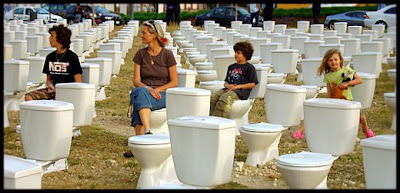
While coming back from a picnic today, I passed by this installation in downtown Beirut that was just about to be unveiled. They were still scrubbing pots, so to speak.
These toilets are supposed to serve as seats for the public for tonight’s concert.

This particular exhibition is a commemoration of the old civil war, which officially started today, on April 13, some 33 years ago. (1975 – 1990).
The date is often seen as the ‘official’ beginning of the Lebanese Civil War. On this day, in 1975 a busload of Palestinians got ambushed in a Christian neighborhood, after earlier that day an assassination attempt had been carried out on a Christian leader. Nobody ever got caught of course, for either event, but that is quite common for this country.

However, is it not only a commemoration, but also a reminder, or a strong warning, to people of the possibilities, and the ludicrousness, of a new civil war. So why the toilets, you may wonder?
People in Lebanon have been hiding in toilets for 15 years, so you’d figure they’d have learned something in the meantime.
For those unfamiliar with the mechanisms of a (civil) war; the toilet (or bathroom) is supposedly the safest room in the house during shelling because a) it has either no windows or very small windows, and b) most bathrooms in Lebanon have a double ceiling, because the water tank for your shower is right above the bathroom.
The people that I know usually hid out in the corridors, or the underground basement of their building, but quite a few must have spend substantial time in the toilet.

Hence the title of this installation.

I think the initiative is cute. But I fear that the decision of a war or not is not in the hands of the common people. I figured out that much. The past few weeks have been uncommonly quiet. Why people would not blow up other people now or engage in street fights regarding bread prices, but a couple of weeks ago they felt a strong need to, gives me the uncanny feeling that it is all orchestrated.

I’ve got two bathrooms. All ready and set. Just kidding.

April 12, 2008

Lebanese Tortoise

The weather is good, the weekend is short, and there is so much to see and do, so I took the tribe and got on the road again.We were on a mission, because we had to release a tortoise.
Last week, H. found a tortoise while we were out somewhere in the mountains, and of course it had to come home.

We figured it was a Golden Greek Tortoise (Testudo graeca terrestris)

The poor thing was a bit handicapped. It had his left leg missing, and the claws of his right front paw were gone as well. But the wounds were old, and it was pretty clear that this ‘cluster bomb’ victim was chugging along through nature just fine.
No matter, according to H, ‘he was coming home with her’. And sleeping in her bed too. Well, that did not quite materialize as she figured out pretty soon that the happy camper was peeing and pooing all over the place. See the missing leg? Well, not much to see, as it is missing. No claws on the front right either. He's been in a pickle, this one.

She washed him, scrubbed him, combed him (I swear I saw a brush), dressed him up and talked to him. It was in the interest of the animal however that she soon lost interest in him.
And so today, with her permission, we returned him to the wild. It was either that or turtle soup. The housekeeper was positively ogling him.

I often find tortoises in the wild here. We don’t have a lot of wildlife. Lack of rules and regulations, and/or the lack of enforcing these rules & regulations regarding the protection of wildlife is probably the biggest cause of it. That, and pollution, and the loss of habitat.
You can blame it on the war, but in general people in this part of the world do not show great empathy towards animals. Apart from canaries. I do not blame them. You can hardly expect people to start worrying about animals when people are suffering.

But tortoises seem to pretty tough animals. Look at this fellow. One leg and part of a hand (claw) missing, and a week with a girl, still going strong.

April 05, 2008

Clouds over Beirut

Isn’t it strange how each place has its own skies? I noticed that a couple of days ago when I saw these clouds over Beirut, and it struck me as being unusual for Beirut.

Skies over Beirut

We rarely have clouds like these. These are not Lebanese clouds. These are clouds that are supposed to hang over the prairie in cowboy movies. At least, that is what it looks like to me. Just like the ones below in the picture (looks like a painting, but it is a picture)
Skies over the prairie (Somewhere in the USA)

Dutch clouds are also very different from Lebanese clouds. Very famous, I might add, as people even write dissertation on the connection between the famous Dutch masters of the 17th century and the cloud cover of those days. Three quarters of Dutch paintings from those days involve portions of the Dutch skies. Actually, there are lively discussions about Dutch cloud covers and their influence on Dutch painters going on on the web .

Dutch skies in the 17th century (Painting Jacob van Ruisdael; 'wheat fields', ca. 1670)

In summer, when I go back home, it is indeed the clouds that I notice the first. They are my ‘home’ clouds. The clouds over Beirut are my ‘holiday’ clouds, as they remind me of holidays spent in the south of France when I was little.

But these clouds, they should hang above the prairie. Not Beirut.
And if you think all this talk about clouds is not fluffy enough for your taste, I recommend you pay a visit to the Cloud Appreciation Society.

April 04, 2008

Definitely Blond

I’m triple parked in Bourj Hammoud (neighborhood in East-Beirut) main street. I’m picking up a sewing machine that was in repair, and there are no parking spots anywhere. The entire street is double parked as it is anyway, and there is no way I can haul a 50 pound sewing machine over a couple of blocks, so I decide to triple park, be real quick, and take my chances.
When I come out of the repair shop, sewing machine in hand, I spot a policeman near my car, leaning in my window, and honking the horn. He’s got a ticket book in his hand.

As I walk over to my car, I give him my biggest smile. I put the sewing machine in the back and look at him. He looks back.

Dior?” he asks me.
Excuse me?” I ask him, as I keep giving him my most charming face.
Your perfume.”
Oh, oh, my perfume! Yes. Yes, Dior.” Confusion now.
Which one?”
Which one what?”
"Which Dior?”
Oh. Oh, my perfume. Uh, Pure Poison.”
Ah, good one. Nice,” he says, and he walks off.

No ticket.

I think I needed about 5 minutes to regain my composition. Totally impressed. So this is a traffic cop in Beirut. Knows his scents, this guy.
I wonder what he must have thought.

‘Definitely blond’, maybe?

April 03, 2008

I Told You So!

Hahaha, didn’t I tell you!

Army Commander General Michel Sleiman told the Lebanese daily As-Safir that he has had enough with the ongoing squabble over his role as Lebanon’s consensus presidential candidate and said that the delay of his election pending an internal agreement has started to offend him.
Sleiman said he will not wait until the end of his term as army commander on November 21, 2008 to leave office, but will resign on August 21.
“I have informed the military council of my decision, and it is final,” Sleiman told the daily.
Source

April 02, 2008

Pimping Up the Outfit

I read a funny article in An-Nahar yesterday. It’s about Lebanon’s Battle of the Billboards. I thought it would cover the sheer multitude of billboards that line the roads, and basically pollute the land- and cityscape, but it was about how the political battle is continued on bill boards. Anyway, read the article for yourself.

They mentioned something that caught my eye:

Hours after Hizbullah commander Imad Mughniyeh was killed, huge billboards of his burly face stenciled like the iconic Che Guevara portrait or a photo of him in battle fatigues were printed and ready to display all over Lebanon. Pictures of this man on America's Most Wanted list are among the first images to greet visitors to the country, lining the road from the airport to downtown Beirut. (….)

Like any ad firm, Ressalat's (a Hizbullah-funded organization that handles advertising and cultural events for the organization) creative director Mohamed Noureddine and his team hunkered down after Mughniyeh's killing in a car bombing in Damascus in February to come up with a sophisticated campaign. "We came up with a stencil of him so that people can remember him like they do Che Guevara," Noureddine said. "This guy sacrificed his life and it is his right to be recognized and for people to see his picture."
Che Guevera versus Imad Mughniyeh
Now there is no comparing the two. In a battle of icons, nobody beats Che. It’s a handsome, adventurous young man with long flowing hair against a pudgy middle aged housefather with glasses.
The only thing they have in common is they both are in battle fatigues. And they both considered themselves freedom fighters, but I’ll let you be the judge of that.

But I can just see these guys sitting together, brain-storming, and suddenly ‘ BLINK’, “Let’s turn this guy into a Che Guevera”. It all fits. The stenciled outline, the background (red for communism, yellow for Hezbollah).

Hezbollah usually has some pretty dorky bill boards, with acne infested teenagers in battle fatigues, surrounded by pale roses, with a light pink or baby blue background, and a bright star, signaling their ascent into heavens, among the stars (basically indicating that they’re dead).
But I must admit, they’re getting better. These guys are actually getting hip! And although I prefer not to make any judgments, this is 1-0 for the opposition.

Andy Warhol (Che Guevera) versus Michael Hogue (Abbas Mussawi)

Can someone get March 14 on the line and tell their advertisement campaign manager to get on the case!