October 30, 2006

Beirut is Mushrooming

When I first moved to Beirut, the garbage wouldn’t get picked up for weeks on end. You might think that would result in huge piles of garbage on the sidewalks, but somehow, that didn’t happen. That was because in those days (1990), Beirut was a city with high-rise buildings, separated by stretches of waste land. So in the middle of Beirut you’d have these blocks of green jungle (well, not in summer) where squatters would have set up a couple of shacks and such. Street dogs would gather there in the evenings. And garbage would be dumped there.
You could also park your car there. Wildlife was still abundant in these waste lands. I had a very crummy car in those days, and one morning, as I got in, a snake had decided to sleep on the seat next to me.
It gave Beirut a rather ‘village like’ atmosphere.


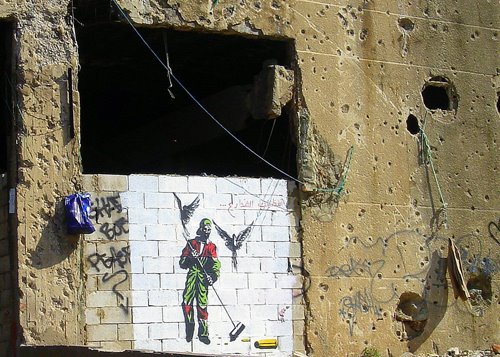
'An ode to the garbage man'.
I do not know who painted this picture on a wall in downtown Beirut, but it seems like an (well-deserved, in my opinion) ode to our 'Sokleen' guys. These are the garbage man (in the well-known green & red uniforms) that sweep Beirut's streets and empty the bins.

The first sign of change came when the government decided to get rid of the street dogs. They’d do this at night. You’d hear a shot, and then horrific yelping going though marrow and bone. And that was the end of the street dogs. We still have a few, but not nearly as many as in the early nineties.

The second change came when all these wastelands were turned into parking lots. There was a law for that one too. So wastelands and dilapidated buildings were bulldozered flat and fitted with a nice layer of tarmac. Now we had an abundance of parking lots. This created work for the so-called parking lot attendants, who’d charge you 1,000 for a spot. This has gone up to 1,500 (a dollar) these days, still not much, although some idiots downtown give you the impression they are going legal, and charge you sales tax, so you pay 1,750. (1,500 + 150 would add up to 1,650, so they steal you of 100 pounds every time you park).

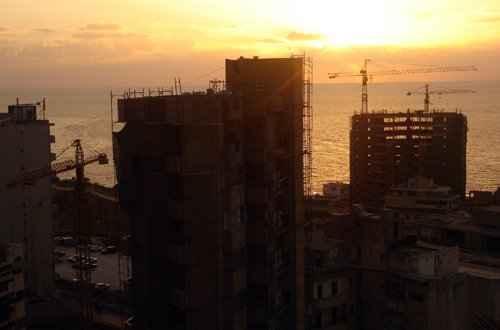
And the third change was the building boom. The past two years, Beirut is mushrooming. Everybody keeps telling me the economy is in a slum, the national debt is over 40 billion dollars, and nobody is making any money anymore, but they sure as hell are building like mad. Little by little, I notice that all the familiar wastelands and parking lots around me are slowly clogging up. The famous French Club, with its pine trees, is a building site. And areas that I hadn’t noticed for years because of their inactivity or suddenly tac-tac-tac-tac-tac-taccing with pick hammers and bulldozers and dump trucks. The Israeli bombardments only momentarily halted the process.


Three building sites visible from my kitchen window only!

Beirut is mushrooming. It is becoming a vast boomtown. In my block alone (!) there are three new buildings being put up. Three! A fourth one was completed just this summer, and there is still space for another one.


Slowly but surely this city is becoming like any other metropolis. The charm of the spaces in between, the little waste lands, is slowly disappearing. Before you know it, we live in a ‘real’ city, and no longer in a village.

October 27, 2006

On Traffic Jams and 'Normal' Conversations

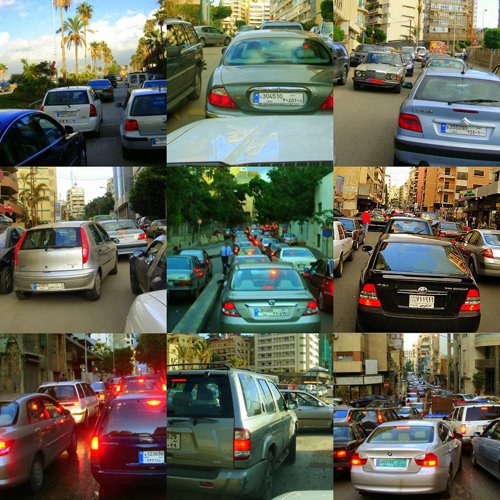
A view of just 9 of the 253 traffic jams I spent half of this week in. I do not know what is happening (a conspiracy?), but this is the worst traffic I have experienced in Beirut in 16 years. I think from now on I am going to walk.


Conversations We Have
The situation in Lebanon is rather odd at the moment. There is this sense of impending catastrophe. Something is in the air, we just don’t know what it is. But it is something. Something is brewing. Something is about to happen. It reflects in the conversations people have.

6:35 AM this morning, the housekeeper:
“Madam, I think you should buy some extra gas bottles. There were so many choppers last night; it looks like we are going to get bombed again.”

11:20 AM at work, the math coordinator:
Check out this math web site, it has good interactive exercises for students to do at home. Excellent in case the war starts again.”

For a Lebanese, there may be nothing strange about conversations like this, but just now and then, as a foreigner, I catch myself thinking “Jesus, just imaging talking like this in the cheese section of the Albert Hein (Dutch supermarket chain)!

October 25, 2006

Rain

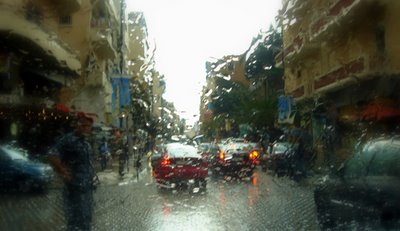
The rainy season has started in Lebanon. This is our official winter, and can last up to March. It is funny how cars seem to multiply in Beirut whenever it rains. Traffic has been pretty horrendous for the past week. Trips that would usually take you 15 minutes can now last up to two hours. Last week, on my way back from work, I got stuck on a crossing. The first 5 minutes, you wait patiently. The next ten minutes, you wonder what on Earth is going on. Then your amusement at the absolute chaos slowly makes places for annoyance, slowly seeping into anger. Everyone is one his own, making the problem only worse. No policeman in sight. A couple of soldiers walked by, I figured they might clear the job, but they didn't do anything either.
In the end I got so upset, that I put my car in L4 (Low gear, four wheels), and thought; "anyone having the balls to block my way now is shit out of luck because I am going to bulldoze them right off the road, and like a snow shovel, I'll clear my own way." The rabid flicker in my eyes must have registered with fellow drivers, because the road suddenly parted like Moses parted the Red Sea (or was it the Dead Sea), and I was on my way home. A friend of mine got stuck in that same jam for over an hour as well.

October 24, 2006

Inburgeringscursus II, or 'In Lebanon, we drive with our arm on the door' Posted by Picasa

Inburgeringscursus, or 'In Lebanon, we drive with our arm on the door'

Inburgering; It’s the Dutch buzz word of the moment. Assimilation. These days, it’s all about ‘assimilation’ in the migrant policy of Holland. It seems we experience some difficulties with Arabs that fail to ‘adapt’ themselves to the Western society. We have a great many Arabs that are not assimilated, or ‘ingeburgerd’, as we say in Holland.
Mostly it is because of a lack of understanding. The older generation of Arabs, that arrived in the 60’s, never got the chance to fully master the Dutch language, and as a result were always living on the outskirts of society. This wasn’t much of a problem for the Dutch as there weren’t that many Arabs to start with, and the ones that were there minded their own business.
The Dutch, very conveniently, never did try very much to help them assimilate, sort of hoping that eventually they would go away, or at the very least would not speak up.

Well, obviously they didn’t. They stayed and they got children. Some of them have become Dutcher than Dutch. Others haven’t. They demand that society accept them as they are. Well, you don’t know the Dutch if you think that is going down very well. I know that we Dutch have the reputation of being the most tolerant nation in the world, but I can tell you that it is our general lack of interest in other peoples affairs that is often mistaken for tolerance.

Anyway, we are now having ‘inburgerings cursussen’; assimilation courses for new immigrants. To make sure that they understand that in Holland we do things differently than in the Arab world. We, as Dutch, make relentless fun of other people's religion, or actually we make fun of just about anyhting. 'Afzeiken' we call that in Dutch (pissing off, would be the direct translation). In my family we are quite good at it. And we believe that when living in Holland, you should be a good sport about it.
I had some lessons in assimilation as well, when, on my first interview with Hezbollah, somewhere in 1990, I drove into Dayiha on my Honda cross motor; 150 cc. That did not go down very well with the then press officer, I guy who I only got to know as a certain 'Mr. Mahmoud', if I remember well. Now if I had been a boy, that might have passed. But I wasn't. He was quite nice about it, offered me a green veil as I walked into the office (they do not do that anymore; they have, in turn, adapted to the Western press since then), but he did mention to me that 'when in Rome,' etc etc,' so could I please come in a car next time?
I did.
The government in Holland is having actual debates on these assimilation courses. I am not quite sure what they teach, but all this (yes, all this) came to mind when I drove through Beirut this morning.
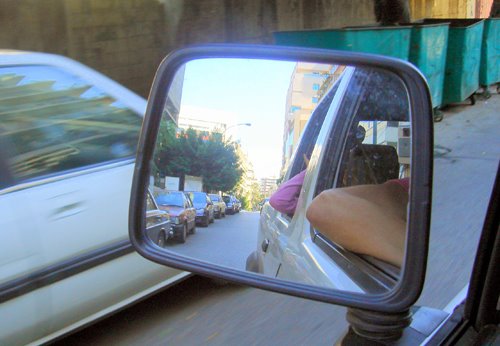
The weather was wonderful, so I had my car window rolled down, and my arm resting on the door. “Look Mom, just like you,” I heard my daughter pipe in the back. I looked in the mirror, and indeed, she had her arm resting on the door, just like me.

And it dawned on me that when it comes to driving, I have assimilated wonderfully well to Lebanese society. I even drive with one arm; the other one hangs out of the window. And now my daughter is learning as well.
So if they ever start an Assimilation Course' for foreigners, they should not forget that 'in Lebanon, we drive with our arm resting on the door.'

Dental Work

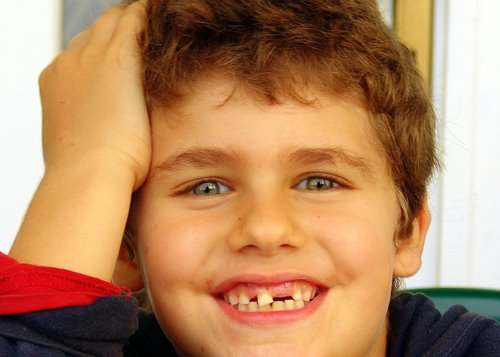
Cousin O is in serious need of some dental work. One tooth is gone already, and the other one is sort of leaning like an old tombstone in a graveyard. When cousin O was born, the idea was that he would be called exactly that; O. However, in view of society's general lack of understanding things that are beyond and above the unusual, they decided to amend it a little into a more ‘acceptable’ name. To us, however, he remains cousin O. He’s not eating apples anymore for the moment. And what a pity, because we just got back from zjiddo’s house (Arabic for grandfather), who’s got an orchard of different apple trees.
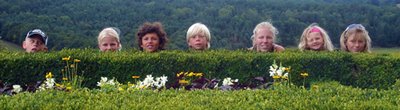
Here are some other cousins; Niels (could use some dental work too), Nienke, Eddie, Jelle, Sietske (Jr.), Hana and Maaike

October 20, 2006

The Original

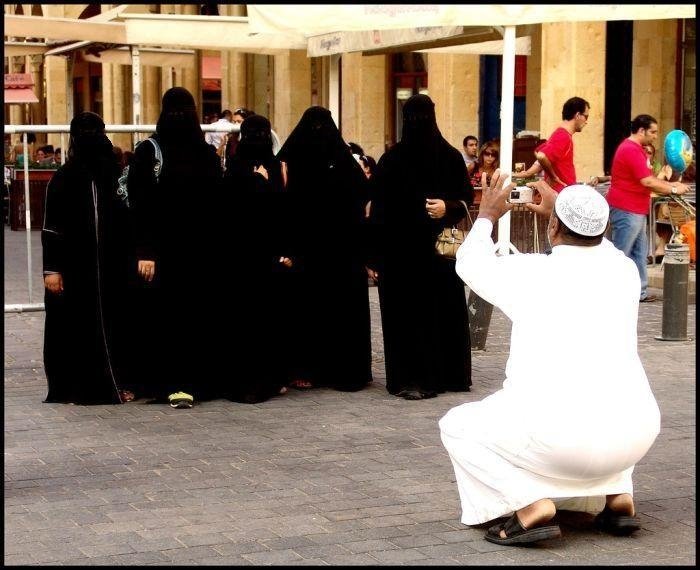
I found the original picture! The one I pasted a couple of days ago was unfortunately a photoshopped one. The lady on the left is not a Gulf Arab, probably a maid, and does not need to cover her face. The original can be found here, and is much nicer.

October 19, 2006

Beirut: Best of Both Worlds

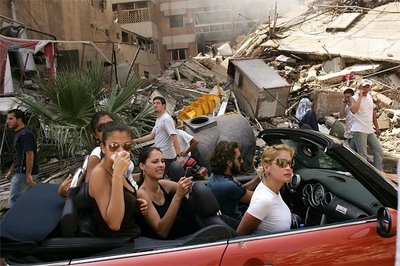
A hilarious shot, I think. So absolutely Lebanon! Got it from another blogger. Insiders will recognize this immediately; the Ashrafiye crowd touring the devastated Southern suburbs. War Tourism at its best.
In a way it is very symbolical; the Western (christian) crowd from East-Beirut (in the cabriolet) coming to visit the Eastern (moslem) crowd in (in the rubble of) West-Beirut, although Lebanese do not like you to use that terminology, West and East Beirut. “We are all one united Beirut” they always say.
To me it has been clear from day 1 that there were two Beiruts: the differences between East and West Beirut are very present. I kind of like it; two worlds in one. There are days I cannot stand the chaos, and spend some time on the other side, and then there are days when I am in a more laid-back kind of mood, need the down-to-Earth friendliness, and delve deep into the suburbs. ‘Getting the best of the both worlds’ is very possible in Beirut. That’s what makes this town so much fun.

I have had numerous experiences though with people in the East that have never set a foot in West-Beirut. Once I went shopping for plants somewhere in the East, and the guy asked us where we lived (I was with an American friend). “In Hamra,” we replied. Like he was smelling something bad. “Oh, you live there? Very dangerous. It is much better on this side.”
You hear similar stories on the moslem side, albeit less graphic. They do not feel so threatened, which explains the difference in attitude. I once got thrown out of cab from Damascus to Beirut (Lebanese cab) because I was not willing to listen to their remarks on how wonderful the shiite were because they ‘allowed’ the christians to live in Lebanon. When I asked them if they could replace the Koran prayers (had been listening to that from Damascus to Shtoura continuously) with a tape of Haifa Wehbe (just to piss them off a little), the atmosphere turned a sour, and I was asked to exit the cab. Never happened to me before in this country. You’ve got idiots on both sides.

I love the picture though. Wonder who took it?

October 17, 2006

It could be California,

Picture taken on October 17, 2006, at 5:47, Corniche, West Beirut, Lebanon

except that it’s safer here. (Huh? What is she saying?)

California Crime Index Rates Per 100,000 Inhabitants
(so multiply it with 37 to get approximate Lebanese figures)
523.6 violent crimes
3,322.6 property crimes
6.9 murders
26.0 rapes
176.1 robberies
317.3 assault
693.3 burglaries
1,916.5 thefts
712.8 stolen vehicles

We do have occasional bombings though, and you might be targeted by an RPG when exiting a night club. Other than that, I don’t think we fare so poorly.

October 16, 2006

A pat on the shoulder for the Lebanese

A tribute to the Lebanese from a senior UN official.

Commentary by By David Shearer Tuesday, September 26, 2006
I left Beirut last week feeling that in the few short months I was the United Nations humanitarian coordinator for Lebanon, I witnessed the Lebanese people in their very best light. Lebanon was my 11th assignment to a humanitarian emergency. It is from that perspective that I judge recent events in the country and how its people responded to the war with Israel.
When I arrived in July, with the conflict raging, 1 million people -- nearly a quarter of the country's population -- were in flight, living in areas away from the fighting and the air and artillery assault on their communities, to the safety of Beirut, North Lebanon or Syria. Only weeks later, with the cessation of hostilities on August 14, these same people were on the move again, this time in a rush back to their homes, so many of which were unfortunately found damaged or destroyed.
To my mind, the most intriguing thing about this large-scale migration was just how orderly and without incident it was. What other country could experience such a mass movement of its citizens in the heat of war and have virtually no incidence of hunger, malnutrition or deadly disease? In my experience, it's simply unprecedented.
For our part, the UN agencies and non-governmental organizations gave help where needed -- with food, water, medicine, tents, blankets and cooking utensils, even some psychological support. We were also able -- thanks to our ability to communicate directly with the Israelis -- to keep the humanitarian convoys moving. Some 80 trucks and two ships, in all, continued to deliver our relief supplies and those of the Lebanese government as well, even in the heat of war.
But the true safety net in this emergency proved to be the Lebanese people, themselves. Regardless of religion or ethnic background, families, even whole communities, embraced those fleeing the fighting, taking them into their homes and feeding and caring for them. To my mind, this is what humanitarian assistance is all about, and the Lebanese people proved in their compassion to be a model for the world.
It's now been just five weeks since the cessation of hostilities, and the humanitarian relief phase is pretty much over. For the most part all who needed food have been fed. Medicine chests in hospitals and clinics throughout the country are now full. And while water distribution in the South will continue for some weeks, government agencies, with the support of the UN and NGOs, are hard at work repairing critical storage tanks and water supply lines.
A few days ago I took a trip through South Lebanon. What was most amazing to me was to see how much of the reconstruction process is already under way. Lebanese communities have moved quickly to clean up the rubble of war. And dozens of government work crews could be seen strung all along the roadways, installing the new electrical lines and transformers that are quickly returning light and heat to communities and schools and that will power the generators and pumps to bring back regular supplies of water.
The reconstruction process will not happen overnight, particularly given the large scale of destruction, and the lingering legacy of those 300,000-plus cluster-bomb sub-munitions that will continue to endanger lives and livelihoods for some time to come. But thanks to the $900 million committed to recovery by donors at the Stockholm conference in early September, and significant bilateral donations from Gulf countries and elsewhere, the government and municipalities will have the resources in hand for a well-planned recovery.
Humanitarian relief efforts can sometimes drag on too long and overstay their need. This is one event in which the Lebanese people themselves helped speed the relief phase. Our job is done, and I take my leave, comfortable in the knowledge that the Lebanese government and its people, with the continuing assistance of UN development agencies and NGOs, are moving ahead confidently with the recovery process.
On a personal note, it has been an honor and a privilege for me to work with the people of Lebanon in their time of crisis. They've taught me a lesson about compassion and solidarity in the face of turmoil. I have no doubt that their wonderful energy and sense of optimism will be the mortar for building a better country than the one that has been so painfully damaged.
David Shearer was the UN humanitarian coordinator for Lebanon.

October 08, 2006

Oil spills, Clean Beaches and Salt Flats

I finally wrote the long overdue oil spill story. (An estimated 10,000 to 15,000 tonnes of crude oil spilled from a power utility south of Beirut after it was struck by missiles between 13 and 15 July. Some 150km of the coast has been affected) People of Seacore had been on the job for only one day, and yet I had never seen the pebble beach on the northern side of the Byblos harbor THAT clean! Not a speck of oil in sight, not one bit of garbage to see.

My elation was a bit premature, it seemed. All they had done, was indeed clean up the garbage, but the oil was still there. About half a meter deep. Because the clean-up operation couldn’t/didn’t start right away, the oil had about a month to percolate into the sand and pebbles. So the actual cleaning still had to begin. It seems you cannot start cleaning the oil when there is ‘other trash’ around. Yet the fact that it took only one day – and, granted, about 80 fishermen from the port of Byblos – to totally clear two beaches (the one on the southern side had been cleaned as well) of plastic bottles, household trash, medical waste and other bits of garbage, makes you wonder why the municipality of Byblos (or any other municipality for that matter) does not do this more often. It can’t be a money issue. How much do 80 men cost you for a day? $1,200 max? Or you think they wouldn’t work for that money?


Anyway, the oil seems to have sunk in on beaches. But according to the Seacore guy, this isn’t really a problem. He is planning on cleaning the stretch of Byblos to Anfeh - about 25 kilometers – in exactly 60 days (and with $5 million). That includes getting that ‘rim out of the bath tub’ as he called it - all the rocky parts have this black oil on the water level - the monuments, the beaches, the oil that has sank to the bottom in front of the coast, the quay, and they intend to get the fishermen’s boats out and sandblast them to get that layer off as well.
The French and the Italians are in town as well to do some cleaning. The French guy however is talking about ‘years’, when it comes to cleaning up the coastal line. The American man of Seacore does not quite see why it should take that long. Maybe because the French are Mediterranean, like us (Lebanese).
The oil that has sunk to the bottom of the Mediterranean is a bit more complicated to clean up. Crude oil, according to the man of Seacore, has the tendency to roll op like carpets. And if that is the case, you can just pick them up, and the job is done. But sometimes it sticks to the rock, even underwater, and then the job obviously is a lot more tricky.

The little fishermen’s port in Beirut though, the small one right next to the zillion star Movenpick hotel, is in very poor state. The French seem to have sucked up the floating layer of oil, which looks a bit like molasses, but they haven’t gotten around doing any detailed work. So this ‘brown bath tub rim’ is all around. The boats are absolutely filthy, and the crevasses around the harbor are still thick with oil. (According to Wikipedia: In general, lighter refined petroleum products such as diesel and gasoline are more likely to mix in the water column and are more toxic to marine life, but tend to evaporate relatively quickly and do not persist long in the environment. Heavier crude or fuel oil, while of less immediate toxicity, can remain on the water surface or stranded on the shoreline for much longer.)

Plenty of fishermen around, however. They do not seem to be overly bothered by the oil. Fishing is ‘khafif’ (light), they said. But these are the guys with the fishing rods (Hana (3), who learned how to fish this summer, is still talking about her ‘fishing rob’). The boats do not seem to be going out. Eddie wanted to swim, especially since he saw a hundreds of little fish in the water, visibility was excellent, so he dove in. A little guy, coming from the port, joined him for a while.

The area around this little port is very interesting in geological terms. It’s got this layered sedimentary rock, and you can see these flint nodules sticking right out. Someone of the AUB Archeological Museum told me that they found stone tools in the caves near Rauche, which makes perfect sense, because that is right next door. Very funny stones they’ve got. It’s a pity I am not a geologist. Next life, maybe.

We went to the salt pans, near Tripoli, to see if they were affected by the oil spill. But if you see what floats in those basins, a little oil wouldn’t do much harm either, I think. Absolutely filthy. No more Lebanese sea salt for me. It is a very old industry, this salt harvesting next to the sea. Most basins have fallen in disrepair however. Overall they are poorly maintained, so it does not seem like this is a money making industry (anymore). It is a pity though, because if marketed smartly, you could sell this stuff in European organic stores at a really good price. Nice packaging, some organic health story with it, and there you go; great birthday gift; sea salt from Lebanon.

What surprises me though is that everyone is up in arms about the oil spill, but you do not really hear much about the open quarries here these days. Entire hills are being scraped off, and end up in the cement industry. You can see it from far. It is extremely ugly, and environmentally can't be all that healthy either. I've never done a story on that, maybe it is time.

The road to and from Tripoli is a bit of a hassle these days – courtesy of the Israeli Air Force. You have to get on, then off, and then on and then off and then on and off again the high way, as every bridge had been bombed. Or you could take the old coastal road, which is much prettier in many ways, but very slow. Didn’t matter, had all day.

October 05, 2006

Did I Miss This News Flash?

BREAKING NEWS;
LEBANON ANNEXED ISRAELI BORDERTOWN
Yeah, you missed that one too, did you? I know I am missing out on things because I cannot read the Arabic newspapers. But you’d think that news like this would be on CNN.
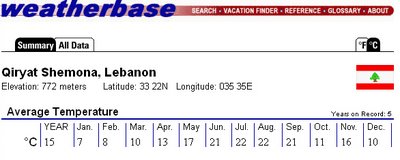
Well, it seems the Lebanese government has decided to annex Qiryat Shemona. Or maybe they already have? For those not familair with the geography of the region; Kiryat Shemona is in Israel. Did anyone see any troop movement near the border this morning? Anyway, it is ours now! We can have another Divine Victory Rally. This one's truly divine. Maybe they’ll keep the townspeople hostage, until they have received the Shebaa farms from Israel in return.

Anyway, in anticipation of this well-studied move, http://www.weatherbase.com/ has decided to update its information database. Link can be found here.

October 04, 2006

Tourists in downtown Beirut

Marijke, another Dutch lady in Beirut, sent me this picture last week of a couple of tourists in downtown Beirut. I do not know who the photographer is.
Lebanon is an Arab country, but this is for the Lebanese as exotic as it is for the Dutch. They are what we call here 'Gulf Arabs'; i.e. Arabs from the Gulf States, but I do not know which one. I showed it to my colleagues (all Lebanese). They had a ball! The comments they made were as funny as the picture.
"Oh look, did you see how wonderful my hair looks on this picture,"
"Ya Hassan, I just blinked my eyes. Please take another picture."
And on and on they went.
There is another one, similar to this one, also taken in downtown Beirut, where a lady wearing an abaya with face covering, is passing another lady with a backless tanktop. If anyone knows where I can find it, please let me know.

October 03, 2006

Fall is in the Air

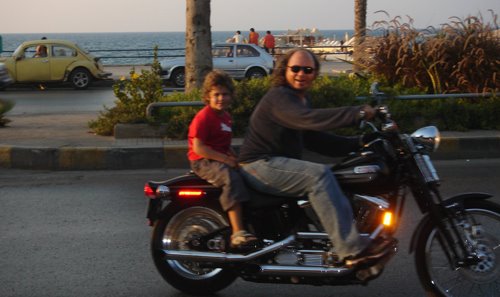
Brother in-law with his son on the bike home after a day on the beach.

Fall is in the air. The weather is becoming down-right pleasant; October (and May) are the best months in this town.
Schools have started again (some of them, at least). We've got to get used to the routine again; Eddie (although he says it was my fault) forgot his schoolbag while going to school. He had to walk all the way back up the hill to pick up his bag. I put my phone on silent. Didn't need to hear his ranting. His hair right now is bigger than his head. "My, your son has grown thin this summer," someone remarked. Not really. He's grown taller, and his hair bigger, so it only appears he's getting thinner.
No pictures of son though. "You are so annoying, you know. You and your camera." He is growing up too. I know, because he is complaining. "Only four girls in my class. Four!", and he sticks four fingers in my face. "Four!" But he is still a little boy. Yesterday, he and a friend, set up his entire Playmobil collection. Accumulated over 8 years or so. A massive amount of little men.
Most everyone is back in town. Theo said it right. This town grows on you. Once you've lived in Beirut, you can never get her out of your system again. The place got bombed to smithereens (The Southern suburbs, the bridges, other infra-structures features and all other targets), yet still people are trying hard to come back, cause there is no life like it. They left nice houses with green lawns, and traffic rules, and line up in banks behind them, to come back to absolute chaos.
Which reminds me of the 'absolut' ads. One excellent ad is doing its rounds. It is the southern suburbs (you'd recognize it if you've visited this link), after the massive Israeli bombings. It's not an official one, but could have been. Should have been.
A friend of mine, Dutch, is totally taken by this place, even though he only visits it on occasional business trips. "This place gets your creativity going." It is true. Never a boring day. This place is a MUST for people with ADHD.
And so the fall is on its way.