 I wrote a story on the Homophobia week (organized by Helem , the organization for gay Lebanese) for my newspaper, and here it is. Sorry, it is in Dutch, but that is to be expected from a Dutch journalist. Story can be read at http://www.trouw.nl/digitalekrant/today.html (Go to The Verdieping, pages 2 & 3). Link only works for today (May 30).

May 30, 2006
Homophobia in Beirut
I wrote a story on the Homophobia week (organized by Helem , the organization for gay Lebanese) for my newspaper, and here it is. Sorry, it is in Dutch, but that is to be expected from a Dutch journalist. Story can be read at http://www.trouw.nl/digitalekrant/today.html (Go to The Verdieping, pages 2 & 3). Link only works for today (May 30).

May 29, 2006
The Ugly Side; Maid in Lebanon
The new maid has arrived! It cost me an arm and a leg, but that was my own fault; I did not have time to ‘order’ one from the Philippines, I needed her instantly.
And instantly, you can get, but the price goes up. Where do this ‘instant’ maids come from, you may wonder? Well, those are the ‘rejects’, i.e. maids that were employed in houses, but were then rejected by the ‘Madam’, as the owner of a maid is called here, for whatever reasons. I don’t mind a ‘reject’, because the ‘reject’ label tells you about the employer, rather than the employee.
This country has many positives, but if you want to see some of its uglier sides, go ask the maids. The way these ladies get treated is incredibly demeaning. There's even a documentary that highlights this. More on their situation here. It's modern-day slavery.
The new lady that I have now, came to Lebanon three months ago. She’s in her early thirties, has three children, and came here on a three year contract. The fact that she is willing to leave her children for three years (!) should tell you that this lady is serious about working.
So she got to work for a couple that owns a hotel (won’t name any names) in town. They ate in the hotel, but forgot to feed the maid. So she went hungry. She was not allowed out of the house, did not have days off, so worked 7 days a week, and in the end was called a ‘whore’, by the ‘madam’. She was finally dumped back in the office, and rejected. This is good for me, because now she got to work for me, and she is fine.
Now how anyone would dare call a grown-up woman, a mother of three, who comes all the way from the Philippines to work here, a whore, is totally beyond my comprehension. I would have gone after the bitch with a knife. The Pilipino before her was deported after being accused of stealing $700; charges that I doubt. Very often, when the contract of a maid is about to end, they deport the maid, so they do not have to pay her final salary. 10 floors down is a Phillipino who has not been paid for 3 months, and three buildings down the street there is an employer who owes his Phillipino $3000 in salary.
The situation for maids in this country is sad. Just google ‘maid in Lebanon’, and you won’t believe what you read. They get treated like slaves, beaten, raped, mistreated, abused, thrown of balconies, verbally insulted and otherwise treated incorrectly.
The Phillipinoes have a sweet revenge though; they talk. The maids know what goes on in each household. They do the laundry, so they know who’s been sleeping with whom. They overhear the conversations, so they know when there are money problems. They hear the fights at night, because they sleep in the house. They pay attention to the telephone conversations of ‘Madam’, and catch up on all the local gossip. They know when the bank calls for their money. They clean up, and know what is in every drawer and closet of the house, so whatever sex toys ‘Mister’ may be hiding, or medications ‘Madam’ is taking for fungus infections, they know it.
And this is how I know what goes on in this neighborhood. Because the maids come over in the afternoon (well, the ones that are allowed out of the house, that is), and have tea with my maid, and then the stories flow. They tell me, because I am considered a ‘foreigner’, i.e. non-Lebanese. I know rather painful stuff of about 75% of the households in my building. I have heard stories about people in the neighborhood that would want to make them crawl under a stone of shame.
And instantly, you can get, but the price goes up. Where do this ‘instant’ maids come from, you may wonder? Well, those are the ‘rejects’, i.e. maids that were employed in houses, but were then rejected by the ‘Madam’, as the owner of a maid is called here, for whatever reasons. I don’t mind a ‘reject’, because the ‘reject’ label tells you about the employer, rather than the employee.
This country has many positives, but if you want to see some of its uglier sides, go ask the maids. The way these ladies get treated is incredibly demeaning. There's even a documentary that highlights this. More on their situation here. It's modern-day slavery.
The new lady that I have now, came to Lebanon three months ago. She’s in her early thirties, has three children, and came here on a three year contract. The fact that she is willing to leave her children for three years (!) should tell you that this lady is serious about working.
So she got to work for a couple that owns a hotel (won’t name any names) in town. They ate in the hotel, but forgot to feed the maid. So she went hungry. She was not allowed out of the house, did not have days off, so worked 7 days a week, and in the end was called a ‘whore’, by the ‘madam’. She was finally dumped back in the office, and rejected. This is good for me, because now she got to work for me, and she is fine.
Now how anyone would dare call a grown-up woman, a mother of three, who comes all the way from the Philippines to work here, a whore, is totally beyond my comprehension. I would have gone after the bitch with a knife. The Pilipino before her was deported after being accused of stealing $700; charges that I doubt. Very often, when the contract of a maid is about to end, they deport the maid, so they do not have to pay her final salary. 10 floors down is a Phillipino who has not been paid for 3 months, and three buildings down the street there is an employer who owes his Phillipino $3000 in salary.
The situation for maids in this country is sad. Just google ‘maid in Lebanon’, and you won’t believe what you read. They get treated like slaves, beaten, raped, mistreated, abused, thrown of balconies, verbally insulted and otherwise treated incorrectly.
The Phillipinoes have a sweet revenge though; they talk. The maids know what goes on in each household. They do the laundry, so they know who’s been sleeping with whom. They overhear the conversations, so they know when there are money problems. They hear the fights at night, because they sleep in the house. They pay attention to the telephone conversations of ‘Madam’, and catch up on all the local gossip. They know when the bank calls for their money. They clean up, and know what is in every drawer and closet of the house, so whatever sex toys ‘Mister’ may be hiding, or medications ‘Madam’ is taking for fungus infections, they know it.
And this is how I know what goes on in this neighborhood. Because the maids come over in the afternoon (well, the ones that are allowed out of the house, that is), and have tea with my maid, and then the stories flow. They tell me, because I am considered a ‘foreigner’, i.e. non-Lebanese. I know rather painful stuff of about 75% of the households in my building. I have heard stories about people in the neighborhood that would want to make them crawl under a stone of shame.
On the surface, I live in a very nice and decent neighborhood. Upper middle class, mixed religions, all very respectable people with good jobs, and successful children.
But under all that, are other stories. I know who cannot pay the school fees anymore. I know who’s got a mistress, and I know who’s screwing (or trying to) around on her husband. I know who’s $20,000 in debts, and is about to be evicted. I know of the fights between two sisters in-law, and the problem with the inheritance (or rather, the absence of one). I know why one of their daughters married this guy (she was ‘damaged goods’ as they call a non-virgin in Lebanon), and why the son had to ‘go' to the US (Lebanese justice department is on his heels for massive fraud), and that he is currently ‘down and out’ in Miami. I take a perverse pleasure, every time I see her, to ask; “So how’s your son doing in Miami?” “Oh, he’s doing so well. They adore him there. He’s never coming back, he says,” is the reply. Yeah, I bet. He’d be arrested at the border, and end up in jail. Besides, he can't afford the plane ticket from what I hear.
And that is their sweet revenge. So for anyone out there in Beirut with a maid that they mistreat; be careful, somewhere in your neighborhoods there is someone who knows every ugly detail in your household.
May 26, 2006
How Low Can You Go?
Nobody seems to be picking up on this story, but I am quite intrigued by this Tikriti guy.
It turns out he’s not a cousin, but a nephew. Bashar Sabawi Ibrahim Hassan al-Tikriti. His dad gained notoriety by appearing in court in his underwear.
Once, these guys were at the top of their game, and pretty much in charge of an entire nation. Their word was law. They could wheel and deal and they pleased, move around as they wished. God on Earth.
And then suddenly, there’s this Texas cowboy, whom they must have vexed an awful lot, and he goes out for the kill.
And here Sabawi ends up; in a two star hotel in the seedy neighborhood of Maameltein, Lebanon, a semi-red-light district somewhere above Beirut, while tampering with his passport. The police caught him because the staff of the hotel had the feeling that the guy had tried to change the name in his passport. You would think that these guys would have access to multiple passports, or at least a source for a new one. His Dad ran the secret service of Iraq for a number of years for crying out loud! And here this simpleton is trying to change the name on his passport because he wanted to get into Brazil, of all places. Sounds like Paraguay, where all the Nazis ended up after WW II. What an amateur!
The guy didn’t even have a decent second passport! This makes you think. For years and years and years, Iraq has been run by a bunch of amateurs; simple crooks, who happened to get away with it because everybody was just too scared.
That’s a very sad thought. How an entire nation can be run aground by a bunch of crooks.
It turns out he’s not a cousin, but a nephew. Bashar Sabawi Ibrahim Hassan al-Tikriti. His dad gained notoriety by appearing in court in his underwear.
Once, these guys were at the top of their game, and pretty much in charge of an entire nation. Their word was law. They could wheel and deal and they pleased, move around as they wished. God on Earth.
And then suddenly, there’s this Texas cowboy, whom they must have vexed an awful lot, and he goes out for the kill.
And here Sabawi ends up; in a two star hotel in the seedy neighborhood of Maameltein, Lebanon, a semi-red-light district somewhere above Beirut, while tampering with his passport. The police caught him because the staff of the hotel had the feeling that the guy had tried to change the name in his passport. You would think that these guys would have access to multiple passports, or at least a source for a new one. His Dad ran the secret service of Iraq for a number of years for crying out loud! And here this simpleton is trying to change the name on his passport because he wanted to get into Brazil, of all places. Sounds like Paraguay, where all the Nazis ended up after WW II. What an amateur!
The guy didn’t even have a decent second passport! This makes you think. For years and years and years, Iraq has been run by a bunch of amateurs; simple crooks, who happened to get away with it because everybody was just too scared.
That’s a very sad thought. How an entire nation can be run aground by a bunch of crooks.
It should give you some insight into Syria though, which is very similar to Iraq in many ways.
May 25, 2006

May 24, 2006
Saddam Hussein's cousin
My newspaper (trouw.nl) just reported that a cousin of Saddam Hussein was arrested today in Beirut. Here’s the report in English. "The arrest of the criminal Bashar Sabawi al-Tikriti represent a successful intelligence operation which will continue chasing the former regime elements on the run and bring them back to Iraq to face fair trials," the announcement of the Iraqi government read. But when you Google the guy - Bashar Sabawi Ibrahim Hasan Al-Tikriti -, it turns out that the US State Department already reported in June of 2005 that he had a residence in Beirut (and Damascus as well). Now that intelligence operation was either not successful until one year later, or the intelligence they had was not used intelligently. He had his assets frozen by the US State Department way back in 2005. I’m not quite sure what that means. That you can’t get access to the money on your US account? I doubt he would put his money on an American bank to begin with. The guy is younger than I am, born in 1970. I wonder if we go to the same beach. So he gets arrested just when the summer is about to begin. What a sucker.
May 22, 2006
Housekeeper needed!
Oh misery oh misery! I am in the market for a new housekeeper!
My housekeeper, a Phillipino lady, has succeeded in something that most Lebanese can only dream of; a visa to the US! Don’t ask me how she did it, but she did.
So after four years working with me, she’s off to brighter horizons. Well, I don’t know about that, but she sure is on her way to more money. Which is, after all, the whole point of going overseas and spending years and years away from your family and children. This one is a very smart cookie. This must be her 13th year overseas. She now is the proud owner of a big piece of land somewhere in the Philippines, and she showed me the house she has invested in in the city; a cute white, two story place. I’d rather have her stay, but can’t offer her the salary she is going to make as a live-in maid in the States. So adios it is.
And boy, are we going to feel it when she is gone. We are pretty much handicapped without her. She has run our entire house for four years like a general. She can cook just about anything; dinner for two or dinner for twenty, no problemo. She has businesses on the side (selling fake jewelry, for one), and we often call her the ‘consul’, as she mediates for just about half of the Phillipino community in town. She knows Beirut like the pocket of her pants, has a fantastic sense of humor, and is quite wicked. The janitor downstairs is scared shitless of her, which is an excellent thing as that guy is your ultimate dog.
On Sundays, when she’s having her day off, our household comes to a grinding halt. Children do not get fed, don’t have their nap on time, we cannot find anything, and we are overall pretty much lost without her.
She’s said she’ll stay until the new housekeeper has been properly introduced into our peculiar habits, but then she is off to Miami Beach, Florida (of all places!).
So the question is: Does anyone know of a Phillipino lady that would like to take her job? We’re really easy!
My housekeeper, a Phillipino lady, has succeeded in something that most Lebanese can only dream of; a visa to the US! Don’t ask me how she did it, but she did.
So after four years working with me, she’s off to brighter horizons. Well, I don’t know about that, but she sure is on her way to more money. Which is, after all, the whole point of going overseas and spending years and years away from your family and children. This one is a very smart cookie. This must be her 13th year overseas. She now is the proud owner of a big piece of land somewhere in the Philippines, and she showed me the house she has invested in in the city; a cute white, two story place. I’d rather have her stay, but can’t offer her the salary she is going to make as a live-in maid in the States. So adios it is.
And boy, are we going to feel it when she is gone. We are pretty much handicapped without her. She has run our entire house for four years like a general. She can cook just about anything; dinner for two or dinner for twenty, no problemo. She has businesses on the side (selling fake jewelry, for one), and we often call her the ‘consul’, as she mediates for just about half of the Phillipino community in town. She knows Beirut like the pocket of her pants, has a fantastic sense of humor, and is quite wicked. The janitor downstairs is scared shitless of her, which is an excellent thing as that guy is your ultimate dog.
On Sundays, when she’s having her day off, our household comes to a grinding halt. Children do not get fed, don’t have their nap on time, we cannot find anything, and we are overall pretty much lost without her.
She’s said she’ll stay until the new housekeeper has been properly introduced into our peculiar habits, but then she is off to Miami Beach, Florida (of all places!).
So the question is: Does anyone know of a Phillipino lady that would like to take her job? We’re really easy!
May 12, 2006
The Saida Slide Show
Lots of good things about this place, but one drawback is the speed (or lack of it) of the Internet. To upload images takes hours (or that’s how it feels), and my provider places a quota on what you can upload, so towards the end of the month, the net goes slower, and slower, a n d s l o w e r a n d . . . . . .
Very annoying.
I found this web site where you can make slide shows. Lots of fun, but takes hours to do. And as some may have noticed, it does not work very well on this page. Oh well.If it does work, below is an explanation.
What I like about this country # 395:
Going around the souq (old market), gives you a very medieval feeling. The life is very much the same as it must have been hundreds of years ago. The food is still sold fresh, or as fresh can be, displayed out in the open. It is not pre-packaged in small quantities, cut up or triple wrapped in Styrofoam. It is out there, looking pretty much the same way as it looked as it was baked, harvested, caught, or slaughtered. The food is not weighed on digital scales, but with the old balance and weights.
May 11, 2006
Elvis Is Alive an Kicking, in Saida
 Seen in the Saida Souq: Elvis. He is Alive and Kicking!
Those sunglasses from the 70's are really a hit in Lebanon.
May 10, 2006
More on Chomsky
Something I read on http://siciliannotes.blogspot.com/2006/05/chomsky-on-tour.html, and I agree with him:
"What’s especially sad about Chomsky’s influence in this part of the world is that his conspiracy theories click in so neatly with the conspiracy mongering and scape-goating that is rife in the Middle East. If the countries of the Middle East are to emerge from authoritarianism and poverty, they will need to cast aside the search for conspiratorial explanations and focus on domestic institutional reform. Were I a Chomskyite, I would attribute the bad timing to a conspiracy by hegemonic forces to silence the marginalized. But I’m not, so I chalk it up to bad luck."
I think that kind of explains it why Chomsky, Finkelstein and the lot are quite so popular here.
'Tom Palmer, a scholar I have great respect for, was due to speak in Beirut on institutions. He did, but there was a stroke of bad luck. Chomsky was on next door. Tom doesn't bother with the formal rebuttal (been there etc.) but does query the prominently displayed endorsement from the Prince Alawaleed Bin Talal Bin Abdulaziz Al Saud Center for American Studies and Research. Tom makes an important point though about the baleful influence of Chomskyite conspiracy mongers and the Middle East:
"What’s especially sad about Chomsky’s influence in this part of the world is that his conspiracy theories click in so neatly with the conspiracy mongering and scape-goating that is rife in the Middle East. If the countries of the Middle East are to emerge from authoritarianism and poverty, they will need to cast aside the search for conspiratorial explanations and focus on domestic institutional reform. Were I a Chomskyite, I would attribute the bad timing to a conspiracy by hegemonic forces to silence the marginalized. But I’m not, so I chalk it up to bad luck."
It's worth adding, that from the Nazi and Tsarist anti-Semites through to Chomsky and the rest of the Cockburn/Finkelstein/Tariq Ali crowd, Arabs have always been heavily dependent on Western imports for their conspiracy theories. It's an import they could do without. '
I think that kind of explains it why Chomsky, Finkelstein and the lot are quite so popular here.
May 09, 2006
Chomsky in Beirut
I had planned on attending the lecture of Naom Chomsky at AUB on Tuesday. But it seems there were quite a f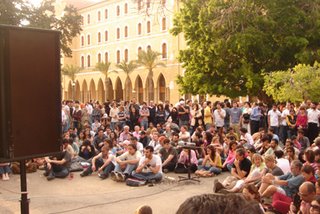 ew people that had the same thing in mind, because when I arrived at the AUB Assembly Hall, where he was speaking, the square in front of it was packed, the stairs leading up to the auditorium were full, and nobody was moving. I settled for a spot in front of a screen outside (nothing visible since it was broad daylight), and a set of speakers, but couldn’t hear anything either, so I gave up after a while.
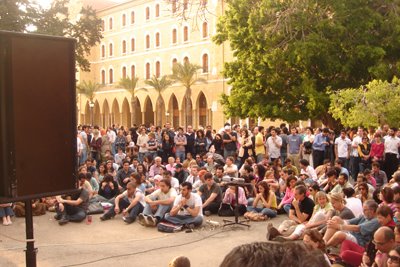 ew people that had the same thing in mind, because when I arrived at the AUB Assembly Hall, where he was speaking, the square in front of it was packed, the stairs leading up to the auditorium were full, and nobody was moving. I settled for a spot in front of a screen outside (nothing visible since it was broad daylight), and a set of speakers, but couldn’t hear anything either, so I gave up after a while.
 I’ll try again on Wednesday, when he does a lecture on linguistics.
For those not familiar with Chomsky; his name appeared and reappeared and appeared again in just about any university Masters course I have ever followed. He’s
 been in the public eye since the early sixties. He’s well-known for his research on linguistics (how children aquire languages), but he’s also quite a famous American philosopher, and one of the most influential left-wing critics of American foreign policy. The reason why his talk was attended so well (I think) is not because we are a breed of educators and linguistics here in Lebanon. What makes the man interesting is that he is an American who is basically anti-American policies, and a Jew who is anti-Israeli policies. People like that are greatly loved here. And for a good reason, I might add. His talks are quite famous.
 Norman Finkelstein was here about two years ago, (another ‘self-hater according to Jews), he wrote about the Holocaust Industry, and his talk was equally well attended.
I would have loved to see Chomsky, because he is been linked to the educational field since the 60’s (with flowers in your hair). Maybe tomorrow.
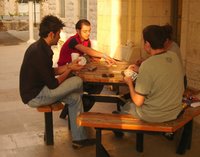 Walking back through the AUB campus brings back an atmosphere of the 60’s, American Universities and California. Mind you, I did not consiously live through the 60’s (too young), and never went to an American university (did spend
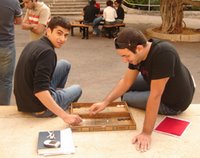 time in California though) but I think that the atmosphere of those times must have been similar. At least this is how I perceive the 60’s. A little Mediterranean, warm mild weather, late afternoon – early evening, young people hanging around with friends, playing, having fun, all in the name of learning and changing the world. I wouldn't mind Eddie attending AUB, but that will not be any time soon.
I would have loved to see Chomsky, because he is been linked to the educational field since the 60’s (with flowers in your hair). Maybe tomorrow.
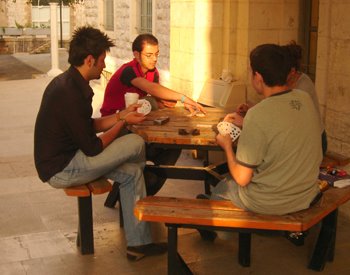 Walking back through the AUB campus brings back an atmosphere of the 60’s, American Universities and California. Mind you, I did not consiously live through the 60’s (too young), and never went to an American university (did spend
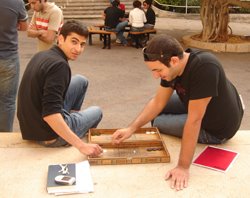 time in California though) but I think that the atmosphere of those times must have been similar. At least this is how I perceive the 60’s. A little Mediterranean, warm mild weather, late afternoon – early evening, young people hanging around with friends, playing, having fun, all in the name of learning and changing the world. I wouldn't mind Eddie attending AUB, but that will not be any time soon.
 I made some pictures while walking through the campus. They've got some amazing trees there.
Life is good in Beirut.
Life is good in Beirut.
Bureacracy & Beds (Part II)
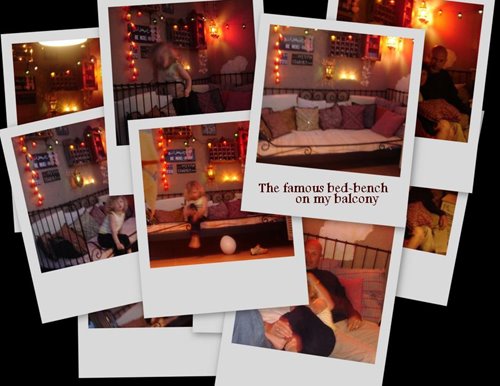
I put the bench together. That went pretty smoothly( a lot smoother than picking it up), even got one iron bar left. On second inspection, it turned out that this bar is actuall not part of the bed.It was stuck to the outside of the box with scotch tape when I picked it up from the airport. My guess is that it dropped out of a box near mine, and some thoughtfull employee thought it belonged to my box, and glued it to mine. So somewhere out there is some poor guy (or gal) trying to assemble, who knows, maybe a bed just like mine, and he’s got that iron bar missing.
That thought is, somehow, really funny. The result is not bed, oop sorry, bad.
That thought is, somehow, really funny. The result is not bed, oop sorry, bad.
No time to relax on/in it however, as an incident last Saturday during Eddie's Gala has got the entire family up in arms and on the war path. More about that later.
May 07, 2006
Beds & Bureaucracy
I have been looking around for an old fashioned iron bed for on the balcony for ages now. With a couple of pillows, it would make a fantastically relaxed seating. I’ve seen several at the Garden Show at the Race track in Beirut, but the prices they asked were in the range of $600, which I think is exorbitant for an iron bed.
So I’ve been around the southern suburbs to look around for the metalworkers, and see if they could fabricate me one. And although they were (just a little) cheaper, here you are dealing with people who are either not very professional (one leg shorter than the other three; “That’s okay Madame, why don’t you put a small piece of wood under the leg and the problem is solved?”), or they are not familiar with what you want, and even though you might give them a picture with the exact model you want, they’d fix it somehow differently (“That’s the same,” or “That’s how we do it here.”)
And then you’re stuck with a shitty bed for a not-so-good price.
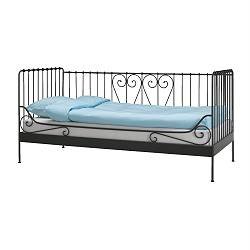
But when I was in Holland, I saw this bed at IKEA. For people who do not know IKEA; it is a self-service furniture store: you basically have to drag your furniture out of the warehouse yourself and assemble it too. That does make it notoriously cheap.
So I see this iron bed for €75. That’s about 145,000 LBP! I find that cheap, because going around any furniture store in Lebanon will give you the feeling that you are living in a country where the average income is somewhere in the range of $6000, which it is not. More like a zero less.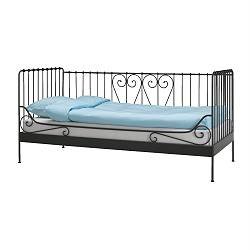
And I bought two! (I’ve got a pretty big balcony). Now parts of the beds I could carry with me on the plane, so that saved me some money, but there were still 3 boxes, weighing 31 kilos, that had to be shipped. So I call a shipping company. I didn’t want the beds to arrive in 6 months, and I didn’t want to deal with the hassle at the port. I had done that before, when I moved most of my stuff to Lebanon, and apart from the long wait, people at customs – or whoever they were – nicked about half of the items from my boxes. So I figured I’d pay a little extra to have it flown in by plane.
Sure, they said, that would be €278. (532,000 LBP). I gulped. But by then I had already bought the beds, so shipped, they had to be. (And Yoda, I am not) Fine. Whatever, that would still be cheaper than buying them in Lebanon.
Shipping went fast indeed. I was barely back home (Beirut) when I got a call from the airport. “You’re stuff has arrived.” So Saturday morning, I went to the airport.
First I need to show my ID. First time of about a hundred times. I went into the customs building, car had to be parked outside. I go up and see a long hallway with about 27 little offices. My first hit was right on the target. Got to waybill for a mere 38,000 (although the paper said 33,000 LBP), but hey, who cares when it goes so fast? I was all hopeful for a quick and cheap ending of my customs adventure. (How come I do not learn?)
On to the next guy, who was not in yet. He came at 9. He places a stamp and a signature on my - now - two papers. ‘Go to Abu Ibrahim,” and he points to some window down the lane. You have to visualize this: only men walking around, all on their cell phones, slugging heavy dossiers under their arms, and all were looking at this one female foreigner (who had made the smart choice of wearing baggy stuff and no make-up). Abu Ibrahim is not in his office. “Will be back in ten minutes.” And indeed, he is back in ten minutes. He gives me another signature. And a paper. “Now go make a picture of your passport (meaning photocopy).” Back to the first office, then to Abu Ibrahim. He sends me down the stairs, to the cargo department. Millions and zillions of boxes and various states of decomposition. How can anyone ever hope to find anything in there? I pass by seven more guys, all asking the same “What is it?”, and giving a little scribble on my ever growing stack of papers with stamps and signatures.
In this cargo hall, and upstairs in the building, there are just hundreds of men milling about, in a variety of states of relaxation. Many in different kind of military uniforms. Some smoke, they hang on boxes, yawn and stretch their arms, drink coffee, or hang around in groups and tell each other jokes, judging from the laughter of it. There are some guys in blue overalls that do haul some boxes up and down, but other than that, you do not get the impression that anyone is doing any actual work.
My boxes get found. They are still in reasonable recognizable state. Now I have to wait for another guy, who will look into what I have got. “What do you have?” “A bed.” “Wood?” “No, iron.” “How much?” “€75.”
More signatures, more stamps. Back up to Abu Ibrahim, who makes a bill for me. A whopping 246,000 LBP? “That’s more than the beds!” I argue. He explains that the price is not related to the price of the beds, but to the price of the freight, i.e. the €278. You pay a little bit over a dollar per euro, and than 30% of that. At least, that is what he said. But hey, my boxes are in cargo, and without these three pieces, I cannot assemble my beds.
Then on to another four (!) stations to pay, with more paperwork. I am carrying around a dossier around now as well. Another 1,000 for a tax stamp. Back down again for more paperwork, back up for Abu Ibrahim’s final consent, and then to the paperwork office. Now this is a sight in itself. A puny little office, with stacks and stacks of paper up to the ceiling! This is almost movie material, as if they had staged ‘a scene which should indicate bureaucracy’. Here again are a couple of men in various uniforms, who – quite surprisingly – manage to find the accompanying papers within five minutes in all these stacks of paper. My amazement was obviously easy to read. “It’s all manual in Lebanon, Madame,” the soldier said after he had given another paper, a stamp and a signature. Then down for some more (three) guys, who gave their signatures, and I had to pay another 10,000 for the porter. That was just a tip.
Two hours later, and 295,000 LBP pounds lighter, I was out of the door with my three boxes.
I made my calculations. 290,000 for the beds. 532,000 for shipping. 295,000 for customs. That is a total of 1,117,000 LBP. That’s $742. Or €584. I don’t have much to say on this issue. They’d better be darned good beds, and last for twenty years or more. And anyone ever coming on my balcony better compliment me profusely on the excellent choice of furniture.
So I’ve been around the southern suburbs to look around for the metalworkers, and see if they could fabricate me one. And although they were (just a little) cheaper, here you are dealing with people who are either not very professional (one leg shorter than the other three; “That’s okay Madame, why don’t you put a small piece of wood under the leg and the problem is solved?”), or they are not familiar with what you want, and even though you might give them a picture with the exact model you want, they’d fix it somehow differently (“That’s the same,” or “That’s how we do it here.”)
And then you’re stuck with a shitty bed for a not-so-good price.
But when I was in Holland, I saw this bed at IKEA. For people who do not know IKEA; it is a self-service furniture store: you basically have to drag your furniture out of the warehouse yourself and assemble it too. That does make it notoriously cheap.
So I see this iron bed for €75. That’s about 145,000 LBP! I find that cheap, because going around any furniture store in Lebanon will give you the feeling that you are living in a country where the average income is somewhere in the range of $6000, which it is not. More like a zero less.
And I bought two! (I’ve got a pretty big balcony). Now parts of the beds I could carry with me on the plane, so that saved me some money, but there were still 3 boxes, weighing 31 kilos, that had to be shipped. So I call a shipping company. I didn’t want the beds to arrive in 6 months, and I didn’t want to deal with the hassle at the port. I had done that before, when I moved most of my stuff to Lebanon, and apart from the long wait, people at customs – or whoever they were – nicked about half of the items from my boxes. So I figured I’d pay a little extra to have it flown in by plane.
Sure, they said, that would be €278. (532,000 LBP). I gulped. But by then I had already bought the beds, so shipped, they had to be. (And Yoda, I am not) Fine. Whatever, that would still be cheaper than buying them in Lebanon.
Shipping went fast indeed. I was barely back home (Beirut) when I got a call from the airport. “You’re stuff has arrived.” So Saturday morning, I went to the airport.
First I need to show my ID. First time of about a hundred times. I went into the customs building, car had to be parked outside. I go up and see a long hallway with about 27 little offices. My first hit was right on the target. Got to waybill for a mere 38,000 (although the paper said 33,000 LBP), but hey, who cares when it goes so fast? I was all hopeful for a quick and cheap ending of my customs adventure. (How come I do not learn?)
On to the next guy, who was not in yet. He came at 9. He places a stamp and a signature on my - now - two papers. ‘Go to Abu Ibrahim,” and he points to some window down the lane. You have to visualize this: only men walking around, all on their cell phones, slugging heavy dossiers under their arms, and all were looking at this one female foreigner (who had made the smart choice of wearing baggy stuff and no make-up). Abu Ibrahim is not in his office. “Will be back in ten minutes.” And indeed, he is back in ten minutes. He gives me another signature. And a paper. “Now go make a picture of your passport (meaning photocopy).” Back to the first office, then to Abu Ibrahim. He sends me down the stairs, to the cargo department. Millions and zillions of boxes and various states of decomposition. How can anyone ever hope to find anything in there? I pass by seven more guys, all asking the same “What is it?”, and giving a little scribble on my ever growing stack of papers with stamps and signatures.
In this cargo hall, and upstairs in the building, there are just hundreds of men milling about, in a variety of states of relaxation. Many in different kind of military uniforms. Some smoke, they hang on boxes, yawn and stretch their arms, drink coffee, or hang around in groups and tell each other jokes, judging from the laughter of it. There are some guys in blue overalls that do haul some boxes up and down, but other than that, you do not get the impression that anyone is doing any actual work.
My boxes get found. They are still in reasonable recognizable state. Now I have to wait for another guy, who will look into what I have got. “What do you have?” “A bed.” “Wood?” “No, iron.” “How much?” “€75.”
More signatures, more stamps. Back up to Abu Ibrahim, who makes a bill for me. A whopping 246,000 LBP? “That’s more than the beds!” I argue. He explains that the price is not related to the price of the beds, but to the price of the freight, i.e. the €278. You pay a little bit over a dollar per euro, and than 30% of that. At least, that is what he said. But hey, my boxes are in cargo, and without these three pieces, I cannot assemble my beds.
Then on to another four (!) stations to pay, with more paperwork. I am carrying around a dossier around now as well. Another 1,000 for a tax stamp. Back down again for more paperwork, back up for Abu Ibrahim’s final consent, and then to the paperwork office. Now this is a sight in itself. A puny little office, with stacks and stacks of paper up to the ceiling! This is almost movie material, as if they had staged ‘a scene which should indicate bureaucracy’. Here again are a couple of men in various uniforms, who – quite surprisingly – manage to find the accompanying papers within five minutes in all these stacks of paper. My amazement was obviously easy to read. “It’s all manual in Lebanon, Madame,” the soldier said after he had given another paper, a stamp and a signature. Then down for some more (three) guys, who gave their signatures, and I had to pay another 10,000 for the porter. That was just a tip.
Two hours later, and 295,000 LBP pounds lighter, I was out of the door with my three boxes.
I made my calculations. 290,000 for the beds. 532,000 for shipping. 295,000 for customs. That is a total of 1,117,000 LBP. That’s $742. Or €584. I don’t have much to say on this issue. They’d better be darned good beds, and last for twenty years or more. And anyone ever coming on my balcony better compliment me profusely on the excellent choice of furniture.
May 05, 2006
No Roaming Around These Days
I haven’t had much time these days to roam around Lebanon.
‘Roaming around’ this place is where I get my inspiration from, and I haven’t had much lately (inspiration, that is). First of all, there’s been just too much work. Secondly, my partners in crime, or fellow ‘roamers’ have all moved to other places this past year. My sis in-law, who is always ready for some retail therapy in obscure places, is heavily and heavenly pregnant, so we can’t drag her around too much anymore. And fourth, when I did have time to roam, I had visitors from outside, and then you sort of have to be the tourist guide to places you have already ‘out roamed’, so to speak. If I have to visit Jeita Grotto or Baalbeck one more time, I think I’m going to puke. So no roaming there.
The newspaper in Holland, for which I write now and then, hasn’t had any request either lately. They are always good for a trip to a Palestinian camp in the Beqaa, a Hezbollah base down south, some Sunni beards up in Dinnieh, a documentary on fishermen in Nakoury, or an insider’s guide to Ashoura, but none of that. I even missed the gay bus trip to the wineries in the Beqaa, and I feel sort of sorry for that, because nothing beats traveling around a place with a bunch of gays. I know this is has been a bit of an issue lately, the gay presence in Lebanon, and I would have loved to have been on that trip.
I’ve thought about joining one of the outdoor companies in town; they organize ‘off the beaten track’ hikes. But I’m afraid of scenes of people happily clapping to Arabic music. I have nothing against Arabic music, mind you, but every time I see a bus passing by on the highway, with everyone standing up, loud music, clapping, and the drums in the back, I am oh so happy that I am not on that bus.
So I’ve just been hanging around Beirut lately.
The newspaper in Holland, for which I write now and then, hasn’t had any request either lately. They are always good for a trip to a Palestinian camp in the Beqaa, a Hezbollah base down south, some Sunni beards up in Dinnieh, a documentary on fishermen in Nakoury, or an insider’s guide to Ashoura, but none of that. I even missed the gay bus trip to the wineries in the Beqaa, and I feel sort of sorry for that, because nothing beats traveling around a place with a bunch of gays. I know this is has been a bit of an issue lately, the gay presence in Lebanon, and I would have loved to have been on that trip.
I’ve thought about joining one of the outdoor companies in town; they organize ‘off the beaten track’ hikes. But I’m afraid of scenes of people happily clapping to Arabic music. I have nothing against Arabic music, mind you, but every time I see a bus passing by on the highway, with everyone standing up, loud music, clapping, and the drums in the back, I am oh so happy that I am not on that bus.
So I’ve just been hanging around Beirut lately.
May 03, 2006
For Medicinal Purposes Only

Holland is well known for its liberal policies towards certain mind-expanding drugs. Most people here believe that in Holland everything in the field of non-medical drugs is for sale on the market, but that’s not quite true. It is only cannabis (marijuana and hashish) that islegal, and even that is not quite true. They are semi-legal, which means you can carry an amount on you that is for you personal use only, which is 5 grams, I believe.

So it is not law-enforcement, but non-enforcement. Any amount above that limit would indicate you are a dealer, and this could result in fines and/or prison sentence.
But we do grow some mean weed in Holland, called ‘Nederwiet’.
Anyway, to make a long story short; I was in the supermarket yesterday, and looking for birdfood. I couldn't find the birdfod, but I found this instead. Now this is just your local grocery store. I had to look three times before I got it.
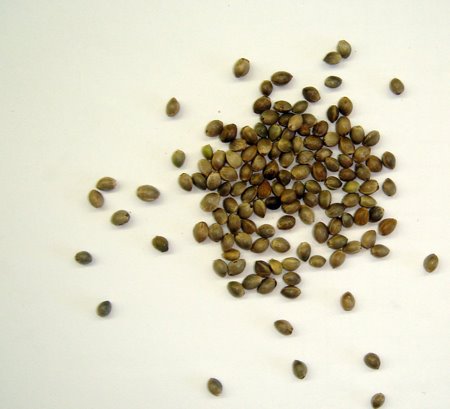
Hemp seed? Isn't that the same as hennep sees, the stuff you grow marijuana plants from? The seeds do look the same. And this is for sale in the supermarket?
I may be missing the point. But just to be sure, I bought a bag, and sowed it in the planters on the balcony. Sowing your bird seed can’t be illegal, no? For medicinal purposes only.
I’ll mail a picture once the plantation is ready for harvest. And yes Theo, you can come and have a look at it then.
Marijuana consists of the buds, leaves, and resin of the cannabis plant. The stalks and sterilized seeds are considered "hemp."
Marijuana consists of the buds, leaves, and resin of the cannabis plant. The stalks and sterilized seeds are considered "hemp."
Anne, who talks with her hands

Hanging around on the balcony, with Rose (Musar:Cuvee Rose and Wardy: Rose du Printemps), but I think I have already mentioned that.
May 01, 2006
On Life in Lebanon & Summer in the City
A cousin of hubbie is in town, and he is thinking of moving to Lebanon. He’s never actually lived here, but his Mom’s from Beirut, and he still has two uncles here, so he figures he should give it a go. When you come here for visits or holidays, this place does approach paradise, I presume. The reason why he’s contemplating the move is that he’s fed up with paying 70% income tax. I thought Holland was bad as far as taxes were concerned, but Income Tax in Houston, Texas, seems to be pretty inconvenient as well.
It is true; taxes are pretty low in Lebanon. I think I pay about 5% income tax. I pay another 10% sales tax on all items I buy in stores, but compared to Holland that’s pretty low too. That seems like heaven, but then again, you don’t get anything in return. Health care does not exist, you pay your own insurance, or else you die. We do not have any public facilities such as libraries, musea (well, maybe two), concert halls, municipal symphony, and free vaccination programs (something that really bothers another uncle of hubbie, who’s a doctor in France, and who’s appalled at the fact that only the rich here vaccinate their children). Roads are often in poor condition if you don’t live in Beirut, garbage does not get picked up all over the country, the majority of public schools are of such poor quality that everyone scrambles to pay exorbitant fees to get their kids into private schools, there is no retirement system to speak of (you retire, you better have money, or you’ll have to depend on your kids to keep you alive), no social services, water and electricity supplies are not consistent, public beaches rarely get cleaned and the list goes on and on and on.
Now if you have money – which I guess only 10% of the population has, it is very easy to circumvent all these miseries. You chose a neighborhood where the government does take care of things (usually just central Beirut or certain suburbs), and you pay for the rest. You get your generator, have extra water tanks placed on your roof for the water, enter your kid in a top-notch private school, get a full-time nanny, take a membership at a private beach, you have your DVD’s and books flown in from abroad (although we do have some reasonable book and music stores), pay big bucks to see some good performers during the summer festivals (choice is limited though. This month we have to choose between 50 Cents and Ricky Martin. Ahum), or spend your summer abroad and inhale some culture, and get a driver that will move your kids from one venue to another.
But for the other 90%, which I often consider the ‘real Lebanese’, there is none of this fancy stuff. So low income taxes may be great, but you don’t get anything in return either.
Besides, I wonder how his wife will take the country. She’s a nice, polite, all-American girl; blond hair, blue eyes. She’s a little worried about her security here. That’s understandable; if you live in the States, you don’t get to hear the positives on Arabs. This place is very safe however. I feel safer walking around here alone at night than I’d feel in my hometown. People just don’t do weird stuff to each other. I know that sounds strange, as the Lebanese did try to kill one another for a good 16 years over the most preposterous reasons, and people do still get blown up now and then.
But other than that, it really is a very safe place, and I know: I’ve traveled all over the country, from broomstick-bearded North to the southern Hezbollah-heaven. I’ve hitch-hiked with Syrian soldiers, ran with Palestinians militias when they were getting shelled by the Lebanese army and lots of other not-so-smart stuff. But I never felt unsafe.
Still, this is not a country that can bee seen in shades of grey; it’s black and white. You either love it or you are disgusted by it. I am not quite sure what makes you hate it or love it. I’ve felt at home here since day 1. I love the chaos, the dirt, the dust, the unusual and the mess. I take it some people do not deal well with that.
Although this not-waiting-your-turn-in-line-up (What line-up?) still can get me pissed off in a New York minute)
It is true; taxes are pretty low in Lebanon. I think I pay about 5% income tax. I pay another 10% sales tax on all items I buy in stores, but compared to Holland that’s pretty low too. That seems like heaven, but then again, you don’t get anything in return. Health care does not exist, you pay your own insurance, or else you die. We do not have any public facilities such as libraries, musea (well, maybe two), concert halls, municipal symphony, and free vaccination programs (something that really bothers another uncle of hubbie, who’s a doctor in France, and who’s appalled at the fact that only the rich here vaccinate their children). Roads are often in poor condition if you don’t live in Beirut, garbage does not get picked up all over the country, the majority of public schools are of such poor quality that everyone scrambles to pay exorbitant fees to get their kids into private schools, there is no retirement system to speak of (you retire, you better have money, or you’ll have to depend on your kids to keep you alive), no social services, water and electricity supplies are not consistent, public beaches rarely get cleaned and the list goes on and on and on.
Now if you have money – which I guess only 10% of the population has, it is very easy to circumvent all these miseries. You chose a neighborhood where the government does take care of things (usually just central Beirut or certain suburbs), and you pay for the rest. You get your generator, have extra water tanks placed on your roof for the water, enter your kid in a top-notch private school, get a full-time nanny, take a membership at a private beach, you have your DVD’s and books flown in from abroad (although we do have some reasonable book and music stores), pay big bucks to see some good performers during the summer festivals (choice is limited though. This month we have to choose between 50 Cents and Ricky Martin. Ahum), or spend your summer abroad and inhale some culture, and get a driver that will move your kids from one venue to another.
But for the other 90%, which I often consider the ‘real Lebanese’, there is none of this fancy stuff. So low income taxes may be great, but you don’t get anything in return either.
Besides, I wonder how his wife will take the country. She’s a nice, polite, all-American girl; blond hair, blue eyes. She’s a little worried about her security here. That’s understandable; if you live in the States, you don’t get to hear the positives on Arabs. This place is very safe however. I feel safer walking around here alone at night than I’d feel in my hometown. People just don’t do weird stuff to each other. I know that sounds strange, as the Lebanese did try to kill one another for a good 16 years over the most preposterous reasons, and people do still get blown up now and then.
But other than that, it really is a very safe place, and I know: I’ve traveled all over the country, from broomstick-bearded North to the southern Hezbollah-heaven. I’ve hitch-hiked with Syrian soldiers, ran with Palestinians militias when they were getting shelled by the Lebanese army and lots of other not-so-smart stuff. But I never felt unsafe.
Still, this is not a country that can bee seen in shades of grey; it’s black and white. You either love it or you are disgusted by it. I am not quite sure what makes you hate it or love it. I’ve felt at home here since day 1. I love the chaos, the dirt, the dust, the unusual and the mess. I take it some people do not deal well with that.
Although this not-waiting-your-turn-in-line-up (What line-up?) still can get me pissed off in a New York minute)
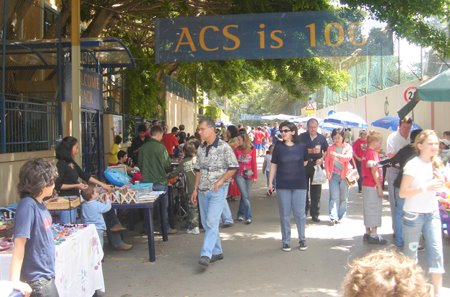 And, on another note than; summer is in town! That means weekends outside the house. We started out with a street market in the morning, or actually, it was a yard sale run by kids, so we ended up with lots of Barbies, stuffed animals and children’s books.
 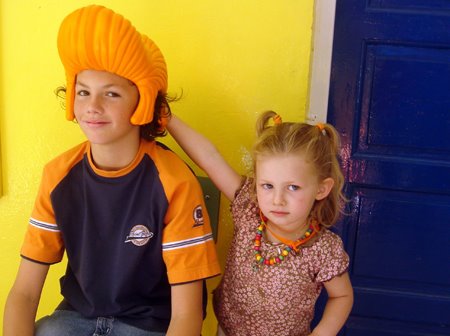 Then on to a free market, which is a party organized for Dutch children during Queen’s Day.
 Lots of orange, games and fun. Kids had a ball. We continued the afternoon on the balcony with some excellent wine (Musar:Cuvee Rose and Wardy: Rose du Printemps ), and the day after we had a picnic along side a river. I have to admit in shame that I do not know the river’s name. It’s the one that runs out into the sea near the Beit edDinne exit on the highway to the south. Anyone?
Subscribe to:
Posts (Atom)